
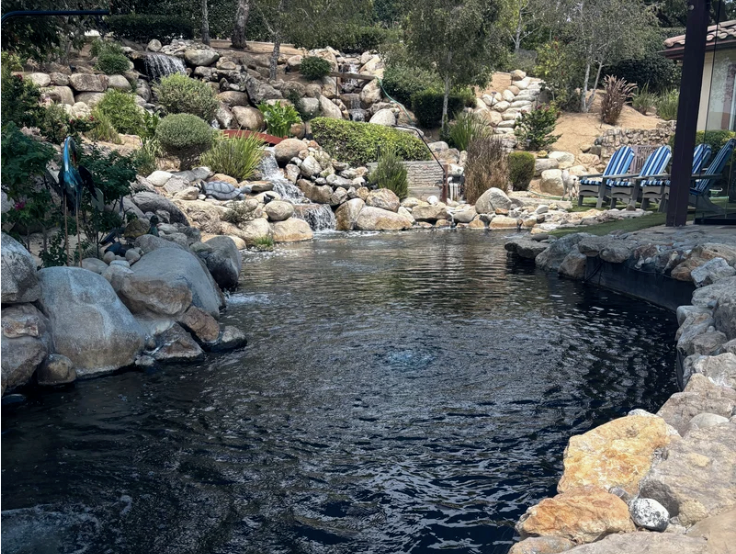

What 26,000 gallons actually looks like
For scale: a typical backyard koi pond in this country holds 3,000 to 5,000 gallons. A serious hobbyist pond might reach 10,000. Twenty thousand is the number that makes other pond people lean in. Tim's water volume belongs to a public garden or a dealer's holding facility, and it sits on a hillside in La Habra Heights, southeast of Los Angeles, with a valley view over the far bank.
The pond, running.
Calling it a pond undersells the build. What Tim has is a hillside water system. Falls come down the slope in three separate runs, feed a long stream, pass under a red arched bridge, and open into the koi pond proper: a dark, rock-edged body that curls around a covered patio and a swimming pool. Boulders form every bank. The whole thing reads as though the hill was always doing this and someone simply cleared the brush.

From the top of the falls, looking down the run.
Straight walls, five feet down, and not one fish lost to a predator
Tim went the shotcrete route on this build, and the thinking behind it is the best piece of advice in the whole article.
"When designing we choose to use Shotcrete cement with 3 bottom drains not a pond liner. All edges go straight down to 5 feet."
Shotcrete is sprayed structural concrete, the same method used to build swimming pools. It is a bigger up-front project than a liner build, and at 26,000 gallons on a slope, Tim wanted the walls formed to an exact shape and left there. Gorgeous ponds get built both ways, and most of the ponds in this series are liner. What matters in Tim's case is less the material than the shape he asked it to hold.
"This was designed so no predators can enter the pond without having to swim. We have never had a predator in the pond or take any fish."
Every edge drops straight down to five feet. There is no shelf, no gentle shallow margin, nowhere for a bird to stand. Herons hunt by wading. Take away every place one can put its feet and it has to swim to reach a fish, and a heron will not do that. Neither will a raccoon.
That is the part worth copying, and you do not need shotcrete to copy it. A vertical wall built from block or poured concrete and then lined with something like our PIK 30 Mil Ultra or PIK 45 Mil EPDM gets you to the same place, and that is how plenty of builders do it. The predator protection is coming from the geometry, not from the material.
Sit with what it has been worth over the life of this pond. Most of us are on our second round of netting, or a motion sprinkler, or fishing line strung in a grid across the water, and we are still losing fish. Tim has not lost one. He paid for it once, at the design stage, and has not had to think about it since.
The pond and the pool are two different animals
One thing that surprises people about a build at this scale is what sits next to it. Tim's koi pond shares the hillside with a swimming pool and a raised stone spa, separated by a strip of turf and a low boulder wall. Blue shade sails stretch over the patio and out across the water. From the pool deck, you look across at the falls.

What the falls look like from the pool deck.
Those sails are not just there for the people, either. They cover three quarters of the pond, and Tim has the number to show for it:
"The shade sail is massive and covers 3/4 of the pond. This reduced to water temp by 7° on average and helps control algae blooms."
Seven degrees is a serious swing in Southern California. Warm water holds less dissolved oxygen, pushes koi metabolism and waste production up, and hands string algae the light and heat it needs to take over. Shading most of the surface goes after all of that at once, with no power draw, no plumbing, and nothing to service.
The two bodies of water could not be run more differently. The pool is clear and blue and chemically maintained. The pond, six feet away, is dark, alive, and fighting Southern California sun with biology. Keeping both in the same backyard means keeping two entirely separate mindsets, and never mixing the equipment.

The filtration on this Pond is Key
Those three bottom drains Tim mentioned are Aquadyne Rhino IIs, the four-inch version with the air diffuser built in. They pull solids off the floor by gravity before anything reaches a pump, and each one doubles as an aeration point in the deepest water. Everything downstream is easier because of what those three catch first.
The pond runs on a Nijikawa Niji-no-Taki rotary drum filter, and not a current one. Tim bought his roughly five years ago, one of the very first units Nijikawa USA brought into the country. He picked it up through another dealer, before Play It Koi carried the line at all. We've helped him along the way with a couple of replacement parts here and there, but it otherwise runs flawlessly keeping the pond mechanically filtered.


That second shot is worth stopping on. Most pond owners have never seen the inside of a running drum filter. The cylinder is the screen: pond water passes through it, solids stay on the outside face, and a spray bar washes them off into a waste line so the screen never blinds over. The blue glow on either side is a pair of 60-watt UV lamps sterilizing the water on its way through, and Tim replaces those two every year like clockwork.
Early production units come with early production quirks. When Tim called us in March, the drum's access door had never sealed correctly. He texted a photo showing a quarter-inch gap at the rear of the lid when the door was shut, and after years of that gap, corrosion inside had finally taken the drive motor with it.
Our team worked with Nijikawa USA to track down a rotary gear motor for a unit they had sold years before we ever carried the brand, and got it on a truck.
There is a lesson in that exchange that has nothing to do with us. Tim kept a five-year-old prototype in service instead of replacing it, because he knew the unit, knew exactly what was wrong with it, and was willing to chase one part. At his volume, a new drum filter is a four-figure decision. A gear motor is not.

The drum is not the whole system. Tucked behind clipped hedging sits a second stage:
- 2 X Ultima II 20k pressure filters
- 4 X PerformancePro ArtesianPro 1.5 HP High Flow Pumps
- a black holding tank
- and 7 (yes 7) UV lights across the whole system, the two in the drum included, totaling 455 watts of UV: 2 X 40W, 2 X 60W, 3 X 85W UVs
What Would You Do Differently With Your Pond?
When we asked Tim the question "Knowing what you know now about your pond, what would you have done differently?" his number one regret was not buying a single large UV unit with one bulb to replace each year. The 7 UVs work just fine, but he ends up replacing 7 bulbs a year instead of 1, and that is just more things to buy and more things to go wrong. So if he had to do it over again, he'd have probably sprung for a couple of the Oase Bitron Premium UV Clarifiers or one of the new H480 NishikigoiUV Amalgam Pond UV Clarifiers.

Waterfall rock is its own maintenance job
Ask anyone with a large water feature what they actually fight, and it will not be the pond. It will be the rock.
Three waterfall runs means an enormous amount of wet stone in Southern California sun, and wet stone in sun grows algae. Tim's approach:
"I use Algeacides granules on my extremely large water fall rocks. It works on its own but use a large pole pool/pond brush to scrub it with wetting the brush for even spread."
That is a technique. Products like PondMax Oxy Pond Cleaner or CrystalClear AlgaeOff work on contact wherever the granules land, which on a big rock face means clumps and hot spots. Wetting a long-handled brush first and working the product across the stone gets you even coverage. Tim buys it 25 pounds at a time, twice already this season.
The rock work up close, and the residents.
The residents nobody expects
The koi are not the biggest fish in this pond.
Tim keeps three Diamond Sturgeon. He bought them from a dealer in Miami as 15-inch babies three years ago, and describes them now as five-footers, which is about where the species tops out. For scale, most of the koi sharing the pond with them run 32 to 36 inches. Those are jumbo koi by any standard, and the sturgeon still make them look ordinary.
Sturgeon are a demanding choice. They are bottom feeders, they don't compete well at the surface, and they want considerably more dissolved oxygen than koi do. They are the reason Tim's food sinks and the reason there is a very large air pump on this property.
The best part has nothing to do with their size:
"They are crazy sociable and love attention and petting on their nose."
Three prehistoric fish, five feet long, that come up to the surface to be petted.
The sturgeon, and the koi they share the pond with. Sound is Tim's own waterfalls.
What it takes to keep it running
Tim's order history reads like a maintenance calendar for a pond this size. Nothing exotic, all of it consumable.
- Food. Nijikawa Professional Sinking Pellet, 7mm, in the 22-pound bucket. He knows sinking food is the minority choice. When we hit a stock snag on his first order in January, he wrote back: "I know sinking is not very popular."
- Water clarity. AquascapePRO Sludge Cleaner by the gallon, two at a time.
- Muck. An Oase PondoVac 5, kept alive through a new motor head and a full discharge hose and extension. A vacuum that needs a motor head is a vacuum that has been worked hard.
- Air. A Hakko 250L air pump, the largest in the line, running what Tim calls "massive aeration for the 3 five foot sturgeon's." He buys the Matala Hakko diaphragm kits two sets at a time, which is exactly what the 250 takes.

The last word
Tim has been a Play It Koi customer since January, which makes him one of the newest names in this series and one of the largest ponds in it. He designed and built this thing years before he had ever heard of us, and what we have done all year is keep it fed, lit, aerated and running.
That is the part worth saying out loud. He did not need us to build the pond. He needs us to keep it running, which at 26,000 gallons, three sets of falls, and three prehistoric fish that swim up to be petted on the nose is the harder job of the two.
The full tour.