
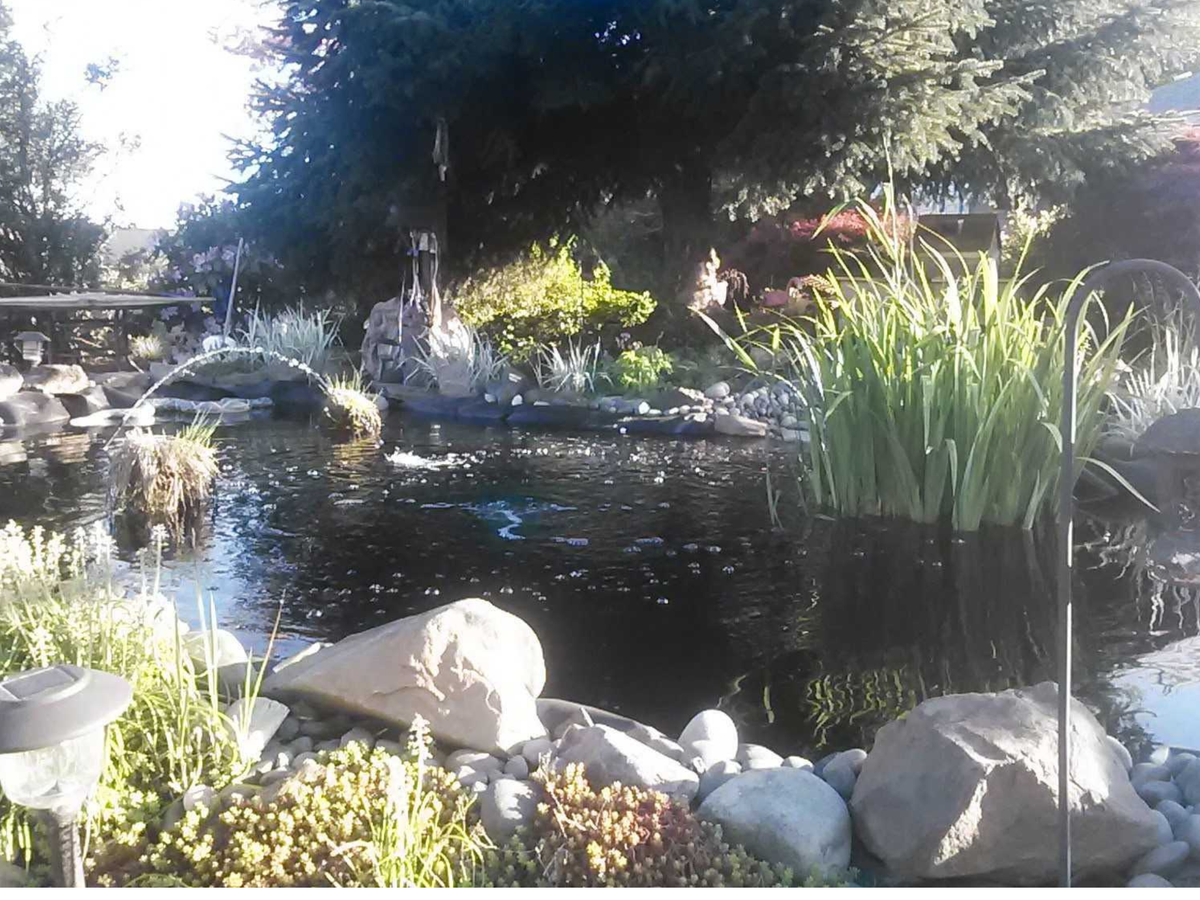
Rudy Herold didn't hire a crew or rent an excavator. With pea gravel landscaping all around the spot, no machine was getting in, so he picked up a shovel. Ten wheelbarrows of dirt a day, for about two weeks, turned a corner of his yard in Battle Ground, Washington, into a 21-by-10-foot koi pond, three feet deep and close to 4,000 gallons. Today a river-rock stream tumbles into it, iris and floating plants crowd the edges, and visitors tell him the same thing: "Your yard looks like a park."

We rebuilt Rudy's pond in 3D in our Pond Planner, stream and all. Skip ahead to explore it.
Rudy's pond at a glance
- Built by: Rudy Herold, by hand
- Location: Battle Ground, Washington
- Size: about 21 by 10 feet, 3 feet deep
- Volume: close to 4,000 gallons
- The dig: 10 wheelbarrows a day for about two weeks
- Water feature: a river-rock stream from a filter at the top of a rock mound
- Circulation: one submersible pump, split with a T between the stream and a hose that loops around the pond
- Plants: water hyacinths, iris, grasses and creeping groundcover on the bank
- Residents: koi, including an all-orange female named Mango, and a bullfrog named Freddy
From a goldfish hole to a raccoon lesson
Rudy's first pond, nearly two decades ago, was 30 to 50 gallons dug around some trees, with a liner and a few goldfish. "I just decided I wanted a pond," he says. "Didn't know my butt from a hole in the ground back then."
The pond grew to 750 gallons, but it was only a foot deep, and that turned out to matter more than its size.
"I lost all my koi one season. A raccoon came in and took them."
That loss sent Rudy to the books. Koi need depth to get away from raccoons and herons, and to ride out cold weather near the bottom. So the next pond would be about 21 feet long, 10 feet wide and a full 3 feet deep.
Planning your own depth? Most koi keepers aim for 4 feet or more. A 3-foot pond works, as Rudy's shows, and a net over the water and a de-icer in winter cover the difference.
Digging close to 4,000 gallons by hand
Rudy kept the old pond running while he dug the new perimeter around it, so his fish always had a home. Then he settled into a routine.
"I kept the old pond active, dug out the new perimeter, and then I just did 10 wheelbarrows of dirt a day for about two weeks."
That works out to well over a hundred loads of Washington dirt, moved one wheelbarrow at a time. When he finally stood in the hole with the liner down, his wife took one look and asked, "Are you digging a pool?" In a way, he was: a pool for his koi.

The liner goes in. The hand-dug hole is about 21 by 10 feet and 3 feet deep.

First water. The rim is still raw dirt and loose liner, with clumps of grass already in the water.

Filling up, with the planted islands in place before the edge stones went on.
How the water moves: one pump, one T, a "tidy bowl" loop
Rudy kept the system simple. A single submersible pump sits in the pond, and a T in its main line splits the flow two ways:
- One line runs up to a filter at the top of a rock mound, and the clean water comes back down a river-rock stream.
- The other runs a smaller hose all the way around the pond to keep the water turning. Rudy calls it his "tidy bowl" effect.
That steady loop keeps the whole pond moving, so there are no dead corners where debris settles. Rudy runs the pump inside a Matala Pump Defender, a cage of filter mat that keeps leaves and string algae off the intake, and an air pump feeds diffusers on the floor for extra oxygen.

The stream starts at the top of the mound and runs down the river rock into the pond.
Plants that do the work
The biggest surprise for Rudy wasn't the digging. It was how delicate pond balance is. Algae was a constant fight until he settled into a routine:
- A muck treatment to break down sludge on the bottom.
- Beneficial bacteria to keep the water's natural cleanup going.
- Pond dye to shade the water, which slows algae.
- Lots of plants.
His favorite is the water hyacinth, which he calls a "multitasker". Hyacinths soak up the nutrients algae would feed on, shade the surface, and grow a curtain of roots the fish love to nibble. Iris and grasses fill the shelves, and creeping plants soften the bank. The next item on his list is a heat-tolerant groundcover, Creeping Jenny maybe, to grow over the last of the visible liner and finish the natural look.
More ideas: our guides to choosing plants for a koi water garden and what algae is and how it affects your water.
Life in the "Taj Mahal of Koi"
The whole backyard now centers on the pond. River rock, lava rock and carefully placed greenery frame it, and it's become Rudy's quiet spot. He's out there a hundred times a day, watching his fish, especially as the cool Washington fall slows them down for winter.
The residents have personalities of their own. Freddy the Frog, a bullfrog, guards his territory. Mango, an all-orange female koi, is the spunky one.
Rudy's advice for anyone thinking about a pond
After two decades of ponds, Rudy has three tips for anyone on the fence:
- Double your budget. "If you're thinking of spending $1,000 to get started, plan on spending $2,000." The pump, the filter, the aerator and the tubing add up fast.
- Keep a backup pump. When a submersible pump fails, there's no quick fix, and the fish can't wait.
- Quarantine new fish. Never add new fish to the pond without quarantining them first.
Watching the budget? See our picks for the best pond filters under $500 and what it costs to run a pond pump.
Plan a pond like Rudy's
Now you can walk around Rudy's pond yourself. We rebuilt it in our Pond Planner: a 21-by-10-foot bean, 3 feet deep with a flat floor, about 3,600 gallons, and a 10-foot river-rock stream that drops 3 feet from a filter at the top of the mound. Blue flag iris, cattails and water lilies fill the water, two pines and a red Japanese maple stand behind it, and a stone patio with a pair of Adirondack chairs faces the stream. Here it is from the patio, from above and along the stream, followed by the 2D plan.


Rudy runs one submersible pump and a small filter. For a koi pond the planner sizes the filter at about twice the pond's volume, so the plan uses an Anjon Living Ponds Pro 10000 (pump, bio filter and UV in one system) feeding a Savio FilterWeir at the head of the stream. Like Rudy's pond, it has no bottom drain and no skimmer. A Hakko air pump runs two Matala diffuser discs on the floor, and the planner flags the 3-foot depth, since it recommends 4 feet for koi.
Open Rudy's pond in the planner to spin it around in 3D, follow the water from the filter down the stream and see every part on the list. Like what you see? Hit "Start my own pond" and design yours.
Rudy's pond is proof that the hardest builds pay back the most. If you're on the fence about digging that hole, start with a plan, and a shovel.