
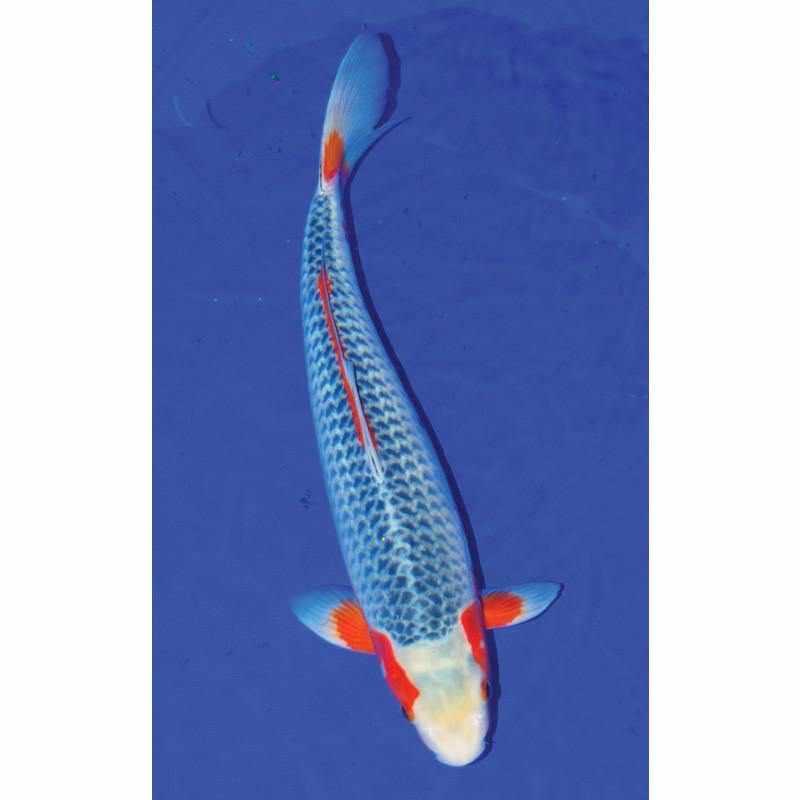
Asagi is the koi that looks least like a koi. No bold patches, no lacquer black — just a net of blue-gray scales down the back and a wash of red rising from the belly. It is also widely described as one of the oldest varieties, and an ancestor of much of what came after — an account worth treating as the hobby's standard version rather than documented fact.
This guide covers what an Asagi actually is, how to tell one from its German-scaled cousin the Shusui, when the net pattern arrives, what separates a good one from a cheap one, and what to look for when you are buying for a backyard pond.

Asagi koi at a glance
| Trait | Asagi |
|---|---|
| What it is | A blue-gray koi with net-like reticulation over the back and red rising from the belly |
| The head | Free of dark marks and blemishes. Hi on the cheeks is normal and often admired; sumi speckling and a yellow cast are the faults |
| The red | Rises from the belly up the flanks, into the pectoral fins and sometimes the cheeks. Should stay at or below the lateral line |
| Its Doitsu form | Shusui — the same fish with mirror scales in limited rows instead of full scaling |
| Sub-types | Konjo (deep indigo), Narumi (light steel-blue), Mizu (very pale powder-blue) |
| Growth | Commonly 24 to 28 inches in a well-run pond; a strong grower |
| Hardiness | Robust, and usually attributed to the variety's magoi descent. Overwinters like any koi in a properly built pond |
| Buying in | Mixed tosai packages from $185, about $37 a fish; individually selected Shusui from $1,600. Quarantine every arrival and stock to the adult size your pond can carry |
What is an Asagi koi?
An Asagi is defined by three things happening at once. The back carries reticulation — every scale edged paler than its center, so the whole dorsal surface reads as a net rather than a color. The base tone underneath is blue-gray, running from pale powder to deep indigo depending on the line. And hi, red, rises from the belly up the flanks, usually reaching the pectoral fins and sometimes the cheeks.
The head is where quality shows. On an asagi koi fish it should be clear and unblemished — free of the net, free of dark speckling, and free of a yellow cast. What it may carry is hi: warm, symmetrical red on the cheeks is normal on this variety and often admired. The faults are the dark ones, and they are the first thing a judge looks at and the last thing a novice checks.
Asagi is also generally described as the oldest of the ornamental varieties and the stock much of the rest descends from. That account comes from the hobby rather than any register, so treat it as the standard version rather than documented fact — but it explains why an asagi koi carp looks closer to a wild fish than a Kohaku does. It never had the pattern bred into it; it is closer to where everything started.
Listings are inconsistent about word order and it costs people fish. The same variety is sold as an asagi koi, a koi asagi, a koi fish asagi and an asagi koi carp depending on who wrote the listing. If you are searching asagi koi for sale and only trying one word order, you are missing stock — search asagi koi fish for sale and koi asagi for sale as well.
Asagi and Shusui: the same fish, two scale patterns
This is the distinction worth getting right, because the two are sold side by side and priced differently.
Asagi is fully scaled, so the reticulation covers the whole back as a fine, even net. Shusui is the Doitsu — German-scaled — form of the same fish: instead of full scaling it carries mirror scales only in limited rows, usually along the dorsal line and often along the lateral line too, against otherwise smooth skin. Row counts vary — a single band, or a rank either side of the dorsal fin. The blue net disappears, replaced by those large dark scales, and the red on the flanks reads far more vividly because there is no scale texture breaking it up.

The conventional account credits Shusui to Yoshigoro Akiyama in the early twentieth century, crossing an Asagi with a German-scaled carp. As with most koi history, that account comes from dealers and hobbyists rather than any register, so treat the particulars as the standard account rather than documented fact.
What matters practically: a Shusui is judged on the tidiness of that scale row, and it is unforgiving. Scales out of line, missing, or doubled are immediately visible where full scaling would hide them.

The Asagi sub-types
| Name | The blue | What to know |
|---|---|---|
| Konjo Asagi (Gunjo in ZNA usage) | Very dark navy, close to black | The darkest of the group and generally the least valued, because depth swallows the net the variety is judged on |
| Narumi Asagi | Light steel-blue | The classic show look — the tone that shows reticulation most clearly |
| Mizu Asagi | Very pale powder-blue | Elegant and uncommon. The pale base shows stress and sun damage sooner than the darker tones |
| Taki Asagi | Blue back, white line, then hi | Not a shade but a structure — a band of white separating the blue back from the red flanks. Distinct enough that ZNA lists it separately |
Those are the ones you will meet most often rather than a closed list — Hi Asagi, Menkaburi Asagi and Asagi Sanke all exist, and Hi Asagi in particular carries hi over the back by definition. Whichever you are looking at, the goal is the same: a crisp blue net, red that knows where to stop for that type, and a head free of dark marks.
How to judge an Asagi
Judge the body first. That rule runs through every guide in this series and it holds here: a fish with poor conformation is a poor fish whatever its net does. Check thickness through the shoulder, symmetry viewed from above, and a strong caudal peduncle. Then read the fish in this order.
The reticulation
The net should be even and precise, each scale edged cleanly, with the pattern consistent from shoulder to tail. Broken lines, patchy sections and oversized scales that interrupt the mesh are the common faults. This is the trait that most separates an expensive Asagi from a cheap one.
Where the red stops
Hi should rise from the belly and stay at or below the lateral line, matched left to right, with the pectoral fins carrying red evenly on both sides. On a fully scaled Asagi, red climbing over the back is generally faulted in modern lines — with named exceptions, since Hi Asagi and Asagi Sanke carry hi over the back by definition. The rule does not transfer to Shusui, where hi commonly runs across the back and shoulders and is not a fault. Cheek hi is a matter of taste rather than a defect: tidy and symmetrical is admired, blotchy is not.
The head
Clear and unblemished. Dark speckling (jyami), smudging and a yellowish cast all pull a fish down a tier, and unlike pattern they rarely improve. Symmetrical cheek hi is a different matter — that is normal on Asagi and generally counted a plus rather than a fault. Truly flawless heads are uncommon, so weigh a small blemish against the fish as a whole.
Skin quality
Look for a translucent, pearly sheen rather than a flat or cloudy surface. Dull skin hides the net and usually says something about how the fish has been kept.
When does the net pattern arrive?
Later than buyers hope, and this is the single most important thing to understand before buying one young. On a tosai the reticulation is often faint and hard to read, and it keeps refining for years — keepers generally do not consider an Asagi finished until three to five years old.
What you look for on a young fish is therefore signs rather than the finished mesh: some visible edging on the back scales, a body worth growing on, and a clean head. Buying a tosai on the assumption that the net is already set is the common way to be disappointed at three.
What changes with age is depth and reach. The blue generally darkens as the fish matures, and the hi tends to rise and spread over the first few years — which is why a young Asagi with red already near the lateral line is a risk, since that red has room to climb into fault territory. On a young fish, look for a crisp net and conservative red rather than for the finished article.
Fine peppering across the back on a juvenile is common and often settles as the fish grows. Rapid fading, sudden heavy peppering or fast red expansion usually trace back to water quality, diet or heavy sun rather than to genetics.
Size, growth and cold tolerance
The asagi koi fish is a strong grower, commonly reaching 24 to 28 inches in a well-run pond, with exceptional fish going beyond that. Growth tracks water volume, temperature and feeding far more than variety does, so an Asagi in a good pond outgrows a Kohaku in a poor one.
The koi fish asagi has a reputation for robustness, usually credited to its descent from magoi, the wild-type carp. Treat that as a reason for confidence rather than a licence to cut corners: an Asagi overwinters the way any koi does, in a pond deep enough not to freeze through, with gas exchange maintained and feeding stopped as the water cools.
Caring for an Asagi
There is no Asagi-specific husbandry. Water chemistry, filtration sizing and seasonal routines are the same as for any koi, and our pond filtration basics guides cover those properly rather than repeating them here. Two things do act on this variety in particular.
Sun. Long hours of direct summer sun push the blue toward washed-out and can drive the hi to spread. Some shade over part of the pond — planting, a structure, anything — protects the tone and costs nothing. The pale Mizu Asagi feels this fastest.
Color food. Foods that deepen red will deepen the hi, and on a variety where the red is supposed to stay below the lateral line, pushing it harder is working against the fish. Feed color support seasonally rather than year-round, and let a plain staple or growth diet do the ordinary work. Overdone, the same food also tints the pale base and costs you the contrast that makes the net read.
Setting up your pond so an Asagi actually reads
This variety is more affected by how you build and light your pond than the patterned koi are, because a blue net is a subtle effect and subtle effects wash out easily. None of it is expensive, and most of it is decided before the fish arrives.
Go darker on the bottom
A pale liner throws light back up at the fish and flattens the reticulation — the net loses its edges and the blue reads gray. A dark pond bottom does the opposite: it gives the blue something to sit against and makes each scale edge visible from above. If you are choosing a liner and you keep Asagi, choose the darker one.
Plan the sightline you will actually use
You will look at this fish from a standing position, from above, at whatever spot you naturally stop. Depth in that spot matters more than average depth — too shallow and the color bleaches in summer sun, too deep and the net stops resolving. Keep the viewing area deep enough to be comfortable for the fish and shallow enough that you can still read scale detail.
Break up the midday light
Partial shade over some of the pond does two jobs at once: it protects the blue from washing out and the hi from spreading, and it kills the surface glare that hides the pattern. Planting, a structure, anything that interrupts overhead sun for part of the day is enough.
Buying online: ask for the right photos
A koi asagi is easy to photograph badly. Ask any seller to show you the fish from directly above rather than side-on, in shade or flat light rather than bright sun, and against a dark bowl. Bright sun on a pale bowl is the combination that makes a mediocre net look crisp and a good one look ordinary. If you can, ask for a short video — reticulation reads differently as the fish turns, and a still can hide broken lines.
Where to buy Asagi koi from us
Most asagi koi for sale reach us through mixed breeder packages rather than as standing single listings, so the routes below are the reliable ones. If you are comparing sellers, search asagi koi fish for sale and koi asagi for sale as well — the same fish is listed under all three.
- Ikarashi Ozumi Koi Farm Kawarimono Designer Tosai Packages, from $185 for five 3 to 5 inch koi — about $37 a fish, or $32.50 each in the ten-koi pack. Tagged for Asagi, and the cheapest asagi koi fish for sale route we carry.
- Hosokai Koi Farm Kawarimono & Gosanke Tosai Packages, from $210 for five 5 to 7 inch koi, about $42 a fish. Tagged for both Asagi and Shusui, so it is the one pack that can bring either.
- Maruhiro Koi Farm Mixed Tosai Variety Packages, from $235 for five, about $47 a fish — also tagged for Asagi.
- Miyatora Koi Farm Mixed Tosai Select Packages, from $225 for five 5 to 6 inch koi, about $45 a fish. Tagged for Shusui rather than Asagi, so this is the mixed route if the German-scaled form is what you are after.
- An individually selected Shusui at $1,600, with a second at the same price — single Japanese fish, one of each, listed as we write this.
Each mixed pack is a unique assortment drawn from several varieties rather than an Asagi-only box, so treat Asagi content as likely rather than promised — the mix is not selectable. Listings for asagi koi for sale and koi asagi for sale move quickly, so if a particular fish is what you want, browse the Japanese koi selection for what is listed right now, or ask us what has just landed.
Before you order any multi-fish package, two things to have ready, and neither is optional. First, quarantine every new koi in a separate, filtered, aerated holding system for two to four weeks before it goes anywhere near your main pond — a group purchase is a group of new arrivals, and one unquarantined fish can take out an established collection. Second, size the group to your pond rather than to your enthusiasm: koi grow into large fish, so count the adult fish your volume and filtration can carry, then buy under that number.
Related guides in this series: our guide to ginrin koi, since the sparkle trait is laid over Asagi as readily as anything else, and our complete guide to Kohaku for the patterned varieties Asagi is usually contrasted with.
Frequently asked questions
What is asagi koi and what makes it unique?
An Asagi is a blue-gray koi whose back carries net-like reticulation — every scale edged paler than its center — with red rising from the belly up the flanks and a clean, unmarked head. What makes it unique is that it is built on scale pattern rather than on color patches, so it reads as texture where a Kohaku or Showa reads as blocks of color. An asagi koi carp is also widely described as one of the oldest ornamental varieties and an ancestor of several of the others — an account that comes from the hobby rather than any register, so treat it as the standard version rather than documented fact. It does fit what you see: the fish looks closer to a wild carp than the heavily-patterned koi do.
How can you identify an asagi koi by its colors and markings?
Three things together. A blue-gray back where each scale is edged lighter, forming an even net. Red rising from the belly onto the flanks and into the pectoral fins, staying at or below the lateral line on a good fish. And a clean, pale head with no pattern on it. If the head carries dark speckling or a yellow cast, the fish is faulted there — though symmetrical cheek hi is normal and not a fault. If the net is replaced by large mirror scales in limited rows — along the dorsal line, often along the lateral line as well — on otherwise smooth skin, it is a Shusui, the Doitsu form of the same fish.
At what age do asagi koi develop their characteristic net-like pattern?
Gradually, and later than most buyers expect. On a tosai the netting is often faint and difficult to read at all, and it continues refining for years — most keepers do not judge an Asagi finished before three to five years old. The blue generally darkens over that period and the hi rises and spreads. Fine peppering on a juvenile back is common and often settles. Two consequences for buying young: judge a tosai on signs of edging, body and a clean head rather than on a finished mesh, and treat a young fish whose red already sits near the lateral line as the riskier buy, because that hi still has room to climb.
What is the typical size and growth rate of an asagi koi?
An asagi koi fish commonly reaches 24 to 28 inches in a well-run pond, with exceptional fish going beyond, and the asagi koi carp is regarded as a strong grower. Rate depends far more on husbandry than on variety — water volume, stable temperature and consistent feeding decide it. A koi fish asagi in a generous, well-filtered pond will outgrow the same fish kept crowded, every time.
Are asagi koi suitable for outdoor ponds in cold climates?
Yes. Asagi has a reputation for robustness, usually credited to its magoi ancestry, and it overwinters well — but the requirements are the ones every koi shares rather than anything special to the variety: a pond deep enough not to freeze through, gas exchange maintained through the ice, and feeding stopped as the water cools. Depth and stability are what matter, not heat.
What water conditions are best for keeping asagi koi healthy?
The same conditions that suit any koi: stable temperature, water volume sized to the adult fish rather than the ones you bought, filtration rated above your bioload, and steady parameters rather than any particular number. Our pond filtration basics guides cover the specifics. The Asagi-particular note is light rather than chemistry — long hours of direct summer sun wash out the blue and encourage the red to spread, so partial shade protects the fish's appearance as well as its comfort.
How should you acclimate a new asagi koi to your pond?
Every new koi goes into quarantine first: a separate, filtered, aerated holding system for two to four weeks before it goes anywhere near your main pond. Float the sealed bag to equalize temperature before netting the fish across, keep the lights and surroundings calm, and do not tip transport water into the quarantine system. Watch the fish eat before you consider it settled. Only after the quarantine period does it join the main pond — and then count your stocking again, because the pond has to carry every one of those fish at adult size.
What do asagi koi eat and how often should they be fed?
A quality staple pellet suited to the season, fed as much as the fish clear in about five minutes, and less often as the water cools — koi digestion slows with temperature and stops in cold water, so feeding tapers through autumn and stops entirely for winter. The Asagi-specific caution is color food: it deepens the red, and on a variety where the hi is supposed to stay below the lateral line, feeding it hard year-round works against the fish and can tint the pale blue base as well. Use it seasonally, not constantly.
How do you prevent common diseases in asagi koi?
Prevention on this variety is prevention on any koi, and it is mostly four things. Quarantine every new arrival in a separate, filtered, aerated holding system for two to four weeks — unquarantined fish are how established collections are lost. Keep the water stable, because chronic stress from swinging conditions is what opens the door. Stock under your pond's capacity rather than at it. And handle fish gently with soft, knotless nets, since damaged skin is where problems start. Watch for flashing, clamped fins or a fish going off its food — those are the early signals. If a fish is genuinely unwell, get a diagnosis from a koi vet before treating anything.
Can asagi koi be kept with other koi varieties and fish species?
Yes. A koi asagi is an ordinary koi in temperament and mixes comfortably with other varieties, and they are commonly kept alongside goldfish and orfe. The constraints are not about compatibility but about load: quarantine every new koi in a separate, filtered, aerated holding system for two to four weeks before introducing it, and size the whole community to your pond rather than to your enthusiasm — count the adult fish your volume and filtration can carry, then stay under that number. A mixed pond that is comfortable at tosai can be overloaded by the same fish three years later.