
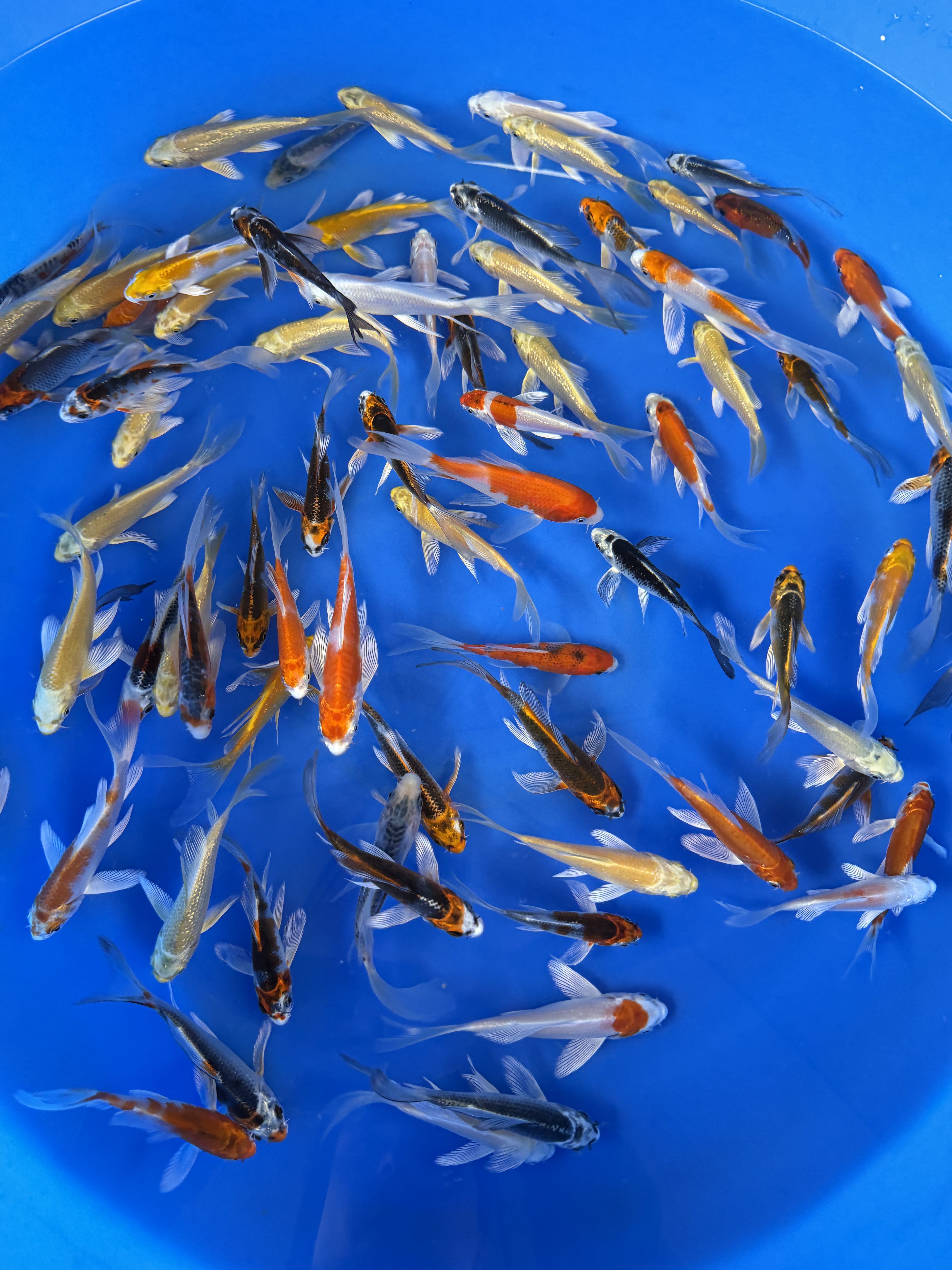
A butterfly koi is a long-finned koi — the same fish as a standard koi, carrying genetics that stretch the pectoral, dorsal, and tail fins into flowing ribbons. You will also hear them called longfin koi, angel koi, or fantail koi. The fins turn an ordinary glide into a show, and they are the reason this is one of the most argued-about fish in the hobby: traditionalists have long kept them out of classic Japanese judging, while pondkeepers keep buying them anyway.
This guide covers what a butterfly koi actually is, the real story behind the "not true koi" argument, which varieties come in longfin form, what changes in day-to-day care when a fish carries fins this long, and how to choose a butterfly koi fish that will still look spectacular at full size.

The names multiply because no one agrees on one. A butterfly koi fish is also sold as longfin koi, angel koi, angel koi fish, fantail koi, dragon koi, butterfly carp, or simply butterfly fish koi — and in Japan the type is Hirenaga. All the same animal; only the listing conventions differ, so search several when you are comparing sellers.
Butterfly Koi at a Glance
| Trait | Butterfly koi |
|---|---|
| What it is | The same species as standard koi, with long-fin genetics — not a separate fish |
| Other names | Longfin koi, angel koi, fantail koi, dragon koi; Hirenaga in Japan |
| Varieties | Longfin versions of the classics — Kohaku, Sanke, Showa, metallics like Yamabuki Ogon |
| What to judge | Health and body first, then fin length, symmetry, and edge condition |
| Care difference | The fins: smooth surfaces, screened intakes, gentle flow, soft nets |
| Adult size | Commonly 18–24 inches; the fins make them read even larger from above |
| Lifespan | Commonly 25 to 35 years with good care; longevity tracks care, not variety |
| Buying in | Multi-fish packages from $201; quarantine every arrival and stock to the adult size your pond can carry |
What Is a Butterfly Koi?
A butterfly koi is a koi — the same species as every standard-fin koi in your pond, generally classified today as Cyprinus rubrofuscus, the Amur carp (older references list koi under Cyprinus carpio) — whose fins keep growing far beyond the standard profile. The trait was fixed by selective breeding in the late twentieth century, generally described as crosses between ornamental koi and long-finned carp, then refined until the long fins bred true across the familiar color classes. As with most koi history, the details live in dealer accounts and hobby lore rather than any register, so treat the particulars as the standard version of the story rather than documented fact.
In Japan the long-finned type is called Hirenaga ("long fin"), and a small number of Japanese farms breed them seriously. Suda Koi Farm in Ojiya, Niigata — the source of our own butterfly packages — is one of the few breeders in Japan specializing in them, applying the same body-first philosophy used for traditional Nishikigoi: proper conformation first, with the flowing, symmetrical fins built on top of it.
Are Butterfly Koi "Real" Koi?
Biologically, yes — same species, same pond, same food, same lifespan. The argument is about aesthetics and judging, not biology.
Traditional Japanese koi appreciation was built around the standard-fin silhouette, and the classic show organizations historically excluded long-finned fish from their main benching. That is where the "not true koi" line comes from. It is a judging convention, not a statement about the fish. Many shows outside Japan now run longfin classes with standards adapted to extended fins, and the fish themselves have never cared either way.
Practically: if your goal is traditional Japanese benching, a butterfly koi is the wrong tool. If your goal is a pond that stops people mid-sentence, the long fins are precisely the point. Plenty of collections run both — butterfly koi mix comfortably with standard koi and goldfish.
Butterfly Koi Varieties
Longfin genetics ride on top of the normal color classes, so butterfly koi come in versions of the varieties you already know:
- Butterfly Kohaku — white base, red pattern, and the crisp edges that make Kohaku the benchmark variety, trailing into white fins.
- Butterfly Sanke and Showa — the three-color Sanke and the black-based Showa, with pattern reading dramatically from above when the fins fan out.
- Butterfly metallics — a platinum butterfly koi is the white metallic form and the one people usually mean by butterfly koi white; alongside it sit gold types like Yamabuki Ogon, where the metallic sheen carries into translucent fin edges and catches sunlight in motion.
- Ginrin butterflies — sparkling ginrin scale over any of the above.
- Butterfly carp of no fixed variety — mixed-parentage fish sold simply as butterfly carp or angel koi fish. Judge them on body and finnage rather than on a pattern standard they were never bred to.
Most butterfly koi for sale anywhere are sold young, before the fins have finished developing, so what you are really buying is symmetry and body. Availability of specific longfin varieties shifts constantly — single-variety butterfly koi come and go far faster than packages do. If you are hunting a specific type, contact us and we will tell you what is actually in the building.

How to Choose a Butterfly Koi
Whatever the listing calls it — butterfly fish koi, angel koi fish, butterfly carp — the assessment is the same, and it starts with the body rather than the fins.
Judge the fish before the fins. A spectacular tail on a weak body is still a weak fish, and body shape is what determines how the fish carries those fins at adult size.
Health and body first
Look for alert, coordinated swimming, glossy skin, clear symmetrical eyes, and no redness at the fin bases or vent. Butterfly koi tend to run slightly more streamlined than standard koi, which flatters the finnage — favor balanced proportions and a smooth taper.
Then the fins
Pectorals and tail should be long, symmetrical, and flowing, with clean, unbroken edges. Minor wear from holding systems happens and heals; persistent splits, ragged edges, or redness at the base are the red flags. On young fish, remember the fins keep developing for years — symmetry now predicts elegance later better than sheer length does.
Color and pattern last
The same standards as the standard-fin version of the variety, with one addition: watch how color and sheen extend into the fins. On metallic butterflies an even sheen across body and fins reads as one continuous fish; on patterned fish, crisp pattern edges plus flowing white fins are what make the top-down view spectacular.
Care: What Actually Changes for a Long-Finned Koi
The husbandry is the same as for any koi — volume, stable water, and filtration sized above your bioload, which our pond filtration basics guides cover properly. What genuinely changes is that you are now keeping a fish whose defining feature is fragile.
The pond has to be fin-safe. Long fins snag, fray, and tear on things standard koi swim past. The checklist is short and worth doing once, properly: smooth-edged stone and rounded hardscape rather than sharp rock; screens on pump and skimmer intakes; returns aimed so fish can choose calm water instead of fighting a constant jet; and soft, knotless nets with minimal handling when you must move a fish.
Feeding is standard koi feeding. A quality pellet matched to the season does more for fin condition than any supplement — growth and repair follow water quality and diet. Nijikawa Growth Formula is the growing-season default, Nijikawa Four Seasons covers shoulder temperatures, and where color support is wanted, Nijikawa Color Genesis is our first recommendation. The full range is in koi food.
Growth is real growth. Butterfly koi commonly reach 18 to 24 inches as adults, and the fins make them look larger still. Stock to the adult fish your volume and filtration can carry — not to the four-inch fish in the bag.
Troubleshooting: When the Fins Look Wrong
On a butterfly koi the fins are the early-warning system — damage and stress tend to show there first, and almost everything below is a husbandry signal rather than a disease.
Edges are fraying or splitting
Look for a mechanical cause before anything else: sharp hardscape, an unscreened intake, a return jet the fish cannot escape, or rough netting. Fix the snag point and clean fins usually regrow over weeks to months. If fraying continues with no mechanical culprit, test the water — chronic poor water often shows up in fin edges before much else.
Redness at the fin base, ulcers, or visible sores
That is no longer a fin question. Test the water immediately and correct anything off, and have a koi-experienced vet or dealer look at the fish rather than reaching for pond-store remedies — infections need a diagnosis, not a guess.
Clamped fins, flashing, or hiding
The universal koi stress signals, and long fins make them easy to spot: a butterfly koi holding its fins tight to its body is telling you something. Check the water first, aerate, and watch. New arrivals often look their worst in the first weeks while they settle — judge a settled fish, not one fresh out of the shipping bag.
How Much Does a Butterfly Koi Cost?
Prices on butterfly koi for sale track size, fin quality and variety. If you want to buy butterfly koi of a specific type — a platinum butterfly koi, or the pale form people search as butterfly koi white — expect to wait for one rather than find it in stock.
A butterfly koi from a multi-fish package starts around two hundred dollars for a group of young fish. Individually selected larger fish climb from there, with size, fin quality, and variety driving the price.
Where to buy butterfly koi from us
Our butterfly koi for sale come as multi-fish breeder packages rather than single fish. If you want to buy butterfly koi in a specific variety — a platinum butterfly koi, a butterfly Kohaku — those come and go far faster than the packages do.
- Premium Japanese Butterfly Koi Fish Packages, from $201 — 4–6 inch fish in packs of three or five.
- Suda Koi Farm — Butterfly (Hirenaga) Tosai Packages, from $210 — authentic Japanese Hirenaga from the Niigata breeder, in packs of five or ten. On these, the per-fish cost drops as the pack grows: at 3–4 inches, five koi work out around $42 each and ten around $37.50 each.
You can also browse the wider Japanese koi selection or the full koi fish range.
Two things worth doing before you order a multi-fish package. Quarantine every new koi in a separate, filtered, aerated holding system for two to four weeks before it goes anywhere near your main pond — a group purchase means a group of new arrivals, and one unquarantined fish can take out an established collection. And size the group to your pond rather than to your enthusiasm: butterfly koi grow into the same large fish as any koi. Count the adult fish your volume and filtration can carry, then buy under that number.

Frequently asked questions
What water conditions do butterfly koi require?
The same as any koi: stable, well-oxygenated water with filtration sized above your bioload, and no rapid swings in temperature or chemistry. Stability matters more than any single number. The one butterfly-specific requirement is physical rather than chemical — gentle flow and snag-free surfaces, because long fins fray on hardware and hard edges that standard koi swim past. If a fin is fraying with no mechanical cause, test the water: on a butterfly koi the fin edges show trouble first.
How often should I feed butterfly koi and what should I feed them?
Feed a quality koi pellet matched to water temperature, in small amounts the fish finish quickly, and less often as the water cools — stopping entirely in cold water, when koi cannot digest properly. There is no butterfly-specific diet; growth and fin condition follow water quality and steady feeding rather than any supplement. Where color support is wanted, a color-enhancing food is the lever, fed seasonally rather than year-round.
What is a butterfly koi?
A butterfly koi is a long-finned koi — the same species as standard koi, with genetics that extend the pectoral, dorsal, and tail fins into long, flowing shapes. They are also sold as longfin koi, angel koi, or fantail koi, and in Japan the type is called Hirenaga. They come in longfin versions of the familiar varieties, including Kohaku, Sanke, Showa, and metallics.
How do butterfly koi differ from regular koi?
Only in the fins and the silhouette. Body, color classes, diet, water needs, and lifespan are the same as standard koi. The practical differences are that long fins need a fin-safe pond — smooth surfaces, screened intakes, gentle flow — and that fin length and symmetry become part of how the fish is judged.
Are butterfly koi considered true koi?
Biologically they are true koi — the same species as standard-fin koi. The "not real koi" argument is about judging tradition: classic Japanese shows were built around the standard-fin silhouette and historically excluded long-finned fish. Many shows outside Japan now run longfin classes. It is a matter of taste and benching convention, not biology.
How long do butterfly koi live?
A well-kept butterfly koi commonly lives 25 to 35 years, the same as any koi — there is no evidence that lifespan is a variety trait. Water volume, filtration sized above your bioload, winter depth and gas exchange, and strict quarantine of new arrivals do far more to determine longevity than finnage does.
What size do butterfly koi grow to?
Commonly 18 to 24 inches at maturity in a properly sized pond, with exceptional fish reported larger. The fins keep growing alongside the body, so an adult butterfly koi reads noticeably larger from above than its body length suggests. Stock to adult size, not purchase size.
What is a butterfly carp or angel koi fish?
Both are the same animal as a butterfly koi: a long-finned koi. Butterfly carp, angel koi fish and butterfly fish koi are listing variants rather than separate varieties, and a platinum butterfly koi or butterfly koi white simply names the metallic white version. Judge any of them on body first, then fin symmetry.
What colors and patterns do butterfly koi come in?
Longfin versions of most familiar koi classes: red-and-white Kohaku, three-color Sanke, black-based Showa, and metallic types such as Platinum and Yamabuki Ogon, plus ginrin scale variants. On metallic butterflies the sheen carries into the fins; on patterned fish, the pattern rides the body while the fins add motion around it.
How much space do butterfly koi need in a pond?
The same as standard koi, which is more than most first ponds allow: they grow into large fish, and crowding tends to show up in water quality before anything else. Count the adult fish your volume and filtration can actually carry and stock under that number, keeping enough open swimming room that long fins are not constantly brushing hardscape. Our pond filtration basics guides cover sizing properly.
Can butterfly koi be kept with other pond fish?
Yes. Butterfly koi mix comfortably with standard koi, goldfish, and shubunkins; avoid known fin-nippers. The real constraints are capacity and biosecurity rather than temperament: stock to the adult size your pond and filtration can carry, and quarantine every new koi in a separate, filtered, aerated holding system for two to four weeks first.