
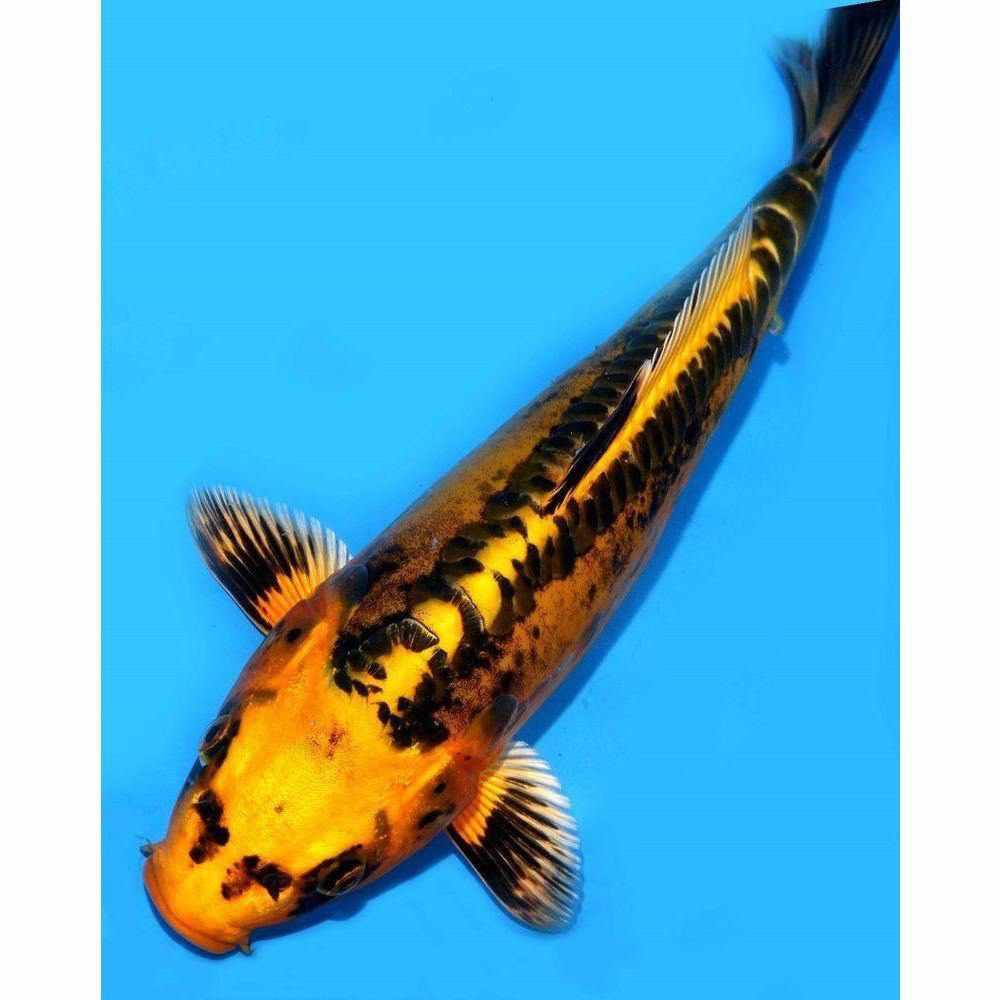
Doitsu koi are sold as "scaleless." The word is wrong: a doitsu koi fish carries mirror scales in limited rows — along the dorsal line, often the lateral line too — on smooth skin.
This guide covers what the scaling actually is, which color varieties wear it best, how to judge one in a bowl, and where to find doitsu koi for sale when you are ready. If you have ever looked at a Doitsu Showa and wondered why the black looks painted on, the answer is in the skin.
Doitsu koi at a glance
| What it is | A scale type, not a color variety |
| The scaling | Mirror scales in limited rows, dorsal and often lateral line, on smooth skin |
| Buying in | Packages from $225, singles from $1,600. Quarantine arrivals; stock to adult capacity |
What is a Doitsu koi?
A Doitsu koi is not its own variety. It is a scale type laid over an existing one, which is why the names stack: a Doitsu Showa is a Showa wearing it, a Doitsu Sanke is a Sanke. Doitsu is simply Japanese for German, after the mirror carp brought in from Germany that the trait came from.
Doitsu against a scaled koi
On a fully scaled koi, every scale scatters a little light, and that softens the edge where one color meets the next. Take the scales away and the color sits flat against bare skin, so edges look cut rather than blended. That is the appeal, and it is also the catch: nothing hides a weak pattern on your Doitsu, and a blemish a scaled fish would have absorbed is simply on show.
The typical Doitsu scale pattern
Three forms are recognised. Kagami (mirror) is the one most people mean: enlarged scales beside the dorsal fin, often a second run along the lateral line, bare skin between. Kawagoi (leather) carries almost none, only tiny dorsal scales. Yoroigoi (armor) scatters irregular scales across the body and is generally faulted. On a doitsu koi fish of the mirror type, out-of-line or missing scales are the fault.
Skin injuries and handling
Not really, and the distinction matters. A Doitsu is not a delicate fish. It is a normally tough koi whose skin reports damage sooner, because there is no scale layer to hide a scrape. Treat it as a visibility difference rather than a fragility one. Round off sharp rockwork in your pond, use a soft net, handle with wet hands, and if a mark persists or spreads, get a proper diagnosis before doing anything else.
Popular color varieties
The bold, high-contrast varieties wear it best, which is why doitsu showa koi and Doitsu Sanke lead the field, with doitsu shiro utsuri close behind. Black against bare white skin is about as sharp as koi get. Then come the varieties that are Doitsu by definition rather than by choice: Shusui, the German-scaled Asagi, along with Kumonryu and Kikusui.
Telling a Doitsu koi's age
You mostly cannot. Size indicates but does not prove, and the growth rings biologists read sit on scales, which a Doitsu barely carries. Ask for the year class.
Pond conditions
Nothing your other koi do not already need: volume sized to the adult fish rather than the ones you bring home, filtration ahead of the bioload, stable temperature, and gas exchange through winter. The one note specific to Doitsu is shade. All that bare skin takes more sun than a scaled fish would, so a planted or shaded section of your pond is worth having.
What size they reach
Trade sources say 24 to 28 inches in a well-run pond. Most backyard ponds produce less.
Doitsu for beginners
Yes, with one honest caveat. The husbandry is identical to any koi, so nothing here is harder to keep. But the cheap doitsu koi for sale you will meet are young fish with nowhere to hide their flaws, which makes them demanding to judge well and very good to learn on, because everything you are supposed to be looking at is right there on the surface.
How Doitsu koi are bred
The trait is inherited, so breeders cross it into an established color line and then select the fry with clean, even mirror rows. That selection is most of the work: the color comes from the parent variety, but a tidy scale row is what separates a good Doitsu from an ordinary one, and it cannot be added later.
Where to buy Doitsu koi from us
- Shinoda Koi Farm Doitsu Gosanke Packages, from $235 for five, about $41.50 a fish at ten. Tagged Doitsu and Doitsu Showa.
- Miyatora Koi Farm Mixed Tosai Select Packages, from $225 for five, about $39.50 at ten. Also tagged Doitsu Showa.
- Koshiji Koi Farm Kikokuryu, Ochiba and Showa Packages, from $255 for five, about $44.50 at ten. Tagged Doitsu Goshiki.
- Individual doitsu koi for sale, listed as we write this: a Doitsu Showa koi and a Doitsu Shiro Utsuri at $1,600 each, a Doitsu Sanke at $1,800.
Each pack is a unique assortment, so Doitsu content is likely, not promised. Quarantine every new koi in a separate, filtered, aerated holding system for two to four weeks, and stock to the adult size your volume and filtration can carry.
Frequently asked questions
What is a Doitsu koi?
A koi carrying the German scale trait, which means mirror scales in limited rows along the dorsal line, often the lateral line too, against otherwise smooth skin. It is a scale type rather than a variety of its own, so it layers onto whatever the fish already is — which is why you meet names like Doitsu Showa and Doitsu Sanke.
How does a Doitsu koi differ from standard koi?
A fully scaled koi scatters light off every scale, which softens the edge where one color meets the next. A doitsu koi fish keeps scales only in limited rows, so the color sits flat against bare skin and the edges read as if they were cut. You get a sharper fish, and one with nowhere to hide a weak pattern.
What scale pattern is typical for Doitsu koi?
Most commonly kagami, the mirror form: enlarged scales beside the dorsal fin, often a second run along the lateral line, bare skin between. Kawagoi (leather) carries almost none, and yoroigoi (armor) scatters them irregularly. Only the leather form comes close to genuinely scaleless, which is why the word misleads on the mirror fish most buyers actually meet.
Are Doitsu koi more prone to skin injuries?
Not more prone, but more revealing. There is no scale layer to hide a scrape, so damage that a fully scaled koi would absorb is visible on your Doitsu. Treat it as a visibility difference rather than a fragility one: round off sharp rockwork, use a soft net, handle with wet hands, and get a proper diagnosis if a mark persists or spreads.
What are the most popular colour varieties of Doitsu koi?
The bold, high-contrast fish wear it best, so doitsu showa koi, Doitsu Sanke and doitsu shiro utsuri lead the field — black against bare white skin is about as sharp as koi get. After those come the varieties that are Doitsu by definition rather than by choice: Shusui, which is the German-scaled Asagi, along with Kumonryu and Kikusui.
How can I tell a Doitsu koi's age?
Honestly, you mostly cannot. Size is an indicator rather than proof, because growth tracks pond volume, temperature and feeding far more than it tracks years, and the growth rings a biologist would read sit on scales a Doitsu barely carries. The reliable answer is to ask the seller for the year class rather than to guess from the fish.
Do Doitsu koi require special pond conditions?
No — the same water, filtration and winter routine as any koi in your pond. The one note worth adding is shade. All that bare skin takes more sun than a scaled fish would, so a planted or shaded section is worth having if your pond runs open and bright.
What size do Doitsu koi typically reach?
Trade accounts commonly cite 24 to 28 inches for a well-kept koi, and since Doitsu is a scale type rather than a variety, the fish underneath sets the range. Most backyard ponds produce less than the published figures, so treat it as potential rather than as a schedule.
Are Doitsu koi good for beginners?
Yes, with one caveat worth knowing. The husbandry is identical to any koi and the pattern reads easily from above, which makes them satisfying to own. But a cheap Doitsu is a young fish with nowhere to hide its flaws, so it is demanding to judge well — and for exactly that reason it is a very good fish to learn on.
How are Doitsu koi bred?
The scale trait is inherited, so breeders cross it into an established color line and then select the fry with clean, even mirror rows. That selection is most of the work: the color comes from the parent variety, but a tidy scale row is what separates a good Doitsu from an ordinary one, and it is not something that can be added later.