
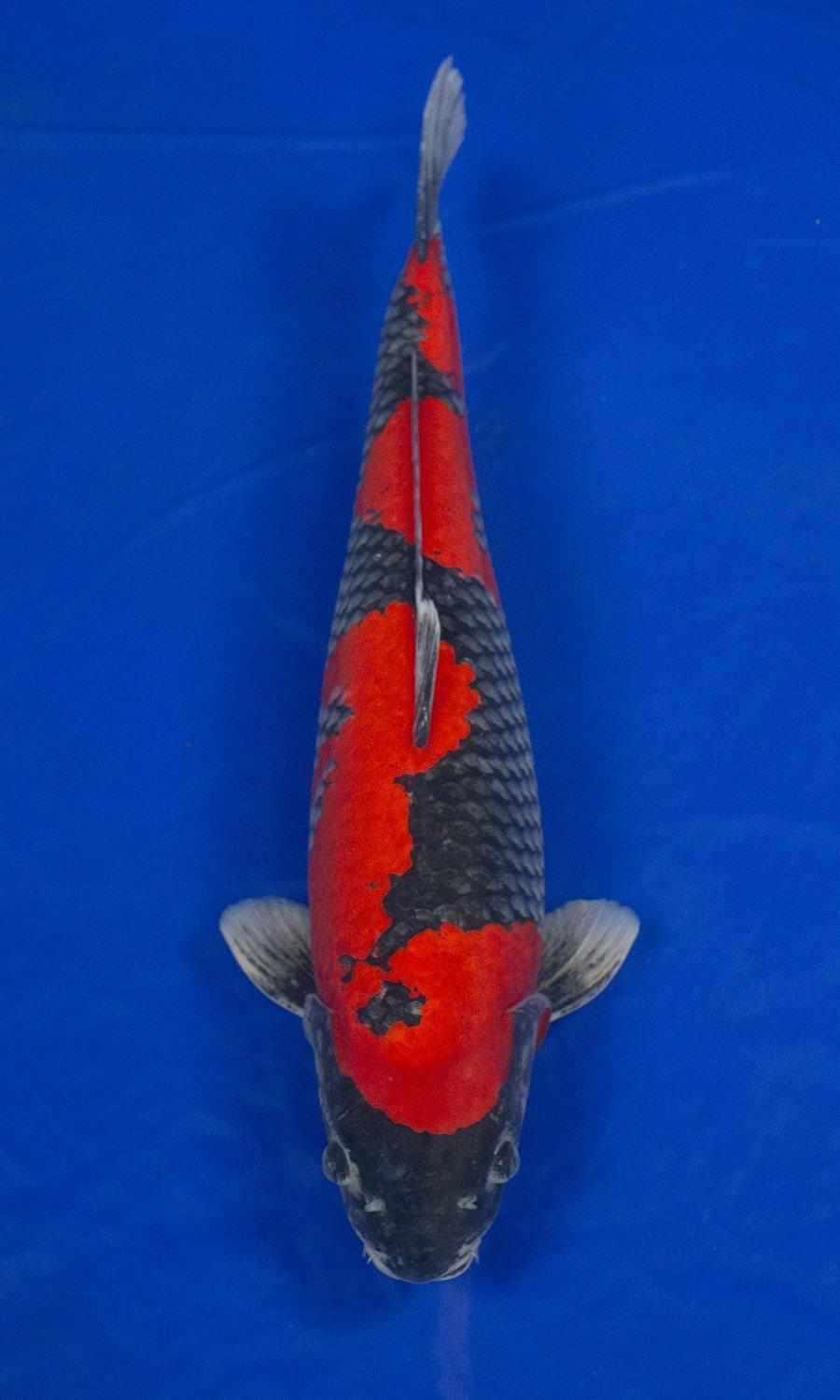
Goshiki is Japanese for five colors, and the fish makes sense once you see it as two koi stacked: a Kohaku pattern of red on white, sitting on an Asagi net.
This guide covers what the five colors are, how a five-color koi differs from the varieties beside it, how to judge one, what ours cost, and why a fish bought in July looks different in February.
Goshiki koi at a glance
| What it is | The five-color koi. Goshiki is Japanese for five colors |
| The five | White, red and black, plus the blue the netting makes. ZNA treats the fifth colour as unsettled |
| Built from | Sources split: ZNA gives Asagi crossed with Taisho Sanshoku, much of the US trade says Asagi crossed with Kohaku |
| The trait to know | The ground darkens in cold water, lightens in warm. Seasonal, not a fault |
| Doitsu form | Doitsu Goshiki, carrying mirror scales in limited rows rather than full scaling |
| Buying in | Mixed packages from $185, one individual fish at $1,600. Quarantine every arrival and stock to the adult size your pond can carry |
What is a five-color koi?
A goshiki koi fish is a white koi with a red Kohaku pattern over a reticulated base, where black edging on each scale reads as a net across the white. The name counts the colors that net makes, not five patches of paint.
How Goshiki differ from other koi varieties
Against a Kohaku, the netting: same red on white, textured ground rather than plain. Against an Asagi, red across the back rather than kept low on the cheeks, flanks and fin bases. Against a Sanke or Showa, black spread through the scale edges rather than laid on in blocks.
The five colors on a Goshiki
White, red and black are the obvious three. The other two are the blues the net makes: pale blue-gray where the edging is light over white, darker blue-black where it thickens. Some fish read purple-gray instead. Five is the name, not a checklist.
What a five-color koi costs
In our catalog: from $185 for a five-koi mixed tosai package tagged for Goshiki, between $32.50 and $44.50 a fish in the ten-koi options, up to $1,600 for the one individually selected Japanese fish listed as we write this.
Are Goshiki hardy in an outdoor pond?
Yes, on the same terms as any koi. No variety-specific weakness, no extra equipment. What unsettles new owners is cosmetic: the netted ground darkens as the water cools, so a bright summer fish can look muddy by midwinter and come back in spring.
How to judge a high-quality Goshiki
On a goshiki koi fish, judge the body first: thick through the shoulder, symmetrical from above, a strong caudal peduncle. Then the net, which should be even and aligned across the back at one weight rather than patchy. Then the red, which wants hard edges - netting running through the hi and muddying it is the common fault. The ground under it should read blue-gray, not yellow.
Where Goshiki came from
Sources split on the cross. ZNA gives Asagi and Taisho Sanshoku; much of the US trade says Asagi and Kohaku. Either way the Asagi supplies the netted blue ground and a Gosanke parent the red on top, which is what the fish looks like: the Asagi supplies the netted blue ground, the Kohaku the red on top. Accounts differ on dates and bloodlines, so we will not put a year on it. Our complete guide to Kohaku covers the pattern on top.
Feeding a Goshiki
No special diet, no supplements. A staple food matched to water temperature is the whole requirement. The one caution is color food: feeds that deepen red also warm the white ground toward yellow if fed hard year-round, costing you the clean base the net sits on.
How large Goshiki grow
Trade sources put a well-kept koi at 24 to 28 inches, with exceptional fish beyond that. Goshiki sit in that ordinary range rather than at either extreme, and most backyard ponds produce less.
Water conditions for a Goshiki
Standard koi water: volume sized to adult fish, filtration above your bioload, stable temperature, gas exchange kept open through winter. Because the ground color tracks temperature, do not use the fish as a water-quality gauge - test the water instead. If a koi looks unwell rather than merely dark, get a proper diagnosis first.
Where to buy Goshiki koi from us
Mixed breeder packages are the reliable route to a goshiki koi fish. Individually selected fish arrive in ones and twos.
- Ikarashi Ozumi Koi Farm Kawarimono Designer Tosai Packages, from $185 for five 3 to 5 inch koi, about $32.50 a fish in the ten-koi pack. Tagged for Goshiki.
- Kanno Koi Farm Metallic and Ginrin Tosai Packages, from $225 for five 5 to 6 inch koi, about $39.50 a fish at ten. Also tagged for Goshiki.
- Koshiji Koi Farm Kikokuryu, Ochiba and Showa Packages, from $255 for five 5 to 6 inch koi, about $44.50 at ten. Tagged for Doitsu Goshiki, the mirror-scaled form.
- Listed as we write this: a single individually selected Goshiki at $1,600 - one Japanese fish, and when it goes it is gone.
Each pack is a unique assortment drawn from several varieties rather than a Goshiki-only box, so treat the Goshiki content as likely rather than promised. Before any multi-fish order, quarantine every new koi in a separate, filtered, aerated holding system for two to four weeks, and stock to the adult size your volume and filtration can carry.
Frequently asked questions
What is a five-colour koi?
A Goshiki. The name is Japanese for five colors, and the fish is a Kohaku pattern of red on white laid over a netted base, where black scale edging produces pale and dark blue through the white.
How do five-colour koi differ from other koi varieties?
The netted ground. A Kohaku carries the same red on plain white; a Goshiki textures that white with scale-edge netting. An Asagi has the net but keeps its red low on the cheeks, flanks and fin bases. A Sanke or Showa carries black in blocks instead.
What colours are found on a five-colour koi?
White, red and black, plus the two blues the netting creates: pale blue-gray over light edging, darker blue-black where it thickens. Some fish read purple-gray, and the balance shifts with the season, so five is the name rather than a scale-by-scale count.
How much does a five-colour koi typically cost?
In our catalog, mixed tosai packages tagged for Goshiki start at $185 for five koi, working out between $32.50 and $44.50 a fish in the ten-koi options. An individually selected Japanese Goshiki is listed at $1,600 as we write this. Each package is a mixed assortment, so Goshiki content is likely rather than promised.
Are five-colour koi hardy for outdoor ponds?
Yes. Hardiness matches any koi, with no variety-specific weakness and no special equipment. Expect the netted ground to darken in cold water and lighten again as the pond warms. That is seasonal color, not a health problem.
How can I identify a high-quality five-colour koi?
Body first: thickness through the shoulder, symmetry viewed from above, a strong caudal peduncle. Then even, aligned netting of consistent weight across the back, red with hard edges the netting has not muddied, and a ground that reads blue-gray rather than yellow.
What is the origin of five-colour koi breeds?
Crossing Asagi with Kohaku. The Asagi contributes the netted blue base and the Kohaku the red pattern over it, which is why a Goshiki looks like both at once. Accounts differ on dates and bloodlines, so we would not state one.
Do five-colour koi require special diet or supplements?
No. A staple food matched to water temperature is all that is needed. Color-enhancing feeds deepen the red, but fed hard year-round they also warm the white ground toward yellow, working against the clean base the netting needs. Feed them seasonally if at all.
How large do five-colour koi grow on average?
Trade sources put a well-kept koi at 24 to 28 inches, with exceptional individuals going further. Goshiki sit in that ordinary range rather than at either extreme, and most backyard ponds produce less than the published figures.
What water conditions are best for five-colour koi?
The same as any koi: volume sized to adult fish, filtration above your bioload, stable temperature, open gas exchange through winter. One variety-specific caution - the ground color tracks temperature, so a dark Goshiki tells you nothing about your water. Test it rather than reading the fish.