
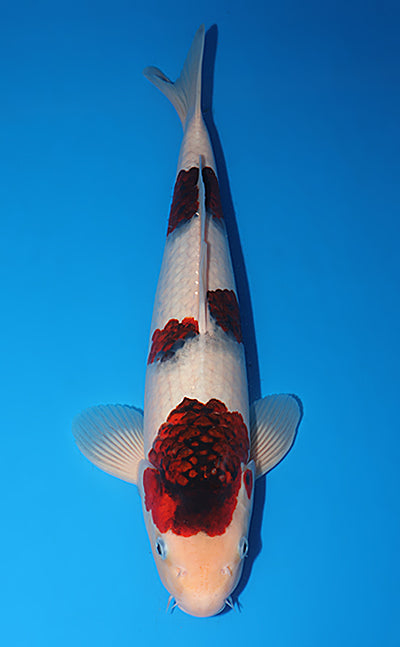
A Koromo starts out looking like an ordinary Kohaku. The robe it is named for arrives later, one scale edge at a time, and once it starts it does not stop.
This guide covers what a Koromo is, how to spot one, the three sub-types sold here, how the robe shifts with age, and where to buy one from us.
Koromo koi at a glance
| The name | Japanese for robe. Koromo and goromo are two spellings of one word, so listings use both |
| What it is | A Kohaku pattern with dark scale-edge reticulation over the red only |
| Sub-types | Ai Goromo (indigo), Budo Goromo (purple, grape-like), Sumi Goromo (black) |
| Parentage | Kohaku crossed with Asagi |
| The quick test | The white stays clean; the robe sits inside the red |
| Buying in | Mixed tosai packages from $185. Quarantine every arrival and stock to the adult size your pond can carry |
What is koromo koi?
A Koromo is a Kohaku wearing a robe: white body, red pattern, and a darker crescent on the edge of each scale inside that red. The white is left alone. Koromo and goromo are one Japanese word romanized two ways, which is why both spellings turn up in listings.
How can I tell if a koi is a koromo?
Check the white. Dark edging inside the red only means Koromo; netting that carries over the white ground means Goshiki. The edging follows scale edges as crescents rather than sitting as separate patches the way a Sanke's sumi does.
What are the typical color patterns of koromo koi?
Three. An Ai Goromo koi shows blue-indigo crescents with the red still visible beneath, and is the classical form. A Budo Goromo koi carries a heavier overlay that blends into purple clusters, the grape look its name describes. Sumi Goromo puts black over the red, denser and less neatly confined to the scale edge.
Are koromo koi considered a specific variety or a pattern type?
Both, awkwardly. Koromo is a recognized judging class, but the name describes an overlay rather than a whole fish, which is why Koromo Sanke and Koromo Showa exist alongside the plain Ai Goromo koi.
How does koromo differ from other koi patterns?
A Kohaku has no overlay. An Asagi nets its blue back instead of the red. A Goshiki nets the white too. Ai Goromo, Sumi Goromo and Budo Goromo koi differ from one another in the color and weight of that overlay, but all three keep it off the white.
What breeding techniques produce koromo koi?
Kohaku crossed with Asagi. The Kohaku brings the red-on-white pattern, the Asagi the scale-edge pigment that becomes the robe. Lines are now largely bred Koromo to Koromo, and crossing to Sanke or Showa gives the Koromo Sanke and Koromo Showa forms.
Do koromo koi require special care compared to other koi?
No. Water chemistry, filtration and feeding are the same as for any koi. The only real difference is patience: the overlay takes years to finish, and steady conditions show in how evenly it comes in.
Are koromo koi suitable for beginners?
Easy to keep, harder to pick. A goromo koi is as hardy as a Kohaku, but at tosai the robe is barely there, so buy on body and red pattern and treat the overlay as upside.
What is the origin and history of koromo koi?
Niigata, around the middle of the twentieth century, out of that Kohaku and Asagi cross. Ai Goromo is generally cited as the first form, with Budo and Sumi following. Sources disagree on dates, so treat any year you see quoted as approximate.
How do koromo markings change as the fish ages?
They advance. A tosai can read as a plain Kohaku with a shadow in the red, then the crescents darken and spread season by season, sometimes until they muddy the red they were meant to decorate. An older fish shows far more of what you will keep.
Where to buy Koromo koi from us
One route at the moment, and the tag data says it is the only Koromo pack we carry:
- Ikarashi Ozumi Koi Farm Kawarimono Designer Tosai Packages, from $185 for five 3 to 5 inch koi, or $32.50 a fish in the ten-koi box.
Each pack is a unique assortment drawn from several kawarimono varieties rather than a Koromo-only box, so treat Koromo content as likely rather than promised. For one particular fish, browse the Japanese koi selection or ask us what has just landed. Our guide to Kohaku covers the pattern under the robe.
Two conditions before you order any multi-fish package, and neither is optional. Quarantine every new koi in a separate, filtered, aerated holding system for two to four weeks before it goes near your main pond. And stock to the adult size your volume and filtration can carry, then buy under that number.
Frequently asked questions
What is koromo koi?
A Kohaku with a robe over the red: a darker crescent on the edge of each scale inside the red, clean white elsewhere.
How can I tell if a koi is a koromo?
Dark scale edging inside the red only means Koromo. Netting that carries over the white ground means Goshiki.
What are the typical color patterns of koromo koi?
Indigo crescents on an Ai Goromo koi, heavier purple clustering on a Budo Goromo koi, denser black over the red on a Sumi Goromo.
Are koromo koi considered a specific variety or a pattern type?
Effectively both: a recognized judging class, but one describing an overlay on a base pattern, which is why Koromo Sanke and Koromo Showa exist.
How does koromo differ from other koi patterns?
An Asagi nets its blue back, a Goshiki nets the white too, a Kohaku has no overlay. In a Koromo the dark sits inside the red and nowhere else.
What breeding techniques produce koromo koi?
Kohaku crossed with Asagi, which supplies the scale-edge pigment. Crossing on to Sanke or Showa produces the Koromo Sanke and Koromo Showa forms.
Do koromo koi require special care compared to other koi?
No, husbandry is identical to any koi. The overlay just takes years to finish, and steady conditions show in how evenly it settles.
Are koromo koi suitable for beginners?
Yes to keep, less so to judge. A goromo koi is as hardy as a Kohaku, but a young one barely shows its robe.
What is the origin and history of koromo koi?
It emerged in Niigata around the middle of the twentieth century from the Kohaku and Asagi cross, Ai Goromo first. Dates vary between sources.
How do koromo markings change as the fish ages?
The overlay advances with age, darkening and spreading, and on some fish eventually overwhelms the red. An older Koromo shows more of what you will keep.