
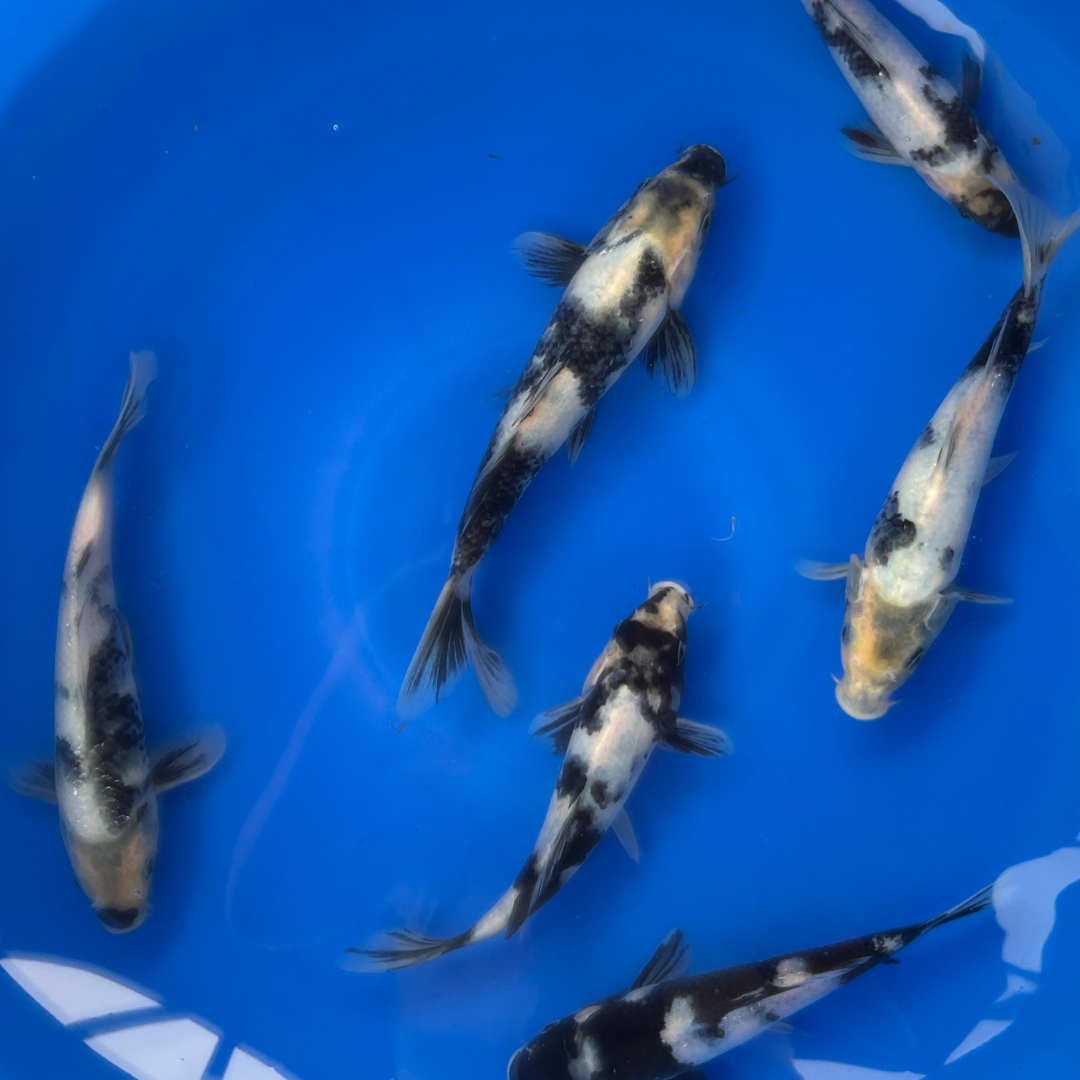
Utsuri is the variety people buy by accident. A black-and-white koi in a dealer's vat is nearly always labeled Shiro Utsuri, and often enough it is really a Bekko — a different fish, judged in a different class, usually worth less. The difference takes ten seconds to check once you know what you are looking at.
This guide covers the three Utsuri, how to tell them from the varieties they are confused with, what separates a good one from a cheap one, and what to look for when you are buying for a backyard pond.

Utsuri koi at a glance
| Trait | Utsuri |
|---|---|
| What it is | A black-based koi with one other color laid over it — white, red or yellow |
| The three | Shiro Utsuri (white), Hi Utsuri (red), Ki Utsuri (yellow) |
| Head marking | Sumi crosses the head. The classic form is menware, a bold band splitting the face |
| Pectoral fins | Motoguro — solid black at the fin base, radiating outward |
| Confused with | Bekko (colored base, scattered spots, clean head) and Showa (three colors, not two) |
| Judged | In the Utsurimono class. Doitsu, ginrin and Kage forms usually bench separately, and metallic Utsuri go to Hikari Utsurimono |
| Care difference | None. Standard koi husbandry; sumi quality tracks stable water |
| Buying in | Mixed packages from $235 (about $47 a fish) through $495 for larger grow-outs; individually selected fish from $1,600. Quarantine every arrival and stock to the adult size your pond can carry |
What is an Utsuri koi?
Utsurimono — usually shortened to Utsuri — means "reflection" or "printed" koi. The working description is that the fish is black underneath, with a second color laid over it in large wrapping plates. That layering is a judging and descriptive convention rather than a proven pigment mechanism, but it predicts what you see well enough to buy on. Two colors, never three, and the black reaches the head.
That structure gives you the three varieties, named for the second color:
| Variety | The second color | What to look for |
|---|---|---|
| Shiro Utsuri | White | The benchmark. Crisp, snow-white shiroji against lacquer black. The highest contrast of the three, and the least forgiving |
| Hi Utsuri | Red | Deep, even red with no orange drift. Warm and dramatic, and the red tends to move more with age than white does |
| Ki Utsuri | Yellow | Clear lemon or canary yellow with a sharp boundary against the sumi. The rarest of the three by a wide margin |
| Doitsu Utsuri | Any of the above, German-scaled | Mirror scales in limited rows against smooth skin make the color boundaries look drawn with a pen — and hide nothing |
| Kage Utsuri | Any of the above, with kage | A faint reticulated "shadow" over the white or color. Divisive: some judges love it, some read it as muddiness |
Ki Utsuri deserves a note beyond its rarity. It sits at the root of the Showa line: the conventional account has Showa produced in 1927 by crossing a Kohaku with a ki utsuri. That account comes from dealers and hobbyists rather than any register, so treat it as the standard version rather than documented fact — and do not read it as genetic distance, because modern Showa have been outcrossed to Sanke and Kohaku lines extensively since. Our complete guide to Showa covers that lineage.

Telling Utsuri from the varieties it gets confused with
This is the useful part of the guide, because getting it wrong costs money at the point of purchase.
Utsuri versus Bekko
The single most common mix-up, and the easiest to settle. Ask which color is the base.
- Utsuri is black underneath. The sumi is the ground the fish is built on, so it wraps the body in large connected plates, tends to carry across the lateral line, and usually reaches the head.
- Bekko is white, red or yellow underneath, with black scattered over it as separate, self-contained spots. Those spots sit on the flanks and back, and the head is clean.
So the quickest check is the head. Black across the face points hard to Utsuri; a clean head with tidy, self-contained black spots down the body points to Bekko. Treat that as a strong indicator rather than a rule, for two reasons. Head sumi on a young fish may simply not have surfaced yet, so a tosai can read "Bekko" and finish as an Utsuri. And a mature Utsuri with no head sumi is faulted for it rather than reclassified. When the head is ambiguous, go to the pectoral fins: motoguro, a solid black block at the fin base, belongs to Utsuri and Showa. Bekko does not carry it.
Utsuri versus Showa
Count the colors. Utsuri has two: black plus one. Showa has three — black, red and white together on the same fish. A shiro utsuri with a single stray patch of red is not a Showa, but a fish carrying genuine red and white over black is.
The confusion runs the other way too, because both varieties share the same two structural markers, and for the same reason — they are related. Both tend to carry menware, the bold black band that splits the face, and both tend to carry motoguro, solid black at the base of the pectoral fins radiating outward — though not every fish of either variety shows both. Neither marker separates them; the color count is the better test. It is still not absolute — a red-dominant Aka Showa carries only a little shiroji breaking up the hi, and telling that from an unpigmented patch on a Hi Utsuri is a judgment call rather than a rule.
Utsuri versus Karasu and other black koi
Karasugoi is black essentially all over, with no significant second color. If you are struggling to decide whether the fish is black-with-white or white-with-black, it is one of the Utsuri or Bekko group. If there is barely any second color at all, it is a Karasu.
What makes a high-quality Utsuri
Judge the body first. That rule runs through every guide in this series and it is not different here: a fish with poor conformation is a poor fish whatever its markings do. Check thickness through the shoulder, symmetry viewed from above, and a strong caudal peduncle. Then read the fish in this order.
Sumi quality
The black should be lacquer — deep, glossy, and dense enough that no undercolor shows through. Flat, gray or brownish sumi is the most common fault and the hardest to forgive, because on an Utsuri the black is most of the fish. Edges should be defined rather than smoky.
Balance and wrapping
Sumi should wrap the body rather than sitting as isolated blocks, and it should be distributed down the length of the fish rather than piling up at one end. A koi that is nearly all black at the front and nearly all white at the back reads as unbalanced from above, which is the view that matters.
Menware
The head band should be bold and reasonably symmetrical. A head with no sumi at all is a real fault on an Utsuri, and a head that is entirely black is usually considered heavy. What you want is a face divided with intent.
Motoguro
Solid black at the pectoral fin bases, radiating out, and ideally matched on both sides. Motoguro that has spread to swallow the whole fin is a fault; so is a fin base with none at all.
The second color
On a Shiro Utsuri, the white should be genuinely white rather than cream or ivory — this is the trait that most often disappoints buyers a year in. On Hi Utsuri, the red should be even and deep without drifting orange. On Ki Utsuri, the yellow should be clear and bright with a hard boundary against the black.

How the shiroji drives the price of a Shiro Utsuri
On a Shiro Utsuri the white is doing more work than on almost any other koi, because it sits directly against black. Contrast is the whole visual effect, and contrast is decided by the white far more than by the black — dense sumi is common, genuinely white shiroji is not.
That is why two Shiro Utsuri with similar black can differ sharply in price. Cream, ivory or faintly yellow shiroji flattens the contrast and drops the fish a tier. It is also the trait most likely to degrade in a home pond: heavy organics, a heavy color-food diet and long hours of direct summer sun all push white toward yellow. Buying a fish with excellent white and then keeping it in conditions that yellow the white is the standard way to lose money on this variety.
Do Utsuri markings change as the fish grows?
Yes, and more than most varieties. Sumi on young Utsuri emerges, consolidates and sometimes recedes; gray shadowy areas on a tosai often finish into solid black plates by two or three years old, and occasionally the reverse happens and a promising plate breaks up.
The practical consequence is the same as it is for Showa: a young Utsuri is a forecast and an older one is a fact. If you want to know what you are getting, buy a fish that has already done its developing. If you enjoy the wait, buy young and cheap and accept the odds. Steady water and moderate sun help sumi finish cleanly; nothing rescues black that was never there.
Buying an Utsuri for a backyard pond
Confirm the variety, then judge the fish body-first
Head sumi and motoguro tell you it is an Utsuri rather than a Bekko — do that check first because it is fast and it prevents the expensive mistake. Then judge the fish itself in the cluster's usual order: body, then finish, then pattern. Confirming the variety is not the same as judging the koi, and the body still decides whether it is worth owning.
Buy Shiro Utsuri on the white
Everyone looks at the black. The white is the differentiator, and it is what will still be visible from ten feet away in three years.
Match the age to your appetite for risk
A young hi utsuri in a package is the cheap way in and the sumi will move. Individually selected adults have largely finished and are priced accordingly. Worth knowing which is which in stock terms: Shiro and Ki Utsuri turn up as individually selected fish, while Hi Utsuri currently reaches us through the mixed packs rather than as a standing single listing — so if a finished Hi Utsuri is what you want, ask us what has just landed.
Doitsu shows everything
German scaling leaves smooth skin with mirror scales in limited rows, which makes color boundaries crisper and every blemish, scar and row irregularity obvious. Doitsu Utsuri is genuinely striking, but buy it in good light and look closely.
Where to buy Utsuri koi from us
Utsuri stock comes in two shapes: mixed tosai packages, which are the affordable way to take several chances at once, and individually selected fish, which are one-of-a-kind and sell quickly.
- Maruhiro Koi Farm Mixed Tosai Variety Packages, from $235 for five 5 to 6 inch koi — about $47 a fish, or $41.50 each in the ten-koi pack. One of two mixed packs we tag for Utsuri, and the cheapest way in. Each pack is a unique assortment drawn from several varieties rather than an Utsuri-only box, so treat Utsuri content as likely rather than promised — the mix is not selectable.
- An individually selected Shiro Utsuri at $2,000, and a Ki Utsuri at the same price — single Japanese fish, one of each, listed as we write this.
- Marusei Koi Farm Premium Mixed Variety Packages, from $495 for three 8 to 10 inch koi, or $675 for a single 12 to 14 inch fish. Also tagged for Utsuri, and the rung between tosai packs and one-off fish — larger, further along, and the size band this guide steers you toward if you want the sumi already settled.
- Doitsu Shiro Utsuri and Kage Shiro Utsuri, $1,600 each, if the German-scaled or shadowed forms appeal.
Single fish at this level are genuinely one-offs — when one sells it is gone, so browse the Japanese koi selection for what is listed right now, or ask us what has just landed.
Before you order any multi-fish package, two things to have ready, and neither is optional. First, quarantine every new koi in a separate, filtered, aerated holding system for two to four weeks before it goes anywhere near your main pond — a group purchase is a group of new arrivals, and one unquarantined fish can take out an established collection. Second, size the group to your pond rather than to your enthusiasm: koi grow into large fish, so count the adult fish your volume and filtration can carry, then buy under that number.
Caring for an Utsuri
There is no Utsuri-specific husbandry. Water chemistry, filtration sizing and seasonal routines are the same as for any koi, and our pond filtration basics guides cover those properly rather than repeating them here.
Two things are worth knowing because they act on the markings. Sustained poor water dulls sumi and yellows white, so an Utsuri that has lost its snap is often telling you about the pond before it tells you anything about the fish — though read that as a slow gauge rather than a monitor, because shiroji yellows over weeks while an ammonia spike does its damage in hours. Test the water rather than trusting the fish's appearance. Two practical notes the rest of this series carries: some shade over part of the pond protects white-bodied koi through summer and costs nothing, and chasing sumi with sudden water changes costs more in fish stress than it gains in color.
The second is diet. Color foods deepen red, which helps a hi utsuri koi and does nothing useful for a Shiro Utsuri — on a black-and-white fish the same food pushes the white toward cream, trading the trait that carries the fish. Feed color support seasonally on the red and yellow forms, and keep a Shiro Utsuri on a plain staple or growth diet.
Related guides in this series: our complete guide to Showa, conventionally traced back to Ki Utsuri, and our guide to Sanke, whose tejima fin striping is the contrast case that makes motoguro readable.
Frequently asked questions
What are the different types of Utsuri koi?
Three, named for the color laid over the black base: Shiro Utsuri is black and white, Hi Utsuri is black and red, and Ki Utsuri is black and yellow. Each also appears in Doitsu (German-scaled) and Kage (shadowed) forms, and any of them can carry the ginrin sparkling-scale trait. Shiro Utsuri is by far the most commonly kept; Ki Utsuri is the rarest.
What is the difference between a Shiro Utsuri and a Bekko koi?
Which color is underneath. A Shiro Utsuri is a black fish with white laid over it, so the sumi wraps the body in large connected plates and crosses the head. A Shiro Bekko is a white fish with black spots scattered over it, and the head stays clean. The head is the quick test: black across the face means Utsuri, a clean white head with tidy body spots means Bekko.
How can you identify an utsuri koi versus other black-patterned varieties?
Work through three checks, treating each as an indicator rather than a verdict. Does the black reach the head, and is there motoguro at the pectoral fin bases? Both point to Utsuri; a clean head with scattered body spots and no motoguro points to Bekko — though head sumi can be late to surface on a young fish. How many colors are on the fish? Black plus one is Utsuri; black plus red plus white is a Showa. Is there any significant second color at all? If the fish is essentially black all over, it is a Karasugoi. Menware across the face and motoguro at the pectoral fin bases confirm Utsuri or Showa, but they do not separate those two from each other — only the color count does.
What is a hi utsuri koi?
A hi utsuri koi is the red form: a black-based koi with red laid over it in wrapping plates, with sumi crossing the head and motoguro at the pectoral fin bases. Good examples show deep, even red with no orange cast. The red on Hi Utsuri tends to shift more with age and with diet than white does on a Shiro Utsuri, so judge a young one on the black and the body rather than on how vivid the red looks on the day.
What are the main color variations found in utsuri-patterned koi?
White, red and yellow over black — Shiro, Hi and Ki respectively. Beyond those three, the variation is in how the color is presented rather than in the color itself: Doitsu forms show the same palette on smooth skin with mirror scales in limited rows, Kage forms carry a faint reticulated shadow over the second color, ginrin forms add reflective scales, and metallic forms — Kin Ki Utsuri and Kin Hi Utsuri — bench as Hikari Utsurimono. What you will not find is a blue or green Utsuri; a blue-gray fish with a netted pattern is an Asagi, which is a different family.
How does pattern placement differ among utsuri varieties?
The placement rules are the same across all three — sumi should wrap the body, balance down the length of the fish, cross the head as menware, and sit at the pectoral fin bases as motoguro. What differs is how forgiving each is. On a shiro utsuri koi the black-white boundary is so high-contrast that uneven placement is glaring. On Hi Utsuri the warmer palette softens the same imbalance. Ki Utsuri sits in between, though its scarcity means buyers often accept placement they would reject on a Shiro.
What characteristics define a high-quality utsuri koi?
Body first: thickness through the shoulder, symmetry from above, a strong tail tube. Then lacquer-black sumi that is glossy rather than flat or gray, wrapping the body rather than sitting in isolated blocks. Then a bold, reasonably symmetrical menware, and clean motoguro matched on both pectorals. Then the second color — genuinely white white, deep even red, or clear bright yellow. A fish that is excellent in sumi and poor in body is a poor fish.
What are the common markings on a shiro utsuri koi?
Menware, the bold black band that splits the face, is the signature head marking. Motoguro, solid black radiating from the base of the pectoral fins, is the signature fin marking. On the body you are looking for large wrapping plates of sumi that cross the lateral line and alternate with clean white, rather than small isolated spots. Together those are what tell you the fish is an Utsuri rather than a Bekko.
How does a shiro utsuri's white background affect its value?
Substantially — though "background" is the wrong picture, since the white sits over a black base rather than under the black. Contrast is the whole effect, and the white decides most of it. Dense black sumi is relatively common; shiroji that is genuinely snow-white rather than cream or ivory is not, and it is the first thing to degrade in a poorly run pond. Two fish with comparable black can sit a full price tier apart on the quality of the white alone, which is why experienced buyers look at the white first on this variety.
Why do you not feed koi in winter?
Because a koi's digestion effectively stops in cold water. Koi are ectothermic — their metabolism tracks water temperature — and below roughly 50°F the gut slows to the point that food can sit undigested, which does the fish no good at all. Keepers taper feeding as the pond cools through autumn and stop entirely once it is cold, resuming in spring as it warms. This is standard koi keeping rather than anything specific to Utsuri; our pond filtration basics guides cover seasonal routines in full.