
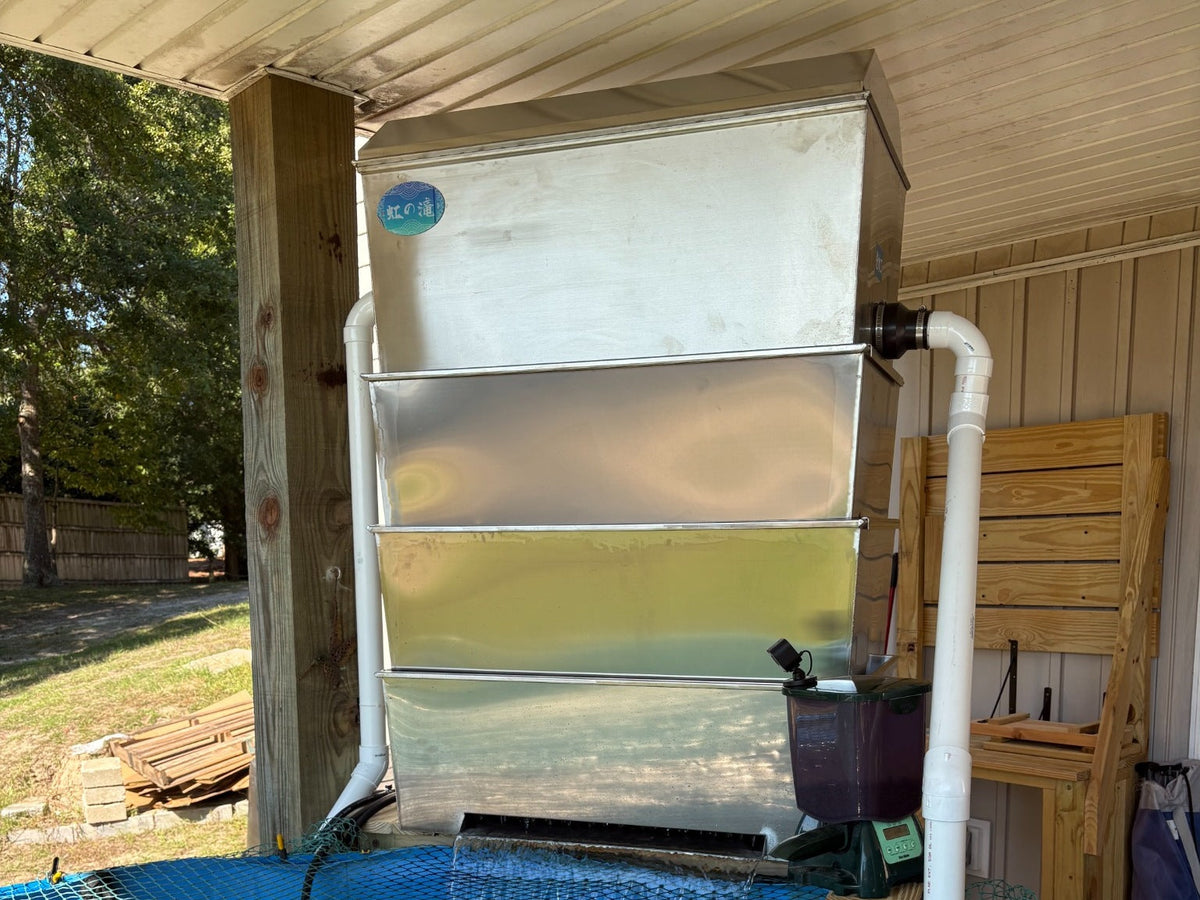
There's nothing quite like getting a new piece of equipment for your koi pond, especially one you've been researching for years!
After moving, I set up a temporary 1,200-gallon, 8-foot-wide above-ground pool for my six large, show-quality koi and two small Hi-Fin Sharks. With more koi expected to arrive from Japan this winter, I knew I needed better filtration. I also wanted something I could use when I build a larger pond. That's how I landed on the three-tier Nijikawa Niji-no-Taki.
Why the Niji-no-Taki?
My previous setup used an Evolution Aqua Tempest and a DIY moving bed filter. They did the job, but I knew that if I wanted to up my koi-keeping game, I needed to upgrade to a rotary drum filter paired with a Bakki shower. The Niji-no-Taki combines both and includes UV, too. Better yet, it works with the pump-fed setup my above-ground pond requires.
And I'll admit, the looks sold me, too! The stainless steel feels solid, the craftsmanship is impressive, and I love the Japanese lettering. Add the waterfall-style spillway as the icing on the cake, and the whole thing gives my pond a wonderful Japanese atmosphere. Most pond filters are meant to be hidden. This one I actually want to show off!
Getting It into Place
The first challenge was height. Because the spillway exits near the bottom of the filter, I built a heavy-duty wooden stand so the water could return directly to my above-ground pond.
Here's my biggest tip: don't underestimate the weight! This is not a filter you move alone. My brother-in-law Matthew helped me lift it onto the stand, and I was glad he was there. The stand also needs to support the weight of the filter, media, and water during operation.

When it came time to choose a pump, I knew the YC-25000 variable-speed pump was the perfect choice for my setup. I'm currently running it at its lowest setting, around 3,000 GPH by my estimate.
The plumbing was surprisingly straightforward. I used 2-inch rigid PVC connected with 3-inch to 2-inch Fernco couplings. I used a similar connection on the waste outlet, then transitioned to flexible PVC leading to an existing house gutter drain line. If you're installing a drum filter, plan a suitable wastewater discharge route from the start.

Nine Boxes of Media. Yes, Nine!
For the three shower tiers, I loaded nine boxes of brand-new No-Taki ceramic media: three boxes and approximately 150 pieces per tier, or roughly 450 pieces altogether. Nothing about loading it was difficult, but wow, did I underestimate the time it would take!

I also wanted to keep my established biological filtration going while the new media matured. I put the K1 media from my old moving bed filter into a new laundry bag near the spillway, with an air diffuser underneath to help keep it moving and oxygenated.
I'm also planning to add Microbe-Lift PL as part of my pond maintenance routine. I'll continue checking ammonia and nitrite while the new biofilter establishes itself.
The Best Part: Turning It On
After all that preparation, I was excited to finally see the filter run. Startup was unbelievably easy! Nijikawa has a video featuring Mr. Lee explaining the timer and programming, and I found it simple to follow.

At the time I first wrote this, the system had been running for just 48 hours, but the water clarity was already unbelievable. My koi even started showing spawning behavior, and the drum was doing a great job handling the visible debris. That doesn't mean the new biological media is fully mature yet, but it's a fantastic first impression.

I've programmed the drum to clean for 25 seconds every 40 minutes, at my current estimated flow of 3,000 GPH. Those are my settings for this particular pond, not a recommendation for every installation. Watching the spray nozzles clean the drum automatically is pretty satisfying!

Living with the Filter
So far, hands-on maintenance has been a dream. I top off the pond in the morning and after work to replace the water used during cleaning. The one tiny downside? Fingerprints show up on that beautiful stainless steel, and I'm still working out the best way to remove them.
Then there's the sound of the spillway. It's so relaxing I've nearly fallen asleep beside the pond a few times! The drum's cleaning cycle is noticeable, but not unpleasant to me. Honestly, I enjoy the whole experience of having it running.
Would I Recommend It?
Absolutely! Between the build quality, easy setup, automatic cleaning, and first impressions of the water clarity, I'm thrilled with the Niji-no-Taki. If you're considering one, my main advice is to plan for its weight and get help positioning it.
I'm especially looking forward to spring, when I'll increase the flow and feed my koi more heavily as I prepare them for shows. That will be a better test of how the filtration handles a bigger workload. For now, though, I'm enjoying the koi, the waterfall, and a lot less filter cleaning!

Interested in the Nijikawa Niji-no-Taki? Explore it at Play It Koi or contact our team to discuss your pond setup.