
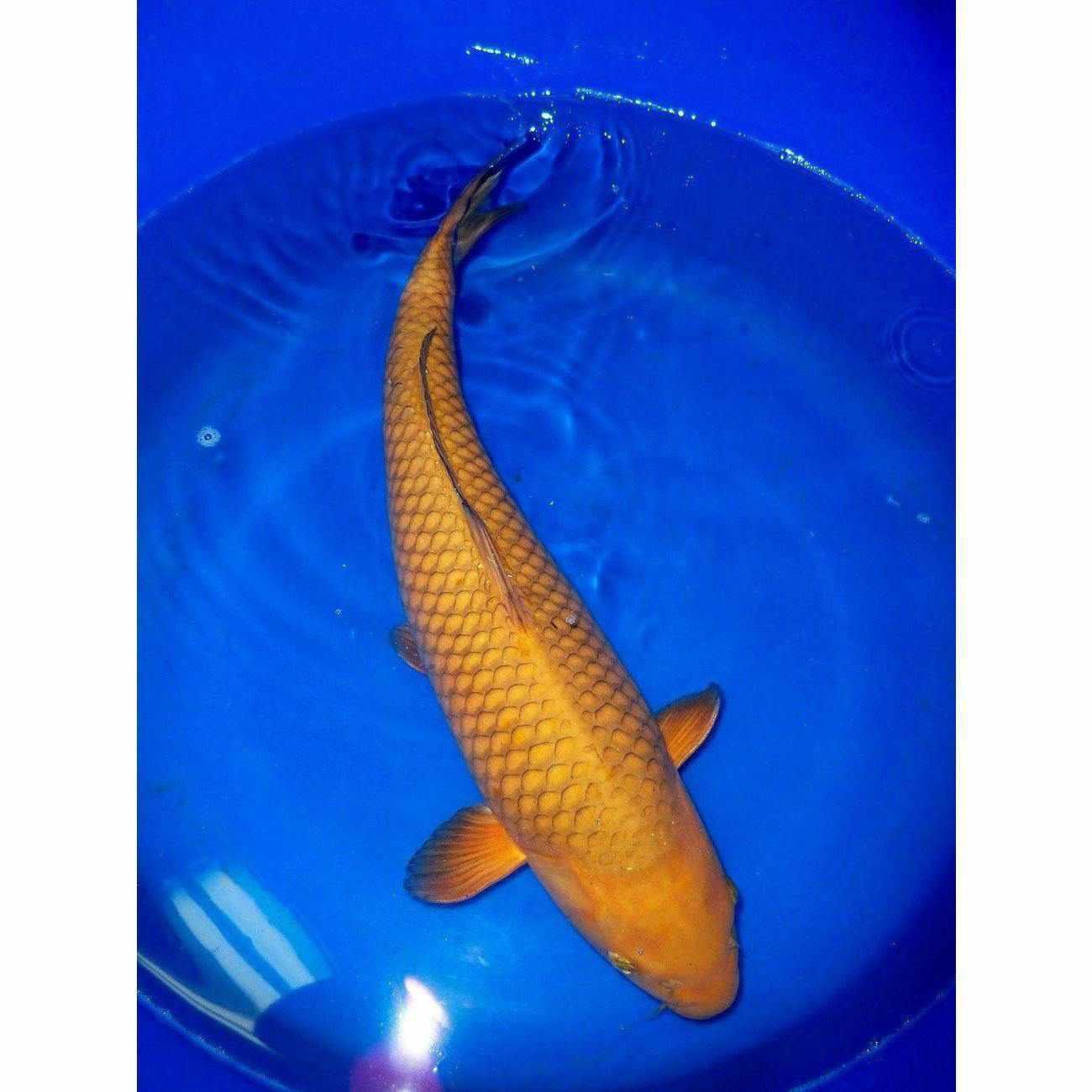
Ask a room of experienced keepers which koi to buy first and a surprising number will say the plain brown one. A chagoi is tea-colored, has no pattern to admire, and never competes for the awards a good Kohaku does — and it is still the fish most likely to change how your whole pond behaves.
This guide covers what a chagoi actually is, how to tell it from the other earth-tone koi it gets confused with, how big it really gets and what that means for your filtration, how to teach one to feed from your hand, and what to look for when you are buying one for a backyard pond.

Chagoi koi at a glance
| What it is | A single-colored, non-metallic koi in tea-brown tones — a variety, not a color applied to another variety |
| Name | Cha (tea) + goi (koi) — "tea koi" |
| Color range | Pale tan through warm copper and olive to deep chocolate |
| Defining detail | Fukurin — the lustrous skin around each scale, overlapping its neighbors to lay a fine net over the body |
| Family | Soragoi (gray-blue), Ochiba Shigure (brown over gray), Karashigoi (mustard) |
| Growth | Among the fastest-growing koi; trade sources commonly cite 30 to 35 inches in strong conditions, with exceptional fish larger |
| Temperament | Widely regarded as the friendliest variety — usually the first to hand-feed, and the one that teaches the others |
| Judged on | Body and skin quality only. There is no pattern to carry a weak fish |
| Best for | Keepers who want interaction, and anyone stocking a pond with shy fish already in it |
| Buying in | Quarantine every arrival and stock to the adult size your pond can carry — this variety gets bigger than you expect |
What is a chagoi koi?
A chagoi koi is a solid tea-brown koi with no pattern — one continuous color from nose to tail, in a non-metallic finish. The name is literal: cha means tea, goi means koi, and the color genuinely does run through the range of a brewed cup, from pale tan to dark chocolate.
It belongs to Kawarimono, the class that collects the non-metallic koi which do not fit the patterned varieties. That sounds like a consolation category, and for a brown koi with no markings it can look like one — until you understand that a chagoi is judged on the two things that are hardest to fake.
Is chagoi a color or a variety of koi?
It is a variety, and the distinction matters when you are reading listings.
Some koi terms describe a trait laid over a variety. Ginrin is a scale trait — a Ginrin Kohaku is still a Kohaku. Doitsu is a scale type. Tancho is a marking. Those names stack onto other varieties, which is why you meet combinations like Ginrin Doitsu Kohaku.
Chagoi does not work that way. The brown is the entire fish rather than a coat applied to something else, and a chagoi is benched in Kawarimono alongside the other non-metallic oddments rather than as a modifier on some other variety's class. The stacking still happens in the other direction — a ginrin chagoi is a chagoi carrying the sparkling-scale trait, and a Doitsu chagoi is a chagoi with German scaling — but the chagoi part is the variety, not the modifier.
The practical version: if a listing says "chagoi," you are being told what the fish is. If it says "ginrin chagoi," you are being told what it is plus one trait it carries.
What are the identifying features of a chagoi koi?
Four things identify a chagoi, and only the first is obvious.
Even, unbroken color
The brown should read the same from head to tail, with no blotching, no patchiness, and no abrupt change where the head meets the shoulder. A head that is noticeably lighter or grayer than the body is the most common fault on an otherwise good brown koi fish, and it is the one that gets worse as the fish grows rather than better.
Fukurin — the netting on the scales
Look closely at an adult chagoi and a fine net seems to sit over the whole body. That is fukurin — the lustrous skin around each scale, growing from beneath one scale to overlap the next, so the edges read as a pale tracery rather than as pigment on the scale itself. On a chagoi koi fish it is the closest thing the variety has to a pattern. Good fukurin is even across the body and consistent scale to scale; muddled or patchy netting is a fault in the same way a muddled pattern would be on a Kohaku.
Fukurin develops with size. On a young fish it may be barely visible, which is one reason a small chagoi is harder to judge than a small patterned koi. It also only applies to a fully scaled fish — on a Doitsu chagoi there is no body netting to read, and you judge the mirror rows and the bare skin between them instead.
Skin quality
With no pattern to look at, skin is doing all the work. A good chagoi has a soft depth to the color — it looks like it continues below the surface rather than sitting on top of it. A flat, chalky, or dusty-looking brown koi rarely improves.
Body
A chagoi koi carp is built thick: a broad head, real width through the shoulder, and a strong tail tube. This is not incidental. The body is why breeders have long used chagoi genetics to add size and bulk to other lines, and it is the single most reliable thing you can read on a young fish.
What colors and patterns are common in chagoi koi?
Strictly, a chagoi has no pattern — that is the definition. What varies is the shade, and the trade recognizes a spectrum rather than fixed grades:
- Light tea — pale tan to beige, sometimes with a faint green or olive cast. The netting shows most clearly here, which makes a light brown koi fish attractive early and unforgiving of unevenness.
- Mid tea — warm copper-brown or olive-brown. The classic chagoi look, and the one most keepers picture.
- Dark tea or chocolate — deep, saturated brown with real presence in the water. Fukurin reads strongly against it when the fish is well kept.
Color is not fixed for life. A chagoi koi fish tends to deepen as it matures, and shade shifts modestly with water temperature, diet, and season. That is normal. New patchiness where there was none is the rare case where a brown fish does report a water problem — and because brown hides so much, by the time it shows the problem is usually well established.
One caution about buying on shade: the darkest fish in the bowl is not automatically the best one. Evenness and depth beat intensity, and a mid-tea fish with flawless skin will outlast a chocolate fish with a blotchy shoulder.
How does a chagoi differ from other koi varieties?
Two ways, one obvious and one that actually matters.
The obvious difference is that there is nothing to look at. On a Kohaku you read the pattern; on a Showa you read how the sumi wraps the body. On a chagoi there is no pattern to read, so you are left judging body conformation and skin — which is the part of koi appreciation most newcomers skip. Buying a brown koi well is genuinely harder than buying a patterned one badly.
The difference that matters day to day is behavior. Chagoi are widely regarded as the most food-motivated and least skittish koi in the hobby — consistently enough that keepers buy them deliberately as a tool, though it is trade consensus rather than anything measured. A chagoi surfaces first at feeding time, and the shy fish in your pond watch it do so and follow. Add one chagoi koi fish to a pond full of koi that vanish when you approach and the shy ones often start following its lead.
There is a related, less-advertised difference. A chagoi hides water quality problems in a way a Sanke does not — brown skin will not show the staining and yellowing that white skin reports. The fish is no more tolerant of bad water; you are simply less likely to see it coming. That makes a chagoi an easy fish to keep and a poor early-warning system, and if your only fish is a chagoi you are flying on test kits rather than on what the pond is telling you.
The earth-tone family: Soragoi, Ochiba Shigure and Karashi
Chagoi sits at the head of a small group of plain, hardy, fast-growing koi that share its temperament. They are constantly confused with one another in listings, and the differences are easy once you know where to look.

Soragoi — the gray-blue one
Soragoi is the gray-blue member of the earth-tone group: solid slate to blue-gray, with the same fukurin netting and the same calm, hardy, fast-growing character as its chagoi cousin. The test is temperature of color, not darkness — a very dark chagoi still reads brown, while a Soragoi reads gray or blue even when pale.
Ochiba Shigure — brown on gray
Ochiba Shigure is a chagoi crossed to Soragoi, and it shows both: copper-brown patches over a gray-blue base. The name is usually rendered "autumn leaves on water," though shigure is really the late-autumn drizzle. Either way the fish looks the part — scattered fallen-leaf markings drifting across a cool ground.
The distinction from chagoi is simple: Ochiba is two-tone, chagoi is one. If you can point at where the brown stops and the gray starts, it is an Ochiba.

Karashigoi — the mustard one
Karashigoi (often just karashi) is the mustard-to-yellow-brown member of the family, and it shares the growth the group is known for — karashi are among the largest koi produced. The test is the cast, not the lightness: if the hue leans yellow-gold rather than tea-brown, it is karashi.
Quick comparison
| Variety | Base color | The tell |
|---|---|---|
| Chagoi | Tea-brown, tan to chocolate | Single color, no patches anywhere |
| Soragoi | Gray to blue-gray | Reads cool and slate, not warm and brown |
| Ochiba Shigure | Brown patches on gray | Two-tone — you can see where one ends |
| Karashigoi | Mustard to yellow-brown | Yellow-gold cast rather than tea |
Are chagoi koi more docile than other koi?
Yes — it is the most consistently repeated behavioral claim in the hobby, though it rests on trade consensus rather than study. Chagoi are reliably the boldest and most food-motivated koi in a mixed pond — first to the surface, first to take food from a hand, and largely unbothered by movement at the pond edge that sends other varieties for cover.
Two honest caveats. "Docile" here means confident and unafraid rather than gentle — a large chagoi at feeding time is pushy, and will out-eat slower fish if every meal lands in one spot. Spread routine feeding across the surface, or use two or three drop points, so the slower fish get their share. And temperament varies between individual fish and bloodlines; the tendency is strong but it is a tendency, not a guarantee on any single koi.
How to hand-feed a chagoi
The process is the same for any koi, but a chagoi will usually get there in days rather than months:
- Use one taming station, at the same time of day. Consistency is the whole trick — the fish is learning a routine, not learning you. This is a training spot and separate from routine feeding, which stays spread across the surface.
- Stand still first. Toss a few floating pellets and do nothing else for several sessions until the fish will feed with you standing there.
- Lower your hand gradually. Rest your fingers at the waterline with pellets between them. Let the fish come to you; chasing resets the progress.
- Do not grab. One grab teaches the pond more than a month of feeding does.
The payoff is not just the chagoi. Once it feeds from your hand in front of the others, the timid fish start testing the same behavior — which is the real argument for buying one.
How large do chagoi koi typically grow?
Chagoi are among the fastest-growing and largest koi. Trade sources commonly cite 30 to 35 inches for a mature fish in strong conditions, with exceptional individuals going well past that — the variety and its karashi relatives account for a disproportionate share of the biggest koi in the hobby, and the largest koi on record is a chagoi. A typical backyard pond will produce less than the trade figures, so treat them as potential rather than as a forecast.
Growth in the early years is quick when water and feeding are right, and slows as the fish matures. Genetics, volume, water quality, and feeding all move the number, so treat any figure as a strong indicator of potential rather than a schedule — a chagoi in a small, cold, lightly filtered pond will not reach the same size as the same fish in a large one.
This is the single most important practical fact about the variety, and the reason the care section below is longer than it would be for a Kohaku. You are not buying the fish in the bag. You are buying the fish it becomes.
How long do chagoi koi live?
Koi are long-lived animals, and a chagoi in a properly sized, well-filtered pond can reasonably be expected to live for decades — commonly cited figures for well-kept koi run from around 25 to 35 years, with exceptional documented cases far longer. Chagoi are hardy even by koi standards, so lifespan is generally limited by the pond rather than the fish.
In practice what shortens koi lives is not old age. It is winters in water too shallow to be stable, summers with too little oxygen, crowding as the fish grow into their adult size, and disease introduced on a new arrival that was never quarantined. Every one of those is a decision you make rather than something that happens to you.
What kind of pond environment is best for chagoi koi?
Build for the adult fish. A chagoi that reaches 28 inches or more is a large animal producing a large waste load, and it grows into the pond faster than most varieties.
Volume and depth
Stock to the adult size your volume and filtration can genuinely carry, not to the size of the fish you are bringing home. A handful of small koi look absurd in a big pond for exactly one season. Depth matters too — in cold regions the pond needs to be deep enough not to freeze through, and deeper water is more thermally stable through winter and gives fish somewhere settled to sit.
Filtration and circulation
Chagoi eat enthusiastically, and everything they eat comes back out. Size mechanical filtration to catch solids before they break down, and biological filtration for the adult stocking level rather than the current one. Aim for smooth, continuous circulation with no stagnant corners — a dead zone in the pond is where problems start.
Oxygen
This is the one that gets people. Warm water holds less oxygen exactly when large fish want more of it, so aeration should increase in summer, not stay flat. Bottom diffusers, waterfalls, and venturi returns all add dissolved oxygen. If you are in a region that loses power in summer storms, battery-backed aeration is cheap insurance for a pond full of large fish.
Water parameters
- Ammonia and nitrite — zero. Anything else is a filtration or stocking problem, not a treatment problem.
- Nitrate — kept low through routine partial water changes.
- pH — stable matters more than any particular number. Maintain carbonate hardness so it does not swing.
- Temperature — stability over ideals. Chagoi are hardy across a wide range and grow best in warm, settled conditions.
Pond design for a surface-forward fish
Chagoi tend to spend more time at the surface and at the edges than most koi, so round off sharp rockwork, remove snag points, and keep plant stakes away from the waterline. A shallow feeding ledge gives them somewhere to gather and gives you the best view of a variety whose whole appeal is close up — site it in the circulation path rather than in a corner, and be aware that a ledge is also where a heron would prefer to find a large fish.
How do you care for a young chagoi koi?
A young chagoi is not fragile, but it is growing fast, which makes the first year the one where mistakes compound.
Quarantine first, without exception
Quarantine every new koi in a separate, filtered, aerated holding system for two to four weeks before it goes anywhere near your main pond. Watch appetite, behavior, and skin daily. This is the single highest-value habit in the hobby, and skipping it once is how established ponds get wiped out.
If anything looks wrong during quarantine, get a proper diagnosis before doing anything else. Treating a guess is how a manageable problem becomes two problems.
Acclimation
- Temperature first. Float the sealed bag until the temperatures match.
- Then chemistry. If the bag water is meaningfully different from your quarantine system, drip acclimate rather than tipping the fish in.
- Never add bag water to the system. Net the fish across and discard the water it traveled in.
- Keep it dark and quiet. A newly moved koi that is left alone settles faster than one being checked on.
Feeding a growing fish
Feed a good-quality koi pellet appropriate to the water temperature, in small amounts several times a day rather than one large meal, and only as much as is cleanly eaten in a few minutes. Taper as water cools, move to easily digested wheat-germ formulas through the shoulder season, and stop entirely once the water is cold — below roughly 50°F a koi's metabolism has slowed to the point where food sits undigested.
Watch shape as much as size. A fast-growing chagoi koi carp should look powerful and proportional. If girth is outrunning length, cut the ration.
Do not keep one without other koi
Chagoi are social, and a chagoi's best qualities only show up in company — the leadership behavior that makes the variety worth owning needs other fish to lead. One chagoi in a community pond is ideal. One chagoi by itself wastes the fish.
What to look for when buying a chagoi koi
Buy the body, then the skin, then the shade
In that order, every time, on any brown koi fish. Width through the shoulder and a strong tail tube are what the fish will be judged on at any size, and they are visible young. Shade is the thing everyone shops on and the thing that changes most.
Check the head against the body
Look for a head that matches the body in tone. A pale or gray head on a warm brown body is the most common fault in the variety and tends to become more obvious with age, not less.
Read the scale edges
On any fish big enough to show fukurin, check that the netting is even across the whole body. Patchy netting on one flank is a genuine fault. On a small fish where fukurin has not developed, accept that you are buying on body and parentage and price accordingly.
Watch which fish comes to you
This is the one piece of buying advice specific to chagoi. In a bowl or a vat, the fish that swims over to investigate you is usually the one that will hand-feed first at home. Temperament is the reason to buy the variety, so it is reasonable to let it break a tie.
Judge doitsu fish differently
"Doitsu" does not mean scaleless. Most Doitsu chagoi are mirror-scaled — large scales in limited rows along the dorsal line, and usually the lateral line too — against otherwise smooth skin, though the leather form (kawagoi) carries almost none at all. That smooth skin shows color beautifully and hides nothing, so check the mirror rows for gaps and misplaced scales, and check the skin between them for blemishes a scaled fish would have concealed.
Where to buy chagoi koi from us
One thing to square first: everything in the section above is how you pick a single fish. You cannot read the body, check the scale edges or watch which fish swims over when the koi arrive in a sealed mixed box. Those criteria are for when you buy a named single, or when you ask us to pull one for you — and they are exactly what to ask us to check on your behalf.
An honest note on availability before the links. Single earth-tone koi move through here quickly and we are currently out of single chagoi, Soragoi and Ochiba Shigure. Rather than list a fish we cannot ship, the chagoi koi for sale on our site right now are named-breeder tosai packages — tosai meaning first-year koi — that include earth-tone fish in the mix. So when you search chagoi koi fish for sale and land here, what you will find is a box of young koi drawn from a breeder who works this variety — not a single named fish. The same applies if you searched chagoi koi carp for sale: koi are carp, and the two phrases describe one fish.
Buying chagoi koi carp for sale this way is genuinely good rather than a consolation. Chagoi are cheap small and grow fast, so a package is a reasonable way to get several young fish at once, plus the mixed collection a chagoi is supposed to lead. If you want one fish chosen on body and skin instead, that is a different purchase — ask us what singles are in the building.
One thing to understand before you order: each package is a unique assortment drawn from that breeder's harvest. The varieties listed are what the mix draws from, so an earth-tone fish is likely rather than promised in any individual box.
Packages we tag for chagoi
- Miyatora Koi Farm — Mixed Tosai Select Packages, from $225 for five 5 to 6 inch fish. The ten-koi option works out to $39.50 a fish, the cheapest per-fish price this breeder offers. The mix draws on chagoi alongside Gosanke, Kujaku, Shusui and Doitsu Showa.
- Maruhiro Koi Farm — Mixed Tosai Variety Packages, from $235 for five 5 to 6 inch fish, or $41.50 a fish in the ten-koi box. The mix includes both chagoi and karashi, plus Asagi, Tancho, Utsuri and Ogon.
Packages we tag for Ochiba
These are tagged for Ochiba Shigure rather than chagoi — the route to take if the fallen-leaf fish is the one you are after.
- Ikarashi Ozumi Koi Farm — Kawarimono Designer Tosai Packages, from $185 for five 3 to 5 inch fish — $32.50 a fish in the ten-koi box, and the least expensive entry point we have. A Kawarimono-focused mix drawing on Ochiba and karashi alongside Goshiki, Koromo and Kujaku.
- Kanno Koi Farm — Metallic & Ginrin Tosai Packages, from $225 for five 5 to 6 inch fish. Worth a look if you want ginrin and metallic fish in the mix — Ochiba is one of the varieties this pack draws from.
- Koshiji Koi Farm — Kikokuryu, Ochiba & Showa Packages, from $255 for five 5 to 6 inch fish, or $44.50 a fish in the ten-koi box. Ochiba is named in the mix rather than incidental to it.
- Marusei Koi Farm — Premium Mixed Variety Packages, from $495 for three 8 to 10 inch fish. Bigger fish and a bigger price — the right choice if you want size on arrival rather than a grow-out project. The mix includes Ochiba.
Two things worth doing before you order a multi-fish package. Quarantine every new koi in a separate, filtered, aerated holding system for two to four weeks before it goes anywhere near your main pond — a group purchase means a group of new arrivals, and one unquarantined fish can take out an established collection. And size the group to your pond rather than to your enthusiasm: chagoi grow into the largest fish in most collections, so count the adult fish your volume and filtration can carry, then buy under that number.
When single fish come back
Single chagoi koi for sale appear here whenever a shipment lands with good brown fish in it, and they sell quickly. If you would rather wait for one than take a package, say so and we will flag you when chagoi koi fish for sale return to the site as singles.
Availability by variety changes constantly here, and single-variety fish come and go far faster than packages do. If you are specifically hunting a single chagoi koi carp, or a Soragoi — which we do not currently have a package route for — contact us and we will tell you what is actually in the building. That is also the fastest route to chagoi koi carp for sale in a specific size, since we can check a shipment before it reaches the site, and to chagoi koi for sale that are not listed yet.
Caring for a chagoi through the year
Nothing here is unique to the variety, but a chagoi's size and appetite make each of these bite harder than they would on a smaller fish.
- Spring — bring feeding back gradually as the water warms and stays warm. Fish are at their most vulnerable coming out of winter with a biofilter that has not caught up yet.
- Summer — aeration, then more aeration. Warm water holds less oxygen while your largest fish are eating most. This is the season where a chagoi's size becomes a load on the system.
- Autumn — taper protein as the water cools and move to easily digested formulas. Clear leaves before they sink and decompose.
- Winter — keep a hole in the ice for gas exchange with an aerator or de-icer, never by breaking it. Move aeration shallow for the season: running a bottom diffuser or a waterfall under ice stirs the warmer deep water your fish are sitting in and destroys the stratification that keeps them stable. Stop feeding once the water is cold and leave the fish alone.
Frequently asked questions
What is a chagoi koi?
A chagoi koi is a solid tea-brown koi with no pattern, in a non-metallic finish — the name combines cha (tea) and goi (koi). It belongs to the Kawarimono group and is judged entirely on body conformation and skin quality, since there is no pattern to assess. Chagoi are also among the friendliest and fastest-growing koi in common keeping, which is why experienced keepers so often recommend one as a first addition to a pond.
Is chagoi a color or a variety of koi?
Chagoi is a variety, not a color laid over another variety. Traits like ginrin (sparkling scales), doitsu (German scaling) and tancho (a head marking) stack onto other varieties, so a Ginrin Kohaku is still a Kohaku. Chagoi does not work that way — the brown is the fish itself. A ginrin chagoi is a chagoi carrying the sparkle, with chagoi as the variety and ginrin as the trait.
How does a chagoi differ from other koi varieties?
In two ways. Visually, there is no pattern, so you judge body and skin rather than markings — which makes a brown koi harder to buy well than a patterned one. Behaviorally, chagoi are the boldest and most food-motivated koi in a mixed pond; they surface first, hand-feed readily, and the shyer fish learn to follow. A chagoi also hides poor water quality that white-skinned varieties would reveal, so it is an easy fish to keep but a poor early-warning system.
What are the identifying features of a chagoi koi?
Even, unbroken tea-brown color from head to tail with no blotching; a head that matches the body in tone; fukurin, the pale netted edging on each scale that gives an adult chagoi its subtle reticulated texture; deep, soft skin quality rather than a flat chalky finish; and a thick body with a broad head, real shoulder width and a strong tail tube. A mismatched pale head is the most common fault, and it tends to become more obvious with age.
What colors and patterns are common in chagoi koi?
A chagoi has no pattern by definition — what varies is shade. The trade recognizes light tea (pale tan to beige, sometimes with a faint green or gold cast), mid tea (warm copper-brown or olive-brown, the classic look), and dark tea or chocolate. Adult fish show fukurin netting on the scales over any of these. Color deepens with maturity and shifts modestly with temperature, diet and season, but new patchiness usually points at water quality rather than genetics.
Are chagoi koi more docile than other koi?
Yes — chagoi are consistently the boldest and most food-motivated koi in a mixed pond, usually the first to hand-feed and largely unbothered by movement at the pond edge. Two caveats: docile here means confident rather than gentle, and a large chagoi will out-eat slower fish if you feed in one spot, so spread food across the surface. Temperament also varies between individuals and bloodlines, so treat it as a strong tendency rather than a guarantee on any single fish.
How large do chagoi koi typically grow?
Chagoi are among the largest and fastest-growing koi. In a well-run pond a mature fish commonly reaches the 28-inch range and up, with exceptional individuals considerably larger — chagoi and their karashi relatives account for a disproportionate share of the biggest koi in the hobby. Growth is quick in the early years and slows with maturity, and volume, filtration, water quality and feeding all move the outcome, so treat any figure as potential rather than a schedule.
How long do chagoi koi live?
Koi are long-lived animals, and a chagoi in a properly sized, well-filtered pond can reasonably be expected to live for decades — commonly cited figures for well-kept koi run from roughly 25 to 35 years, with exceptional documented cases far longer. Chagoi are hardy even by koi standards, so lifespan is usually limited by the pond rather than the fish: shallow winters, low summer oxygen, crowding as fish reach adult size, and disease brought in on an unquarantined arrival.
What kind of pond environment is best for chagoi koi?
Build for the adult fish, not the one you bring home. Stock to the adult size your volume and filtration can genuinely carry, and give the pond enough depth to stay thermally stable through winter. Size mechanical filtration to catch solids before they break down and biological filtration for the adult stocking level. Increase aeration in summer, when warm water holds less oxygen and large fish want more. Keep ammonia and nitrite at zero, nitrate low through routine partial water changes, and pH stable rather than any particular number. Round off sharp rockwork, since chagoi spend more time at the surface and edges than most koi.
How do you care for a young chagoi koi?
Quarantine it first: every new koi goes into a separate, filtered, aerated holding system for two to four weeks, with appetite, behavior and skin watched daily. Acclimate on temperature first and then chemistry, drip acclimating if the bag water differs meaningfully, and never add bag water to your system. Feed a good-quality pellet suited to the water temperature in small amounts several times a day, only as much as is cleanly eaten in a few minutes, tapering as the water cools and stopping entirely once it is cold. Watch body shape as much as size — cut the ration if girth outruns length. And keep it with other koi; a chagoi's leadership behavior only shows in company.