
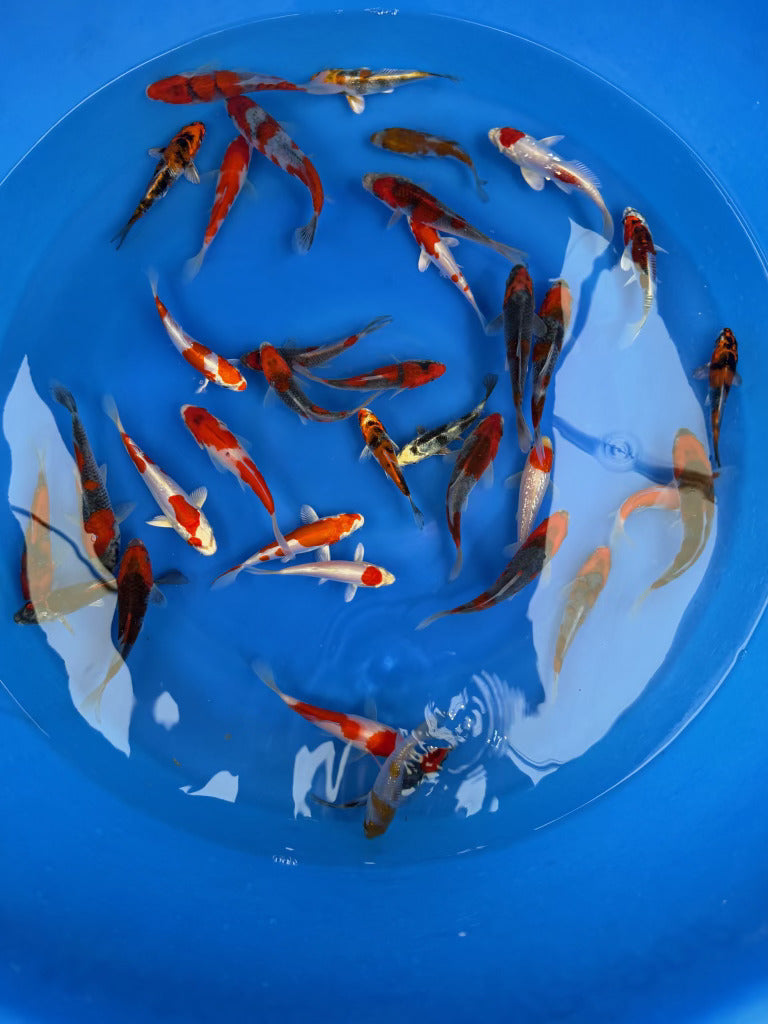
Ginrin is not a koi variety — it is a scale trait that makes each individual scale sparkle. Lay it over a Kohaku, a Showa, or a tea-brown Chagoi and every scale throws back its own flash of light as the fish turns. A metallic koi glows; a ginrin koi glitters, scale by scale. That distinction confuses more buyers than any other in the sparkle department, and it is the first thing this guide clears up.
Below: what ginrin actually is, how it differs from metallic (Hikari) koi, the four ginrin types you will hear named, which varieties carry the trait, how to judge it, and how to buy gin rin koi that keep their glitter as they grow.

Ginrin Koi at a Glance
| Trait | Ginrin koi |
|---|---|
| What it is | A reflective scale trait, not a variety — it overlays Kohaku, Showa, Chagoi, and most others |
| The metallic test | Ginrin sparkles scale by scale; a metallic (Hikari) koi glows in one continuous sheen |
| Types | Diamond, Pearl, Beta, and Kado ginrin — named for where the reflection sits on the scale |
| What to judge | The underlying koi first; then even, aligned sparkle down both flanks, one type head to tail |
| Care difference | None medically — but water clarity and gentle handling are what let the glitter show |
| Lifespan | Commonly 25 to 35 years with good care; longevity tracks care, not variety |
| Buying in | Multi-fish packages from $225; quarantine every arrival and stock to the adult size your pond can carry |
What Is a Ginrin Koi?
Gin rin (銀鱗, usually translated "silver scales") is a reflective quality in individual scales, layered over whatever colors and pattern the koi already has. Each ginrin scale reflects light on its own, so the effect builds with movement — a smooth ribbon of flashes sweeping along the flank as the fish turns under angled light. The trait is generally described as having been stabilized by Niigata breeders in the early twentieth century and bred into most major lines since; as with most koi history, treat the particulars as the standard account rather than documented fact.
Because ginrin is a trait rather than a variety, the name stacks: a Ginrin Kohaku is a Kohaku with sparkling scales, a Ginrin Chagoi is a Chagoi with them, and so on. At shows, ginrin fish are usually benched in their own class — the underlying variety is still judged, with the quality of the sparkle on top.
Ginrin vs Metallic Koi: The Difference That Matters
Ginrin sparkles; metallic glows. A ginrin koi's shine is scale-by-scale — crisp, separate flashes that move as the fish moves. A metallic (Hikari) koi such as a Yamabuki Ogon has a continuous foil-like sheen across the whole skin, fins included.
They are different traits, judged in different classes — and they can combine. A Ginrin Yamabuki carries sparkling scales over a metallic gold base: shine on top of shine. If a fish seems to glitter and glow at once, that is what you are looking at.
The Four Ginrin Types
Hobby usage names four expressions of the trait, by where the reflection sits on each scale — the ZNA’s own list runs longer:
- Diamond ginrin — a bright flash that fans out across each scale from where it seats; the boldest of the four.
- Pearl ginrin — a raised, bead-like point of reflection with a softer, pearlescent glint.
- Beta ginrin — the reflective area covers most of the scale for a near-continuous sparkle.
- Kado ginrin — the reflection concentrates along the leading edge of each scale.
Naming here is looser in practice than any list implies — dealers and judges vary, and some fish mix expressions. What quality fish share is consistency: one type, evenly expressed, head to tail.
Doitsu ginrin is the striking special case. A Doitsu (German-scaled) koi carries scales only in limited rows, usually along the dorsal line — so on a Doitsu ginrin fish, that single mirror-bright row stands against smooth skin. With so few scales, every one of them counts: tidy, uniform alignment matters more here than anywhere else.
Ginrin Across the Varieties
The stacked names are the ones you will meet in listings: a gin rin kohaku is a Kohaku carrying the sparkle, a gin rin chagoi is the tea-brown Chagoi with it, and a gin rin soragoi is the gray-blue member of the same earth-tone group.
The trait overlays most of the varieties you already know:
- Ginrin Kohaku — glitter over the red-and-white benchmark; see our Kohaku guide for what the underlying fish should look like.
- Ginrin Sanke and Ginrin Showa — sparkle over the three-color Sanke and black-based Showa. Kin Showa — a metallic-gold Showa — is the related metallic form you will see alongside them.
- Chagoi ginrin and the earth-tone family — a gin rin chagoi pairs the friendliest koi in the pond with a quiet, pearl-like shimmer, and the same effect carries across Soragoi and Ochiba, the chagoi-family cross with "fallen leaf" patches. These are the varieties that turn subtle colors into something you notice.
- Ginrin metallics — Ginrin Yamabuki and friends, the shine-on-shine combination above.
How to Judge a Ginrin Koi
Judge the koi before the glitter. Body conformation first, then skin and color quality, then pattern — the same order as any koi — and only then the sparkle. Strong ginrin on a weak fish is still a weak fish.
For the trait itself, look for three things under bright, angled light. Coverage: the sparkle should run evenly from head to tail, on both flanks, without dead patches. Alignment: the flashing scales should sit in neat rows, so the glitter reads as a ribbon rather than scattered twinkle. Consistency of type: one ginrin expression throughout, not a mix. And view the fish in motion — ginrin is a moving-light effect, and a bowl-side glance under flat light undersells it.
Care: What Actually Changes for a Ginrin Koi
Nothing, medically — a ginrin koi is whatever variety it is underneath, and the husbandry is the same as for any koi: volume, stable water, filtration sized above your bioload, all covered properly in our pond filtration basics guides. Two things reward extra attention.
Water clarity is the display. Suspended fines scatter light before it ever reaches the scales, and a ginrin koi in murky water is just a koi. Clean mechanical filtration and regular maintenance do more for the sparkle than anything you can feed.
Scales deserve gentle handling. A lost scale can regrow with weaker reflectivity, which matters on a fish whose scales are the show — soft, knotless nets, water-filled bowls for transfers, and minimal handling. On Doitsu ginrin fish, with so few scales, this goes double.
Feeding is standard koi feeding. Where color support is wanted, Nijikawa Color Genesis is our first recommendation — stronger underlying color reads brighter through the sparkle — with Nijikawa Growth Formula as the growing-season staple and the full range in koi food.
Showing Off the Sparkle
Ginrin is a directional-light effect, and most ponds never show it off. A few hours of angled sun crossing the water beats overhead noon light; for evenings, a side-mounted, diffused pond light raking across the fish reveals the scale-by-scale flash that top-down lighting flattens. If you photograph your koi, shoot slightly off-axis as the fish turns — that is the moment the whole flank lights up.

How Much Does a Ginrin Koi Cost?
A ginrin koi from a multi-fish package starts in the low hundreds, and individually selected show-grade fish climb from there — the underlying variety, size, and the evenness of the sparkle drive the price.
Where to buy ginrin koi from us
- Kanno Koi Farm — Metallic & Ginrin Tosai Packages, from $225 — bred in Yamakoshi, Niigata, by a farm specializing in metallic and ginrin varieties; the mix includes Kin Showa, Goshiki, Kikisui, Ginrin Kohaku, and Ochiba. Per-fish cost drops as the pack grows: at 5–6 inches, five koi work out to $45 each and ten to $39.50 each.
- Premium Yamabuki Ogon Japanese Koi Fish Package, from $215 — the metallic-gold side of the sparkle family, if the continuous glow is what you are after.
Hunting a specific combination — a gin rin chagoi, a Ginrin Showa, a Doitsu ginrin? Single-variety ginrin fish come and go quickly, so contact us and we will tell you what is actually in the building. You can also browse the wider Japanese koi selection or the full koi fish range.
Two things worth doing before you order a multi-fish package. Quarantine every new koi in a separate, filtered, aerated holding system for two to four weeks before it goes anywhere near your main pond — a group purchase means a group of new arrivals, and one unquarantined fish can take out an established collection. And size the group to your pond rather than to your enthusiasm: ginrin or not, these grow into the same large fish as any koi. Count the adult fish your volume and filtration can carry, then buy under that number.
Judging ginrin where you actually buy it
Ginrin is a light effect, and almost every place you evaluate one is bad for light. A shipping bag on a driveway, a dealer's vat at midday, a bowl under a canopy, your own pond after a week of rain — each lies about the sparkle in a different direction. Here is how to read it anyway.
In a bag or a bowl
Put the light behind you and slightly to one side, then tilt the container rather than chasing the fish. Ginrin flashes only when the angle between light, scale and eye passes through a narrow window, so a slow tilt tells you far more than staring straight down. What you want is the sparkle switching on in a band that travels along the flank as you tilt — that is even coverage. What you do not want is a handful of scales lighting while the rest stay dull.
In midday sun
Bright overhead sun flatters every ginrin koi, which makes it the worst light for comparing two. Everything sparkles at noon. If you are choosing between fish, ask to see them in shade or wait for cloud — a weak ginrin stops performing and a strong one still reads.
In cloudy or green water
Suspended solids kill the effect outright, so do not judge a gin rin koi in water you cannot see a hand through — and do not conclude your own fish has lost its sparkle until you have fixed the water. Clarity does more for ginrin than anything you can feed, which is why mechanical filtration and regular maintenance matter more on these fish than on most.
Red flags before you buy
Sparkle that stops at the shoulder or fades across the back half. Rows that wander rather than running in neat lines. Two expressions mixed on one fish — a patch of beta among diamond, say — which reads as noise from above. And missing or regrown scales in the ginrin rows: a lost scale can regrow with weaker reflectivity, and on a fish whose scales are the whole point, that gap does not fill back in.
Frequently asked questions
What is a gin rin koi?
A gin rin (or ginrin) koi is any koi carrying the sparkling-scale trait: each scale reflects light individually, producing a glittering, scale-by-scale flash as the fish moves. Ginrin is a scale trait rather than a variety — it overlays Kohaku, Showa, Chagoi, and most other varieties, and ginrin fish are usually benched in their own class at shows.
How do ginrin koi differ from metallic koi?
Ginrin koi sparkle scale by scale; metallic (Hikari) koi glow with one continuous sheen across the skin and fins. They are separate traits judged in separate classes, and they can combine — a Ginrin Yamabuki carries sparkling scales over a metallic gold base.
What is a gin rin kohaku?
A gin rin kohaku is a Kohaku — the red-and-white benchmark variety — carrying the sparkling-scale trait. It is judged as a Kohaku first, on shiroji, hi and pattern, with the evenness of the sparkle assessed on top. The same stacking gives you a gin rin soragoi, the gray-blue earth-tone fish with glitter.
What is a gin rin soragoi?
A gin rin soragoi is a Soragoi — the plain gray-blue earth-tone koi — carrying the sparkling-scale trait. Like its Chagoi cousin it is a calm, hardy, fast-growing fish, and the glitter lifts a color that otherwise reads as quiet from across a pond.
What is a ginrin chagoi?
A chagoi ginrin is a tea-brown Chagoi carrying the sparkling-scale trait — the friendliest, most hand-tame koi variety with a quiet, pearl-like shimmer over its earth tones. The same combination appears across the chagoi family, including Soragoi and Ochiba, the "fallen leaf" cross.
Will ginrin fade as the fish grows?
Well-bred ginrin stays visible for life, though the effect can soften as scales spread over a larger body. Stable water, good nutrition, and gentle handling protect it best — a scale lost to rough handling can regrow with weaker reflectivity.
What is Doitsu ginrin?
Ginrin on a German-scaled (Doitsu) koi, which carries scales only in limited rows — usually along the dorsal line. The result is a single mirror-bright row against smooth skin. Because there are so few scales, neat alignment and uniform shape matter more than on a fully scaled fish.
How do I pick a good ginrin koi?
Judge the underlying koi first — body, skin, color, pattern — then the sparkle: even coverage head to tail on both flanks, scales flashing in aligned rows, and one ginrin type throughout rather than a mix. View the fish moving under bright, angled light; flat overhead light hides the effect. If you buy a group, quarantine every new koi in a separate, filtered, aerated holding system for two to four weeks first, and stock to the adult fish your pond and filtration can carry.
Are there different types of gin rin scale patterns?
Yes — four are named in common hobby usage, and they are told apart by where the reflection sits on each scale rather than by which variety carries them. The ZNA's own list runs longer than four, so treat these as the names you will actually meet in listings rather than as a closed set. Diamond ginrin throws a bright flash that fans out across each scale from the point where it seats, and is the boldest of the four. Pearl ginrin shows a raised, bead-like point with a softer, pearlescent glint. Beta ginrin covers most of the scale for a near-continuous sparkle. Kado ginrin concentrates the reflection along the leading edge of each scale. The four are set out in detail in the section above. In practice the naming is looser than any list implies — dealers and judges vary, and some fish mix expressions — so what matters more than the label is that one type runs evenly from head to tail.
Do gin rin scales change appearance with age?
A scale does not change from one ginrin type into another, but the effect does shift as the fish grows. Ginrin is expressed scale by scale, so as the body enlarges the scales spread and the sparkle softens and separates — denser and finer on a young fish, coarser and more individual on an adult. Ginrin rows are generally taken to be set early, so a koi showing two or three rows as a tosai is not usually expected to add more later — though, as with much of this taxonomy, that is the standard account rather than a documented rule. The change worth actively guarding against is physical rather than developmental: a scale lost to rough handling can regrow with weaker reflectivity, which is why soft, knotless nets and minimal handling matter more on a gin rin koi than on most.