
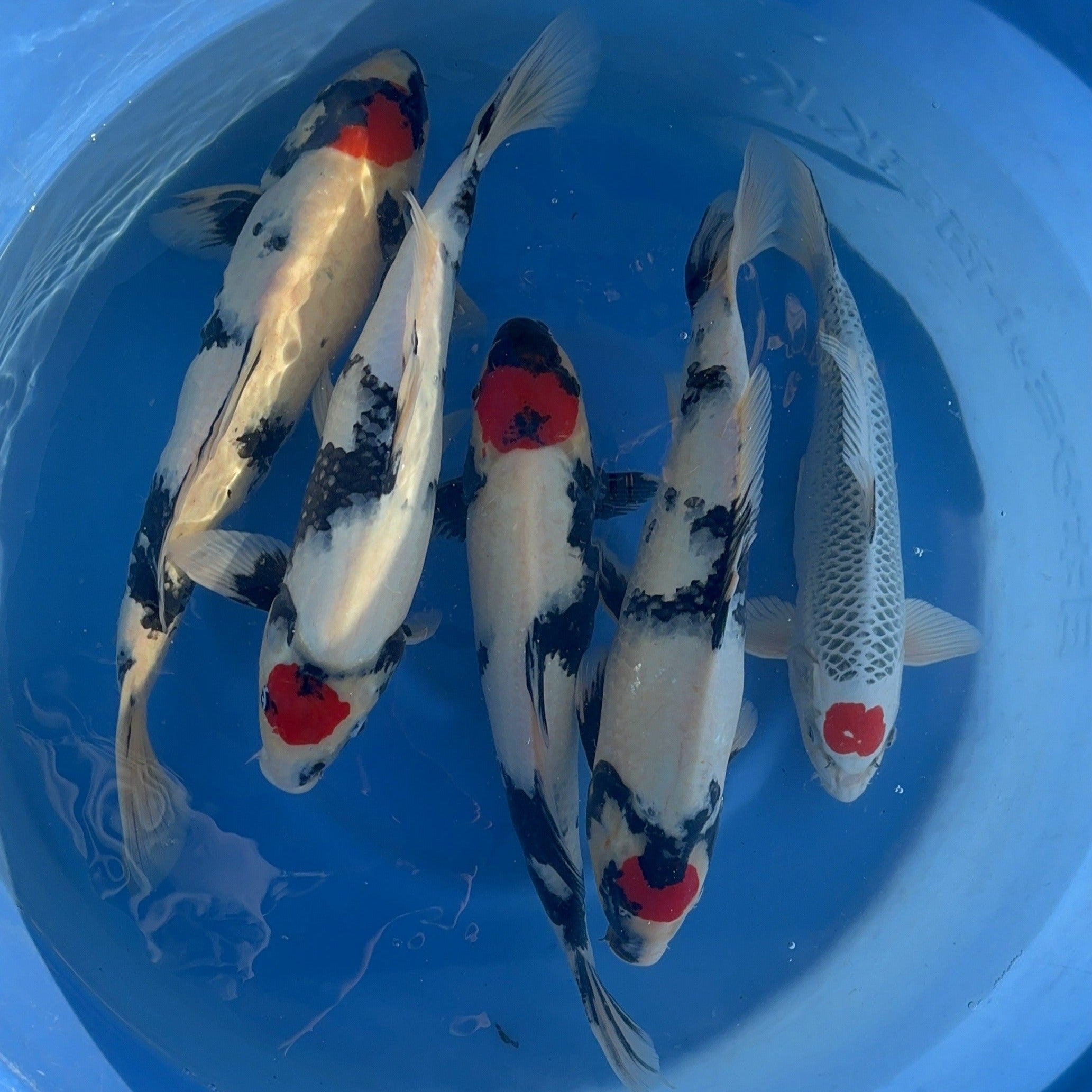
A Tancho is among the easiest koi to recognize and one of the hardest to buy well. One red circle on a white head, nothing else — and the entire value of the fish rests on a marking that took no skill to spot and a great deal of luck to produce.
This guide covers what a Tancho actually is, why the pattern cannot be bred to order, how to judge a crown, whether the marking will still be there in five years, and what to look for when you are buying one for a backyard pond rather than a show bench.

Tancho koi at a glance
| Trait | Tancho |
|---|---|
| What it is | A marking, not a variety — a single red (hi) crown on the head with no red anywhere on the body |
| Carried by | Kohaku, Sanke, Showa, Goshiki, Kujaku and others |
| The disqualifier | Any red on the body. One scale of body hi and it is not a Tancho |
| Judged | Tancho Kohaku, Sanke and Showa bench in their own Tancho class at most shows; rarer bases bench with their own variety |
| The ideal crown | Round, centered, sitting between the eyes without touching them |
| Biggest buying risk | The crown can shrink, spread or soften with age — most on young fish |
| Care difference | None. Standard koi husbandry; the white just shows problems sooner |
| Buying in | Single 16–20 inch Tancho Showa from $1,340; mixed tosai packages from $235. Quarantine every arrival and stock to the adult size your pond can carry |
What is a Tancho koi?
Tancho is a marking, not a variety. The same way ginrin describes sparkling scales laid over whatever fish is underneath, tancho describes a solitary red marking confined to the head — and the koi underneath can be a Kohaku, a Sanke, a Showa or something else again. When someone says they keep a koi tancho, the useful follow-up question is always "a tancho what?"
The rule that defines it is strict and worth stating plainly, because it is the one buyers get wrong: red on the head only. A single scale of hi anywhere on the body and the fish is not a Tancho — it is simply a Kohaku, Sanke or Showa with head hi, and it benches as one. Maruten is a different thing again: a distinct, separate crown on the head in addition to a body hi pattern. That strictness is most of why good Tancho are scarce.
Listings are inconsistent about word order, and it costs people fish. The same koi is sold as a tancho koi, a koi tancho, a kohaku tancho and a Tancho Kohaku, depending on who wrote the listing. If you are searching for tancho koi for sale and only trying one word order, you are missing stock. Search both ways.
Where the pattern comes from
The name is Japanese: 丹頂, tanchō, roughly "crimson crown." It is borrowed from the tanchōzuru, the Japanese red-crowned crane, a bird with a bare patch of red skin on the crown of its head and one of the most culturally loaded animals in Japan — a symbol of longevity and good fortune that appears in art, on kimono and, historically, in wedding imagery.
The visual coincidence that made the koi famous is a different one. A red disc centered on a white field is the Japanese flag, and a Tancho Kohaku viewed from above is very nearly that flag with fins. There is no evidence anyone bred toward it deliberately — the marking appears as a natural outcome in Kohaku bloodlines — but the resemblance is why this is one of the most recognizable koi in the world, and why a good one carries a premium beyond what the pattern alone would justify.
The Tancho varieties
Because tancho is an overlay, the sub-names describe the fish underneath the crown.
| Name | The fish under the crown | What separates it |
|---|---|---|
| Tancho Kohaku | A Kohaku — white body, no other markings | The purest form. Nothing but white skin and one red crown, so nothing hides a flaw |
| Tancho Sanke | A Sanke — white body carrying sumi | Black on the body. That body sumi is exactly what distinguishes it from a Tancho Kohaku |
| Tancho Showa | A Showa — black-and-white body pattern | Bold, wrapping sumi under the crown. The most dramatic of the three |
| Ginrin Tancho | Any of the above, carrying the ginrin scale trait | Even, aligned rows of sparkle. The glitter should frame the crown, not compete with it |
| Tancho Goshiki, Tancho Kujaku | Goshiki or Kujaku base | Less common. The crown is read the same way, but these bench with their base variety rather than in the Tancho class |

A ginrin tancho is the one most often mispriced in both directions. The sparkle is genuinely attractive and genuinely adds value, but it also distracts the eye from the crown — and the crown is what you are buying. Assess the head marking first with the sparkle deliberately ignored, then decide what the ginrin is worth to you. Our complete guide to ginrin koi covers how to read the scale trait itself.

How to judge a Tancho crown
Judge the body before the crown. This is the rule across every guide in this series and it applies with particular force here, because a Tancho tempts you to buy a marking and ignore the fish carrying it. A perfect circle on a mediocre body loses to a slightly imperfect crown on an excellent one, every time. Check that the koi is thick through the shoulder, symmetrical viewed from above, and carries a strong caudal peduncle. Then look at the head.
Shape
A clean circle is the classical ideal. Ovals, hearts and slightly irregular crowns have their admirers and can be genuinely charming, but they do not win, and they resell for less. What matters more than the exact outline is that the shape reads as deliberate rather than accidental.
Placement
The crown should sit centered between the eyes. It should not touch the eyes, run into the nostrils, spill onto the mouth, or reach back over the gill plates. A crown sitting off to one side is the most common fault, and it is very visible from above — which is how you will actually look at the fish for the next twenty years.
Edge quality
The border between red and white should be sharp enough to look cut. A hard edge is the best single sign that a crown has stopped moving. Read a soft edge carefully rather than as a verdict: on a young fish a slightly blurred border often tightens as the fish matures, while thin, patchy red usually does not improve. Density is the more reliable warning of the two.
Depth and evenness
The red should be even and saturated across the whole crown, with no thin patches showing white through it. Uneven density is the other tell that a marking is unsettled.
The white
On a Tancho Kohaku there is nowhere for a flaw to hide — the fish is one unbroken field of white with a single accent. The shiroji should be the color of fresh snow under water, with no yellow cast along the back and no gray in the head. Buyers routinely fall for a beautiful crown on yellowed white and regret it, because the white is most of the fish's surface area.
Are Tancho rare, and why?
Rare in the sense that matters: you cannot breed for one reliably. The tancho marking is not produced by a dedicated bloodline that throws crowned fish on demand. It appears as an outcome within ordinary Kohaku, Sanke and Showa spawnings, and it appears at low rates — a breeder raising fish for pattern finds relatively few usable Tancho in a spawning, and most of those have the crown in the wrong place, the wrong shape, or touching something it should not touch.
Then the fish still has to grow up without the marking moving. That second filter removes most of what survived the first. The result is that a genuinely good adult Tancho is scarce not because the pattern is exotic but because the pattern plus placement plus stability plus a good body is a rare combination, and while proven parents raise the odds, no breeder can make it reliable.
What this means practically: a standing listing at a set size and grade is normal and fine, but be skeptical of anyone claiming a deep, constant supply of show-grade individual Tancho, because that is not how the fish are produced.
Do Tancho markings change as the fish ages?
Yes, and this is the single most important thing to understand before spending money on one.
A crown on a tosai is a forecast, not a fact. Hi markings on young koi consolidate, spread, thin and recede as pigment settles, and a tancho crown does all of those things — it can shrink toward a smaller circle, blur at the edge, drift off-center as the head grows, break up, or in some cases disappear almost entirely. The reverse also happens: a soft, unpromising smudge on a one-year-old can harden into a clean crown by three.
Stability arrives with age. By sansai the marking is largely what it will be, which is why mature Tancho cost disproportionately more than their size alone explains — you are paying to narrow the odds, not to eliminate them. Water quality, diet and sun exposure all influence how well a crown holds, but none of them will rescue a marking that was never stable.
The practical rule: if the crown is the reason you are buying the fish, buy an older fish. If you want the grow-out gamble, buy young and cheap, and choose on body and edge quality rather than on how the circle looks today.
What to look for when buying a Tancho koi
Almost all published Tancho advice is written for the show bench. In a backyard pond you are buying a fish you will look down at, in daylight, for decades. The questions are narrower.
Look from above, not from the side
A Tancho is a top-down fish. Ask to see it in a bowl or from above in the vat, not through the side glass of a tank, because crown placement and symmetry only read properly from that angle — and that is the angle you will own.
Buy the body, then the crown
Say it twice because everyone forgets it in front of a good crown. Conformation first.
Match the age to your appetite for risk
Buying a koi tancho young is the cheap way in, and the pattern will move. Nisai, roughly 10 to 14 inches, is the sweet spot for most home ponds — enough stability to judge, still growing into the body, still affordable. Our Premium Gosanke packages carry single 12 to 14 inch fish at $649.98 if that is the band you want. Sansai and older is what you buy when you want the crown you can see to be the crown you keep.
Check the disqualifier yourself
Look for any red on the body, including under the pectorals and near the tail. Sellers do not always catch it, and one stray body marking means you are paying a Tancho price for a fish that benches as an ordinary Kohaku, Sanke or Showa.
Ignore the sparkle while you judge
On a ginrin tancho, evaluate the crown as if the scales were plain, then add the ginrin back in.
Where to buy a Tancho koi from us
The tancho koi for sale on our site come in two shapes: a standing listing at a set size and pack count, and one-of-a-kind individual fish that appear and sell. Because the marking cannot be produced to order, the second kind is genuinely different week to week.
- Premium Japanese Tancho Showa Koi Fish, from $1,340 for a single 16 to 20 inch fish. This is our standing Tancho listing and the one to start with if you want a finished statement fish rather than a grow-out project. Two and three-koi options work out lower per fish — $1,172.50 and $1,116.67 respectively — if you are stocking rather than buying one.
- Premium Gosanke Japanese Koi Fish Packages, from $335 for three 6 to 8 inch fish. All three Gosanke varieties in one box at roughly $112 a fish, which is the cheapest way to train your eye on what separates them. Note that the pack is selected for Gosanke rather than for tancho, so a crowned fish in it is luck rather than a promise.
- Maruhiro Koi Farm Mixed Tosai Variety Packages, from $235 for five 5 to 6 inch koi — about $47 a fish, or $41.50 in the ten-koi pack. This is the one mixed pack we tag for tancho, so if you want to take the grow-out gamble on several at once, take it here rather than in a Gosanke box.
- Marudo Koi Farm Kohaku and Sanke Pattern Packages, from $675 for three 10 to 12 inch koi — about $225 a fish. Larger, further along, and the right pool if you want a Kohaku or Sanke base rather than a Showa one.
Looking for one particular fish — a kohaku tancho with a textbook crown, a ginrin tancho, or a Tancho Goshiki? Those arrive in ones and twos and sell quickly — there is a single Tancho Kujyaku listed at $1,600 as we write this, and when it goes it is gone. Browse the Japanese koi selection for what is listed right now, or ask us what has just landed. The wider koi fish range is worth a look too if you are still deciding on variety.
Before you order any multi-fish package, two conditions, and neither is optional. First, quarantine every new koi in a separate, filtered, aerated holding system for two to four weeks before it goes anywhere near your main pond — a group purchase is a group of new arrivals, and one unquarantined fish can take out an established collection. Second, size the group to your pond rather than to your enthusiasm: koi grow into large fish, so count the adult fish your volume and filtration can carry, then buy under that number.
Caring for a Tancho
There is no such thing as Tancho-specific husbandry. The water chemistry, filtration sizing and seasonal routines are the same as for any koi, and our pond filtration basics guides cover those properly rather than repeating them here.
Two things do change in practice, and both come from the same fact: the fish is mostly white.
Sustained poor water dulls shiroji and warms it toward cream, and on a Tancho that is not a cosmetic footnote — the white is most of what you see. A Tancho in a neglected pond looks wrong long before it looks sick, which is genuinely useful early warning if you read it that way. Read it as a slow gauge, though, not as a monitor: shiroji dulls over weeks, while an ammonia spike or a summer oxygen crash does its damage in hours. A white fish still looking clean is not evidence the water is fine — test it.
Color food is the other. Foods that deepen red will deepen the crown, and fed too hard or year-round they also warm the white ground toward yellow — trading the thing you bought for the thing that surrounds it. Feed color support seasonally rather than constantly, and let the crown be as red as it is.
Heavy direct sun over long summer days has a similar effect on the white. Some shade over part of the pond, from planting or a structure, protects shiroji on every white-bodied koi and costs nothing.
Next in this series: our complete guide to Kohaku, Sanke and Showa — the three varieties that carry the tancho crown most often.
Frequently asked questions
How do you pronounce "Tancho koi"?
Tahn-choh, with the second vowel held long — that is what the macron in tanchō marks, and it is the part English speakers usually clip. It is written 丹頂 in Japanese and means roughly "crimson crown." The koi takes the name from the tanchōzuru, the Japanese red-crowned crane.
What makes Tancho koi distinct from other koi varieties?
Tancho is not a variety at all — it is a marking that can appear on several varieties, which is what makes it distinct. Every other name in koi describes the fish; tancho describes one red crown on the head of a fish that is otherwise defined by something else. The defining rule is that the red appears only on the head. Any hi on the body and it is not a Tancho.
Are there different types of Tancho patterns?
Yes, and they are named for the koi underneath. Tancho Kohaku is a white fish with the crown and nothing else. Tancho Sanke adds sumi on the body. Tancho Showa carries a full black-and-white Showa pattern beneath the crown. A ginrin tancho is any of those carrying the sparkling-scale trait, and rarer bases like Tancho Goshiki and Tancho Kujaku turn up occasionally. The crown is read the same way on all of them, though only the Kohaku, Sanke and Showa bases bench in the Tancho class.
What is the origin of the Tancho koi pattern?
The marking arises naturally in Kohaku, Sanke and Showa bloodlines rather than from a dedicated Tancho line — it is an outcome of ordinary pattern breeding that breeders select for after the fact rather than a trait they can reliably produce. The name comes from the Japanese red-crowned crane, which carries a patch of red on its crown.
Do Tancho koi have any cultural significance?
Considerable. The crane it is named for is one of Japan's enduring symbols of longevity and good fortune, and the koi's own resemblance to the Japanese flag — a red disc centered on white — gives it a national association no other koi has. That symbolism is a real part of why Tancho are sought after, and why they are a common choice as the single feature fish in a pond.
Are Tancho koi rare?
Good ones are, and for a specific reason: the pattern cannot be bred to order. Tancho appear at low rates within ordinary Gosanke spawnings, and most that appear have the crown misplaced, misshapen, or touching the eyes or gill plates. The survivors then have to keep the marking through several years of growth. It is the combination, not the pattern, that is scarce.
How common are single-spot Tancho koi in ponds?
Common as a sight, uncommon as a good example. Because Tancho is one of the most recognizable koi patterns there is, a great many ponds contain one, and inexpensive Tancho-marked fish are widely available. Most tancho koi for sale at the cheap end are exactly that. What is uncommon is a mature fish with a round, well-centered, hard-edged crown on clean white and a good body — that combination is what people are actually paying for when a Tancho is expensive.
Are Tancho koi considered valuable compared to other koi?
At the top of the market, yes, and disproportionately so, because scarcity and instant recognizability stack. At the entry level a Tancho-marked young fish costs about what any other young Gosanke costs, since nobody yet knows whether the crown will hold. Our own catalog shows the spread: Tancho-marked young fish turn up in mixed tosai packages from $235, and a finished 16 to 20 inch Tancho Showa starts at $1,340. If you buy a package, quarantine every new koi in a separate, filtered, aerated holding system for two to four weeks, and stock to the adult size your pond and filtration can carry rather than to the size the fish arrive at.
Can Tancho markings change as the fish ages?
Yes. On young fish the crown routinely shrinks, spreads, softens at the edge or drifts off-center as the head grows, and it can occasionally fade almost entirely. Markings largely settle with maturity, so a sansai crown is mostly what you will keep while a tosai crown is a forecast — though hi keeps moving slowly for years, and stability tracks steady conditions as much as age. If the crown is why you want the fish, buy an older one; a hard, clean edge is the best early sign that a marking has stopped moving.
What should I look for when buying a Tancho koi?
Body first, then the crown — a perfect circle on a poor body is a poor fish. Then check placement (centered between the eyes, not touching eyes, nostrils, mouth or gill plates), edge sharpness, even depth of red, and clean white with no yellow along the back. View the fish from above, because that is how a pond koi is seen. And check the body for any red at all, since one stray marking means it is not a Tancho — it benches as an ordinary Kohaku, Sanke or Showa instead.