
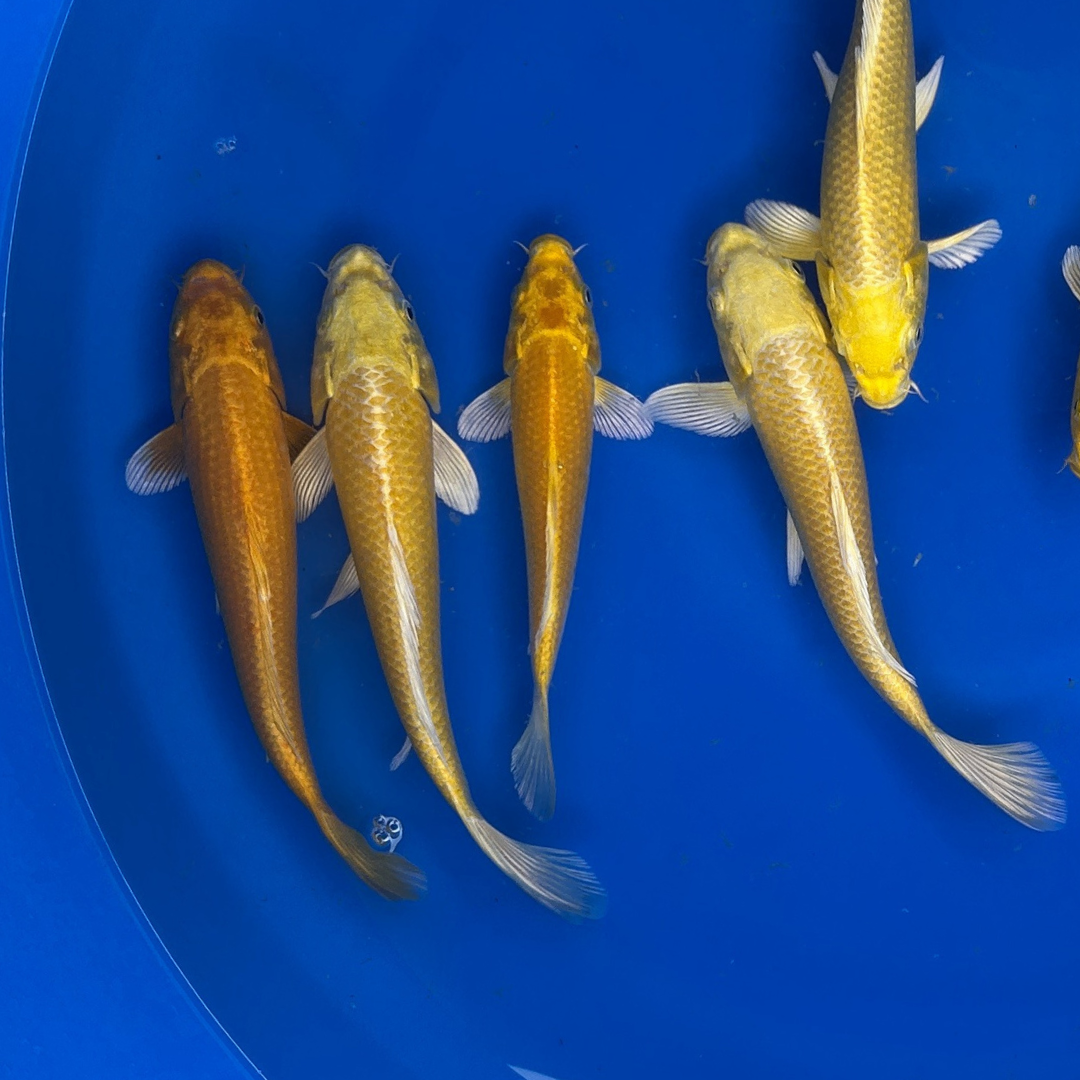
A Yamabuki Ogon is a single-color metallic koi in golden yellow. No pattern, no markings, no second color — just one unbroken sheet of metallic yellow from nose to tail. That sounds like the easy variety to buy. It is the opposite: with nowhere for a flaw to hide, a Yamabuki Ogon is judged almost entirely on skin quality and body shape, and those are the two things a photograph hides best.
This guide covers what a Yamabuki Ogon actually is, how it differs from the Kigoi it gets confused with, how to judge one, what it costs, and how to choose a Yamabuki Ogon koi fish that stays bright as it grows.

What Is a Yamabuki Ogon?
A Yamabuki Ogon (山吹黄金) is a metallic, single-color koi in golden yellow. The name is two words doing two jobs. Yamabuki is the Japanese kerria flower, whose bright golden-yellow bloom is the reference for the color. Ogon means gold, and in koi it signals the metallic sheen — a genuine reflective quality in the scale, not just a bright color.
Formally it sits in the Hikarimuji class: hikari for shining, muji for plain or single-colored. Everything in that class is one metallic color with no pattern, which makes them a completely different judging problem from the patterned Gosanke varieties. If you are coming from Kohaku or Sanke, put the pattern vocabulary down. None of it applies here.
Ogon koi are generally traced back to work by Sawata Aoki in the first half of the twentieth century, developing metallic koi from a wild carp carrying golden markings. As with most koi history, that account comes from dealers and hobbyists rather than any register, so treat it as the standard version rather than documented fact.
Search phrasing for this variety is all over the place. A yamabuki koi, a Yamabuki Ogon and a plain golden koi are the same fish, and the odder strings people type — "golden koi of the deep" among them — land on the same variety. If you are comparing sellers, try more than one phrasing: stock filed under yamabuki koi will not surface under golden koi of the deep, and vice versa.
Yamabuki Ogon Koi at a Glance
| Trait | Yamabuki Ogon koi |
|---|---|
| Variety type | Single-color metallic koi in golden yellow; no pattern, benched in Hikarimuji |
| What to judge | Body shape first, then even head-to-tail luster, then unblemished skin |
| The Kigoi test | Yamabuki is metallic and reflects light; Kigoi is matte and paler |
| Temperament | Confident and food-motivated; often the first koi in a pond to hand-feed |
| Growth and stocking | Ogon have a reputation for growing large — stock to adult size, not purchase size |
| Lifespan | Commonly 25 to 35 years with good care; longevity tracks care, not variety |
| Care difference | Same husbandry as any koi — a solid-gold fish simply shows problems earlier |
| Buying in | Multi-fish packages from $215; quarantine every new arrival before the main pond |
Yamabuki Ogon vs Kigoi: The Difference That Matters
A Yamabuki Ogon is metallic. A Kigoi is not. That is the whole answer, and it is the single most common point of confusion in yellow koi.
Both are yellow, single-color, patternless koi. Side by side in a bowl the difference is obvious and hard to photograph: the Yamabuki throws light back at you, and the Kigoi does not. A few practical tells:
| Feature | Yamabuki Ogon | Kigoi |
|---|---|---|
| Finish | Metallic, reflective | Matte, non-metallic |
| Color | Deeper golden yellow | Paler, lemon to pale yellow |
| Fins | Typically carry the same metallic sheen | Plain, often translucent |
| Show class | Hikarimuji (metallic single-color) | Kawarimono (the catch-all class) |
| Eyes | Normal dark eyes | Occasionally red-eyed, in the rare Akame Kigoi form |
They are benched in different classes at shows, so this is not a pedantic distinction — the two fish are judged against different standards and different competitors. And if it is the matte Kigoi you actually want rather than the metallic, contact us about availability.
The Rest of the Ogon Family
Yamabuki is one color option in a family of metallic single-color Ogon koi. If you like the look but not the yellow, the family is worth knowing:
- Platinum Ogon (also called Purachina) — metallic white. The other most popular Ogon, and arguably the hardest to keep looking clean.
- Orenji Ogon — metallic orange, deeper and warmer than Yamabuki.
- Nezu Ogon — metallic gray, named for the mouse-gray tone, and usually softer in shine than the other Ogon.
- Cream Ogon — a paler, softer metallic between platinum and yellow, and comparatively rare.
Add scale variations on top and you get further names. A Ginrin Yamabuki Ogon carries sparkling ginrin scales over the metallic base — shine on top of shine. A Doitsu Yamabuki Ogon is German-scaled, so the metallic finish sits on smooth skin broken only by mirror scales in limited rows, and reads much sleeker.
A practical note on availability: the metallic varieties move in and out of stock constantly, and at any given moment we usually hold Yamabuki and ginrin metallics rather than the full color range. If you have your heart set on a Platinum, Orenji, Nezu, Cream or a Doitsu Ogon, contact us rather than assuming — what is in the building changes faster than any guide can.

How to Judge a Yamabuki Ogon
With no pattern to assess, judging collapses onto three things: body, luster, and evenness. That makes Ogon deceptively hard — there is nothing to distract the eye from a flaw.
Body conformation comes first
As with every koi, body leads: a clean torpedo shape, width through the shoulder, symmetry, and a strong tail tube. On a patternless fish this matters even more, because body shape is most of what you are actually looking at.
Luster must be even
The metallic sheen should run consistently from the head to the tail, and onto the fins. The most common fault is a fish that shines beautifully across the shoulder and then goes flat toward the tail. Look along the fish rather than at it, and look in daylight — metallic koi flatter themselves under artificial light.
Color should be uniform, and the skin unblemished
You want one consistent shade of gold across the whole body, without patches, banding, or a paler belly line breaking it up. Any dark speck (shimi) is a visible fault on a single-color fish in a way it rarely is on a sumi-heavy Showa, where a stray speck disappears into the pattern. Check the head too: on many Ogon the head is the first place to look dull or discolored.
Fins finish the fish
Pectoral fins should carry the same metallic quality as the body. Fins that look plain or washed out against a bright body drag the whole impression down.
Care: What Actually Changes for a Metallic Koi
The husbandry for a Yamabuki Ogon is the same as for any koi — volume, stable water, and filtration sized above your bioload, all of which our pond filtration basics guides cover properly. Two things are genuinely different for a metallic single-color fish.
Nothing hides. On a patterned koi, minor skin problems and blemishes disappear into the pattern. On a solid gold fish, every mark is visible from across the garden. That is not a health difference — it is a visibility difference, and it makes an Ogon an unusually good early-warning system for water quality. If your Yamabuki looks dull, check the water before you check anything else.
Color food is a real trade-off here. Color-enhancing foods push warm tones, which can deepen a Yamabuki's gold. Pushed too hard they can also tip the yellow toward orange or muddy the clean metallic look you paid for. Feed it seasonally rather than year-round and watch the fish.
Nijikawa Color Genesis is our first recommendation where color support is wanted. For young fish you are growing on, Nijikawa Growth Formula is the better default, and Nijikawa Four Seasons covers shoulder-season temperatures. The full range is in koi food.
One welcome quirk: Ogon have a strong reputation among keepers for being confident, food-motivated, and among the first fish in a pond to hand-feed. If you want a pond that comes to greet you, a metallic koi is a good bet.
Troubleshooting: When the Gold Loses Its Shine
On a patterned koi these problems hide in the pattern; on a Yamabuki Ogon koi they are the first thing you see from across the garden. Use that. The fish is the pond's early-warning light, and almost every appearance problem below is a husbandry signal rather than a disease.
The sheen has gone dull
Check the water before you check the fish. Poor water usually shows on a metallic koi as dulled luster before anything else looks wrong — usually, not always, so treat a dull fish as an early warning and a bright one as no guarantee. Test for ammonia, nitrite and nitrate first, then correct with water changes and a look at whether your filtration still matches your stocking. Two caveats before you conclude anything: assess in daylight, because artificial light both flatters and falsifies shine, and remember the head often dulls first and hardest with age on Ogon, which is a trait rather than a warning.
The yellow is drifting toward orange
The usual cause is color-enhancing food fed too hard for too long — the same carotenoid push that deepens gold eventually warms it past gold. Ease the color food back to seasonal use and the drift generally stops where it is. Some deepening with age is also normal genetics; what diet did not cause, diet will not undo.
The gold looks washed out or patchy
Prolonged direct sun with no cover is commonly blamed for paling and patching yellow skin over a season, and stress genuinely does the same faster — new arrivals in particular often look their worst in the first weeks while they settle. Give the pond some shade (floating pond plants are the simple version), keep the water stable, and judge a new fish after it has settled, not out of the shipping bag.
Dark specks are appearing
Small dark flecks (shimi) show on a solid gold fish in a way a sumi-heavy Showa simply hides. Keepers commonly attribute them to water quality, age, and genetics, and stable, clean water is the main lever you actually have — existing specks often stay. They are a cosmetic fault, not an illness — but if a mark is raised, sore-looking, or paired with a change in behavior, that is no longer a color question: have a koi-experienced vet or dealer look at the fish rather than reaching for pond-store remedies.
The behavior changed, not just the color
Color problems are cosmetic; behavior problems are not. Gasping at the surface or crowding the waterfall usually points at oxygen or water trouble — aerate and test before anything else. Flashing (scraping against surfaces) is an irritation signal worth watching. A fish that stops eating, clamps its fins, or hangs apart from the group is telling you something is genuinely wrong: check the water first, and if it does not resolve quickly, bring in a koi-experienced vet or dealer. These are indicators, not diagnoses — but on a fish this visible, you will see them early. Use that head start.
How Much Does a Yamabuki Ogon Cost?
A Yamabuki Ogon koi fish from a multi-fish package starts in the low hundreds. Individually selected show-grade fish climb steeply from there, and the very best metallic koi reach figures most keepers will never need to think about.
What moves the price on this variety specifically:
- Size and age. The biggest factor on any koi. A fish that has already put on size is carrying years of a breeder's food, space, and risk.
- Luster quality. The single most expensive attribute here. Bright, even, head-to-tail shine is what separates tiers.
- Skin cleanliness. On a single-color fish there is nowhere to hide a blemish, so clean skin carries a premium it would not on a patterned koi.
- Scale variation. Ginrin and Doitsu forms are usually priced above the equivalent standard-scaled fish.
- Package versus single fish. Buying a pack is generally the cheaper route to several fish, but per-fish cost is not uniform across sizes and pack counts — compare the variants on the product page before you choose, because the cheapest pack is not always the cheapest per fish.
Where to buy a Yamabuki Ogon from us
Two ways to buy a Yamabuki Ogon koi fish from us, both multi-fish packages:
- Premium Yamabuki Ogon Japanese Koi Fish Package, from $215, in a range of sizes and pack counts.
- Kanno Koi Farm — Metallic & Ginrin Tosai Packages, from $225, if you want ginrin scale variation alongside the metallic base.
You can also browse the wider Japanese koi selection or the full koi fish range.
Two things worth doing before you order a multi-fish package. Quarantine every new koi in a separate, filtered, aerated holding system for two to four weeks before it goes anywhere near your main pond — a group purchase means a group of new arrivals, and one unquarantined fish can take out an established collection. And size the group to your pond rather than to your enthusiasm: koi grow into large fish, and solid-colored varieties like Ogon have a reputation for growing large. Count the adult fish your volume and filtration can carry, then buy under that number.

Choosing a Yamabuki Ogon Koi That Stays Bright
Two pieces of buying advice specific to this variety.
Judge the luster, not the color. A young Ogon's gold deepens with age and good feeding, but shine is largely what it is. A dull fish rarely becomes a bright one. Given a choice between a deeper yellow with flat skin and a paler fish that genuinely gleams, take the gleam.
Look for what will show later. Because there is no pattern to develop, an Ogon changes less dramatically over its life than a Sanke or a Showa does. That cuts both ways: less upside surprise, but far less risk. If the unpredictability of Gosanke sumi is what puts you off, an Ogon is the variety that shows you what you are buying.
Frequently asked questions
What is Yamabuki Ogon?
A Yamabuki Ogon is a metallic, single-color koi in golden yellow, with no pattern or markings. The name combines yamabuki, the Japanese kerria flower whose golden bloom gives the color its reference, and ogon, meaning gold. It is judged in the Hikarimuji class, which covers metallic single-colored koi.
What is the difference between Kigoi koi and Yamabuki Ogon koi?
A Yamabuki Ogon is metallic and a Kigoi is not. Both are yellow, single-color, patternless koi, but the Yamabuki has a reflective sheen in the scale while the Kigoi has a matte finish and is usually a paler, more lemon yellow. They are also benched in different show classes: Yamabuki Ogon in Hikarimuji, Kigoi in Kawarimono.
How much does a Yamabuki koi fish cost?
A Yamabuki Ogon koi fish from a multi-fish package starts in the low hundreds, and individually selected show-grade fish climb steeply from there. Size and age drive price most, followed by luster quality and skin cleanliness. Per-fish cost is not uniform across pack sizes, so compare the variants before choosing. If you buy a group, quarantine every new koi in a separate, filtered, aerated holding system for two to four weeks first, and size the group to the adult fish your pond and filtration can carry.
What is a "golden koi of the deep" — is that a real variety?
No. "Golden koi of the deep" is a search phrase rather than a variety name, and it lands people on the Yamabuki Ogon: the metallic golden-yellow koi. If you searched golden koi of the deep and arrived here, this is the fish you were looking for.
What are the identifying features of a golden metallic koi?
An even metallic shine running from head to tail and onto the fins, one uniform shade of gold with no patches or banding, and skin free of dark specks. Because there is no pattern, body conformation and skin quality carry almost the entire assessment.
What water conditions best showcase the color of golden koi?
Stable, well-filtered water does more for a metallic koi's appearance than anything you can add to the pond. Because a single-color fish hides nothing, dulling is usually the first visible sign that water quality has slipped. Assess the fish in daylight rather than under artificial light, which flatters shine.
Do Yamabuki Ogon get along with other koi?
Yes. Ogon are ordinary koi in temperament and mix comfortably with other varieties, with a reputation for being confident and among the first to hand-feed. The real constraints are capacity and biosecurity rather than compatibility: stock to the adult size your pond volume and filtration can carry, and quarantine every new koi in a separate, filtered, aerated holding system for two to four weeks first.
Are Yamabuki Ogon good for beginners?
They are an easy fish to keep and a hard fish to judge. The husbandry is the same as any koi, and their confidence makes them rewarding in a garden pond. Buying one well is harder than it looks, because with no pattern to admire, everything rests on body shape and skin quality.
What is the typical lifespan of a metallic yellow koi in a pond?
The same as any other koi: 25 to 35 years in a well-run pond, and longer is possible. Metallic varieties are not shorter-lived than patterned ones. What gets a Yamabuki Ogon there is what gets any koi there — enough water volume for the adult fish rather than the one you bought, filtration sized above your bioload, a pond deep enough to overwinter without freezing through, and every new arrival held first in a separate, filtered, aerated holding system for two to four weeks. What differs is only how visibly this fish ages: a Yamabuki Ogon being kept badly announces it in the skin long before anything else shows, because dull, uneven metal is the first thing to go when water quality slips.
How can you tell the age of a metallic yellow koi?
You cannot, precisely, and neither can the person selling you one — so buy on condition rather than on a claimed age. Koi carry no reliable external age marker, and size depends on feeding, water temperature and pond volume as much as on years, so a well-grown two-year-old can outsize a neglected five-year-old. What you can read on the fish is maturity: full body depth, a broad head, thickened shoulders and finished, even luster mean an adult, while a slender body and thin, still-developing metal mean a young fish that will change a great deal yet. What to ask the seller for is the size class and the year class, which is what a reputable dealer actually tracks. Scale-ring analysis can estimate a koi's age, but it needs a removed scale and a trained reader, so it is not something to do to your own koi and not something anyone does at the point of sale.
What care differences exist between solid-color metallic koi and patterned koi?
The husbandry is identical — same water parameters, same filtration, same feeding logic. Two things change in practice, and both are things you do rather than things you buy. First, diet: color food deepens a yamabuki ogon koi fish’s gold, but fed too hard for too long it pushes the yellow toward orange, which is a defect in this variety — so feed it seasonally rather than year-round, with a plain staple or growth food as the everyday diet. Second, tolerance for error: a solid metallic fish has nowhere to hide a blemish. Every scale sits in an unbroken field, so one damaged scale, a patch of dull metal or a smudge of dark pigment reads immediately, where the same flaw on a Kohaku or a Showa would disappear into the pattern. In practice that means gentler netting and handling, and treating any dulling as a reason to test the water rather than as cosmetic bad luck.
How do breeding methods affect the color of metallic koi?
Enough that it should change where you buy. Luster and yellow depth are both heritable, and breeders select for them separately: an established Ogon line is chosen for even, unbroken metal across the head and back — head luster is the hardest trait to fix and the first to fail in a weak line — and for a yellow that holds its tone instead of drifting toward orange or fading toward cream as the fish grows. That is why a fish from a named line holds its color at size more often than a bargain fish of the same length does, and why head luster is the single thing worth checking hardest when you are comparing two Yamabuki Ogon of similar age side by side — on an older fish the head dulls first and hardest as a trait rather than a warning. None of it removes your part: a well-bred Yamabuki Ogon in poor water still goes dull.
Are golden metallic koi prone to specific health issues?
No. Yamabuki Ogon are not more disease-prone than other koi, and there is no condition specific to metallic varieties. What is specific to them is that they warn you early. Because the whole fish is one uninterrupted field of metal, trouble reads here sooner than it would on a patterned koi: dulling luster, dark specks appearing in the skin, or a yellow that suddenly looks flat almost always point at the water rather than the fish. Test for ammonia, nitrite and nitrate first, and check that your filtration has kept up with fish that have grown since you sized it. If a fish is genuinely unwell — sitting on the bottom, clamping its fins, flashing against surfaces — get a diagnosis from a koi vet before treating anything.