
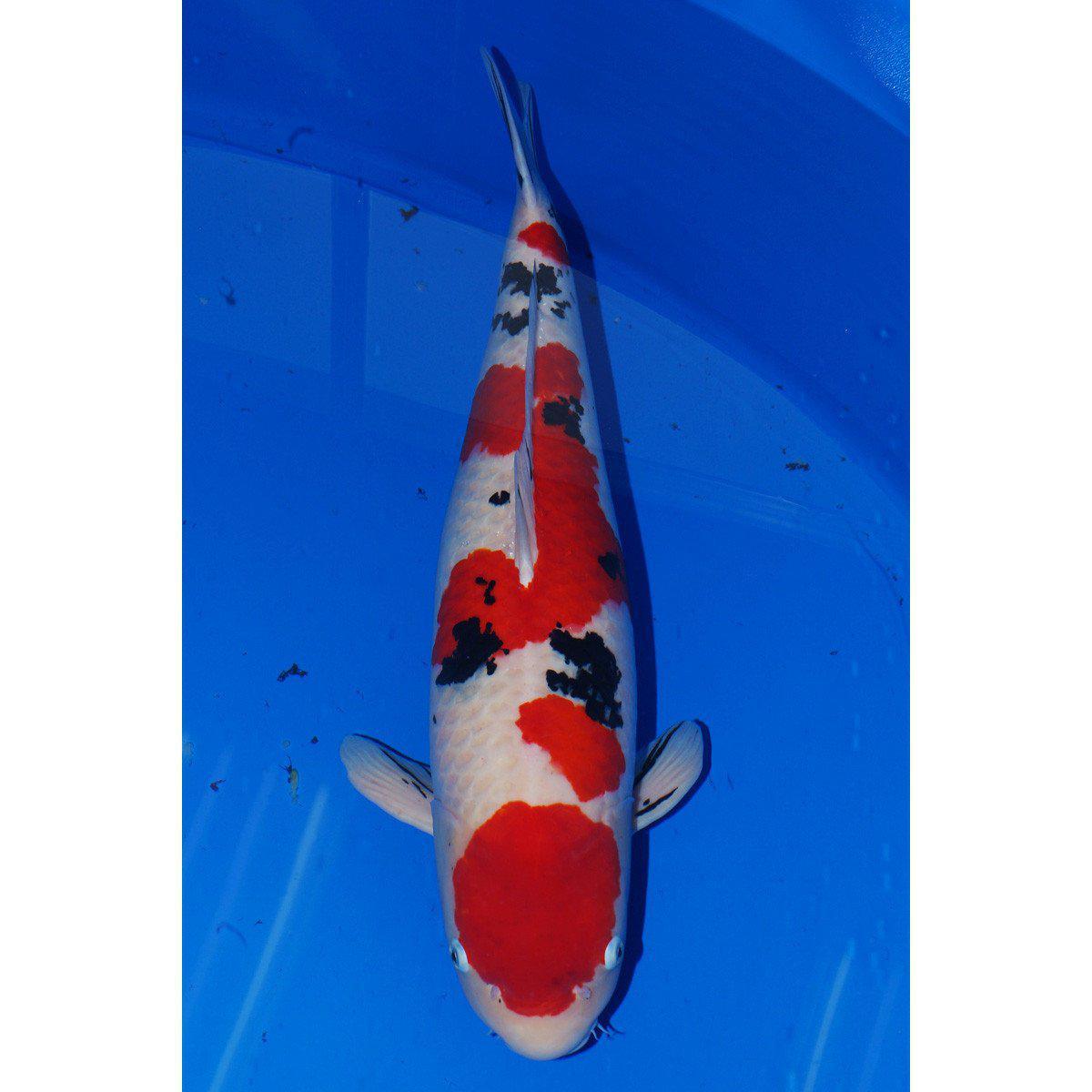
Buy a Sanke and you are buying a fish that is not finished yet. The white is there, the red is mostly there, but the black — the thing that makes a Sanke a Sanke — may not fully settle for several years. That one fact explains why two Sanke of the same size can be hundreds of dollars apart, and why more keepers panic about Sanke than about any other Gosanke variety.

What Is a Sanke Koi?
Taisho Sanshoku — usually shortened to Sanke — is a white-bodied koi carrying red (hi or beni) and black (sumi) markings. The name means "three colors of the Taisho era." With Kohaku and Showa Sanshoku it forms the Gosanke, the big three varieties that dominate serious koi shows.
The name shortens several ways in the wild. A taisho sanke koi, a sanke koi fish and a plain sanke fish are all the same variety — Taisho Sanshoku — and listings pick whichever form they like. Search more than one when you are comparing sellers.
The mental model that matters: a Sanke is a Kohaku with black added on top. The base skin is white, the red sits on the white, and the black sits on both as discrete accent markings. A Showa is built the opposite way — a black-based fish with red and white laid into it.
A Short History of Taisho Sanshoku
Three-color koi of the Sanke type emerged in Japan in the early twentieth century, and the variety took its modern name and shape during the Taisho era (1912–1926). Published accounts disagree on exact years and on who exhibited what first, so treat any single date you see quoted — including on breeder and dealer sites — as one account among several.
Mechanically, Sanke came out of Kohaku. Breeders kept finding fry among their Kohaku with scattered, messy black across the body, and selected over generations to consolidate it into fewer, larger, better-placed markings. Early Sanke were, by most accounts, also crossed with Shiro Bekko. Showa arrived later, in the Showa era, from Ki Utsuri crossed to Kohaku — so the variety Sanke gets confused with is the younger of the two. Do not read that as genetic distance, though: modern Showa are generally understood to have been outcrossed to Sanke and Kohaku lines extensively enough that today's Showa sumi is not independent of Sanke breeding.
How to Judge a Sanke
Judging a taisho sanke koi runs in the usual order — body, then skin and color, then pattern — with one variety-specific caveat: on a sanke fish the black is the last thing to arrive, so on a young one you are grading what is legible now and forecasting the rest.
In most shows judging is comparative — fish are ranked against the others on the bench rather than tallied to a score sheet — though various clubs and organizations publish weighting guidance, and some do score to sheets. Rather than quote percentages that vary by organization, work from the order: body conformation first, color and skin quality second, pattern last. A stunning pattern on a mediocre body loses to a good pattern on a great body.
Shiroji — the White
The shiroji is the whole canvas, and it often separates two otherwise equal Sanke. It should be bright, snow-white, and free of yellowing or shimi — small stray black specks in the white. A creamy white drags a good fish down the placings faster than an imperfect pattern will.
Hi — the Red
You want the red deep and even across all its plates, not one plate strong and the next washed out. The kiwa (trailing edge) should be sharp, cut cleanly at the scale line; the sashi (leading edge, where colored scales sit under unfinished white ones) is naturally softer.
Sumi — the Black
Sanke sumi should be an accent, not a coat. Keepers describe it as stepping stones in a garden: placed, spaced, balanced down the length of the fish. A Sanke banded in heavy black, or visually cut in half by a slab of sumi, is called restless and loses class.
Quality matters as much as placement. Urushi sumi, "lacquer sumi," is the ideal: deep and glossy with a faint bluish tinge under light. Nabe-zumi, "burnt-pan sumi," is dull and brownish, and is a fault. Boke sumi is soft-edged and blurred rather than crisp — on a young fish that can simply mean the black has not finished, but on a mature Sanke it reads as indistinct. Note that in Showa, boke is a recognized style rather than a fault; the same word carries different weight in the two varieties. Tsubo-zumi sits on the white ground, and keepers generally hold that well-placed sumi in the white, particularly around the front shoulder, does the most for a Sanke; kasane-zumi overlaying the red is acceptable but less prized. The usual explanation — hobby consensus rather than verified fact — is that sumi in the white is more deeply rooted while sumi on the hi is shallower and can fade.
The "No Sumi on the Head" Rule
This is the most-cited Sanke rule: a classical Taisho Sanshoku carries no sumi on the head plate, and that is the plain visual difference from Showa. In practice a classical Sanke head shows two colors, white and red.
Two nuances get lost in most write-ups. The convention among keepers and judges is that a small sumi marking on the gill covers is tolerated — the rule is really about the head plate proper, not the operculum. And it functions as an appreciation standard and a benching cue rather than an automatic disqualification; some judges will accept a head sumi that genuinely balances the fish.
You will also hear that Sanke sumi never appears below the lateral line. Treat that as a rough tendency rather than a rule — plenty of well-regarded Sanke carry sumi lower on the body.
Tejima — the Pectoral Fins
Tejima is black striping in the rays of the pectoral fins, and it is the Sanke fin signature. Showa instead tends to carry motoguro, a solid black block at the fin base. It is the standard tie-breaker on an ambiguous fish, but not absolute: not every Sanke has tejima, not every Showa has motoguro, and modern Kindai Showa — bred with more white and lighter, tidier sumi — can look very Sanke-like.

Sanke vs Showa: The Hard Case
Every guide runs this comparison with photos of finished adults. The hard case is a tosai.
- Read the base, not the markings. Is the black sitting on top of white skin, or emerging from underneath as the fish's own ground color? Sanke black floats; Showa black comes up from below.
- Check the head plate. Red and white only points to Sanke; sumi crossing the head, especially a lightning-bolt menware, points to Showa.
- Check the pectorals and sumi shape. Striping and small floating patches lean Sanke; a solid fin-base block and bold wrapping bands lean Showa.
- Accept that some tosai cannot be called. On a young fish, provenance beats visual guessing.
Sanke Sub-Varieties
Tancho Sanke
A single round red spot on the head, no hi anywhere else, but sumi present on the body — and that body sumi is exactly what distinguishes it from a Tancho Kohaku. At most shows Tancho Sanke is benched in the Tancho class rather than with Sanke.

Maruten Sanke
A separate round hi crown on the head in addition to a body hi pattern — unlike Tancho, which has no body red at all. Benched as Sanke.
Aka Sanke
Hi running as one continuous plate from head to tail, so red dominates the body. Generally considered less desirable, since the shiroji is reduced and the pattern loses rhythm.
Doitsu Sanke
Mirror-scaled in limited rows against otherwise smooth skin, from German carp lineage. That near-bare skin makes color edges look razor-sharp, which is the appeal. Doitsu koi are normally benched separately from scaled Gosanke, though the exact class structure varies from show to show — check the schedule for the show you are entering.
Ginrin Sanke
A Sanke carrying ginrin scales — scales with a reflective, sparkling deposit that catches light across the body. The sparkle is a scale characteristic laid over the normal Sanke pattern, so everything else you judge stays the same. Ginrin koi are usually benched in their own class.
Kin Sanke and Metallic Types
Metallic-skinned three-color koi — sold under names including Kin Sanke and Yamatonishiki depending on the seller and the show — carry the same red, white and black over a lustrous, metallic base. Naming here is genuinely inconsistent across dealers and clubs, so ask what a specific fish is being benched as rather than assuming.
Bloodlines: What You Are Actually Buying
Whether a listing says taisho sanke, sanke koi fish or simply sanke fish, the line behind the fish is the most useful thing on the label — it is the only real forecast of when the black arrives.
Bloodline matters more in Sanke than in Kohaku, precisely because sumi is unpredictable. The line is your best available forecast of how and when the black will arrive.
The names you will see most often are Torazo, Sadazo, Jinbei, Matsunosuke, Kichinai and Dainichi. In hobby usage, Torazo, Sadazo and Jinbei are described as the older, classic Sanke lines, and Matsunosuke as the name most associated with the modern big-bodied, late-finishing type. Beyond that, be careful what you accept as fact.
Koi bloodline history lives on dealer sites and forums, not in any federation register. Founding dates, family successions and line-by-line characteristics get repeated until they sound settled, and a lot of them do not survive contact with the breeder. If a specific claim about a line matters to your purchase, ask the seller to source it. "Bloodline" today also means a breeder's brand and current broodstock rather than a closed population — farms cross to each other's fish routinely, so a line name tells you about a breeding program, not a sealed genetic lineage.
Why Sanke Sumi Arrives Late
Sanke sumi develops over years, not months. A young Sanke may show faint black or none at all. The working rule: do not judge a Sanke's sumi before the fish is two years old.
In young koi, sumi usually shows first as pale blue or gray shading that looks like it is sitting under the skin rather than on it. Experienced buyers read those shadows as a forecast of where black will surface — a forecast, not a guarantee. Sumi is the most unpredictable element in a tosai Sanke, more variable than body, beni, or shiroji.
Sumi also moves with the seasons. Keepers widely report black sinking and looking washed out through warm summer water, then rising again as temperatures drop. If your Sanke's black faded in July, wait for fall before drawing conclusions.
Timing is bloodline-dependent too. Some lines throw sumi early and some are still filling in well past five years, and the same is true of body: certain Sanke keep bulking long after a Kohaku of the same age has finished. Knowing the line is what tells you whether a blank-looking tosai is a problem or a normal stage.
How Long Do Sanke Koi Live?
A well-kept Sanke commonly lives 25 to 35 years, and koi in excellent conditions can go considerably longer. There is no evidence that lifespan is a variety trait — a Sanke is not understood to have a shorter or longer natural life than a Kohaku, a Showa, or any other koi. What varies is the care.
That distinction matters when you are comparing fish. Sanke are sometimes described as more delicate because their sumi is unstable and their white shows every problem first. Those are appearance sensitivities, not health ones. A Sanke that looks poor in bad water is telling you something a Chagoi would have hidden, which is arguably an advantage.
What factors affect the lifespan of Sanke koi?
Water volume and stability. The single biggest factor, and the one most often underestimated. Koi grow into large fish; a pond that comfortably holds five tosai will not comfortably hold the same five fish at maturity. Chronic crowding shortens life more reliably than any single incident.
Filtration sized above your bioload. Not to it — above it. Filtration that is exactly adequate today becomes inadequate as the fish grow, and stability is what koi need most.
Winter handling. Koi overwinter well in a pond deep enough not to freeze through, with gas exchange maintained and feeding stopped as the water cools.
Quarantine discipline. Established collections are lost to unquarantined arrivals more often than to anything else. Every new koi goes into a separate, filtered, aerated holding system for two to four weeks before it meets your existing fish.
Genetics and start in life. A fish that was well grown in its first year — good parentage, unforced growth, low stress — starts with an advantage you cannot add later.
Sanke lifespan in a backyard pond
Backyard koi in a properly built, properly filtered pond reach the same decades as any other. The common shorteners are all build decisions rather than bad luck: too little volume, too little depth, filtration bought to the pond's nominal gallons rather than its actual stocking, and no quarantine system. Get those right at the start and longevity mostly takes care of itself — our pond filtration basics guides cover the sizing properly.
What is the average lifespan of Sanke koi?
A Sanke kept well lives 25 to 35 years. That is the same range as any other Gosanke — variety does not change longevity, husbandry does. The average across all koi sold is considerably lower, but the fish pulling it down are the ones lost in their first year to poor water, undersized ponds and skipped quarantine, not to anything inherent in the variety.
How does water quality influence Sanke koi longevity?
Directly, and it is inseparable from the volume question above — volume is largely what makes quality stable, which is why the two are really one factor. Ammonia and nitrite are acutely toxic, and chronic exposure at levels too low to kill outright still damages gills and suppresses the immune system — a Sanke living in that water dies years early of something that looks like an infection rather than of the water itself. Stable temperature, adequate oxygen, and a filter sized for the fish you actually have rather than the fish you started with are what turn a ten-year Sanke into a thirty-year one. There is a cosmetic reason to care as well: sustained poor water dulls shiroji, and on a Sanke the white is half the fish.
Can Sanke koi live 20 years or more?
Routinely, in a properly built pond. Twenty years is not an exceptional age for a koi — it is roughly what a healthy fish in adequate conditions should reach, and well-kept Sanke commonly pass it by a decade or more. Getting there is mostly a matter of not making the four mistakes that kill koi young: stocking beyond the pond's capacity, running an undersized filter, skipping quarantine on new arrivals, and letting winter temperatures swing.
Do Sanke koi live longer indoors or outdoors?
Outdoors, in a real pond, provided it is deep enough to overwinter safely. Koi are pond fish: they need volume, seasonal temperature change, and room to reach full size, and an indoor tank of any practical size denies them all three. Indoor systems earn their place for quarantine, for winter in severe climates, and for growing on young fish — not as a permanent home. The exception proves the rule, in that an indoor system genuinely large enough for an adult Sanke is a pond that happens to be under a roof.
What is the oldest recorded age for a Sanke koi?
There is no verified record for a Sanke specifically. Koi ages are not systematically documented, and the famous claim in the hobby — a scarlet koi named Hanako, said to have reached 226 years before dying in 1977 — concerns a Higoi rather than a Sanke, and rests on one scientist's reading of growth rings in her scales. Treat it as folklore rather than data. The defensible statement is the ordinary one: a well-kept Sanke lives into its thirties.
How does diet impact how long Sanke koi live?
Less directly than most keepers expect, and mostly through the water. Koi are hard to starve and easy to overfeed, and the damage from overfeeding is done to the pond rather than to the fish: uneaten food and a heavier waste load push ammonia and nitrite up, and it is that water, not the food itself, that takes years off a Sanke. Feed what the fish clear in about five minutes, and cut back as the water cools — a koi's digestion slows with temperature, and food sitting in a cold gut does nothing good.
Two things matter more directly. Match the food to the season: a wheat-germ or four-season diet in spring and autumn digests at temperatures a high-protein growth food does not, and our Nijikawa Four Seasons is the cool-water staple here, with Nijikawa Growth Formula through the growing season. And feed some variety: years on a single cheap diet is where deficiency problems start, and they show up first as poor healing and dull skin. Keepers widely hold that pushing growth hard year after year trades longevity for size — we would treat that as the accumulated opinion of the hobby rather than a settled fact, but feeding for steady growth rather than maximum growth costs nothing and is what experienced keepers do.
Sanke Care
A sanke koi fish needs what every koi needs, with the white doing the complaining first: shiroji dulls before anything else in the pond looks wrong.
Sanke need what all koi need: volume, stable water, filtration sized above your bioload. Two things matter more here.
Protect the white. Shiroji degrades first under poor conditions and is hardest to get back. Stable water and clean mechanical filtration do more for a Sanke's appearance than any additive — browse pond filtration if your setup is at its limit, or a complete koi pond kit if you are starting fresh. Floating pond plants add shade, which helps both beni and white hold up in summer.
Be deliberate about color food. Color-enhancing food strengthens beni, and it is also the most common reason a Sanke's white turns creamy. Most keepers feed it seasonally or in rotation rather than continuously, watching the shiroji for the first sign of yellowing.
Nijikawa Color Genesis is our first recommendation for beni support. Rotate against Nijikawa Growth Formula in the growing season, Nijikawa Four Seasons in shoulder temperatures, and Nijikawa Professional Sinking for bottom feeders — full range in our koi food collection.
Buying a Sanke
Tosai (first year) is the cheapest entry and the biggest gamble. You are buying body, skin, beni, and pattern calmness, and betting on sumi. Weight your assessment toward what is legible now: conformation, purity of the white, and whether the pattern feels balanced rather than crowded.
Nisai (second year) is the widely-cited sweet spot — pattern is stable enough to judge honestly, price is still below a finished fish. Sansai and older is where you pay to remove risk, since body, skin, and pattern are essentially settled.
What you get at each price point
Sanke pricing tracks three things: how much risk has been removed, how good the fish is, and how well documented its parentage is.
Entry tosai are the cheapest way in. Body and white are legible, beni is mostly legible, sumi is a bet. Parentage is often unstated at this level. Good value if you are learning to read fish and relaxed about the outcome.
Bloodline tosai and nisai cost more because the line is known, which is the only real forecast available for when and how the black will arrive. This is where most serious hobbyists buy.
Sansai and older, or show-quality fish at any age, sit at the top of the range. You are paying to remove uncertainty: body, skin, and pattern are settled, and what you see is close to what you keep.
This is why price spreads are so wide in Sanke specifically. Two same-size tosai can be an order of magnitude apart because one has known parentage from a respected line and the other does not. When the defining feature shows up years after purchase, provenance is a real part of the price, not marketing.
Where to buy a Sanke from us
Our sanke koi for sale come as multi-fish breeder packages rather than single fish. On a variety whose sumi takes years to settle, several outcomes beat one.
A package is usually the sensible entry for a home pond — on a variety whose sumi is this unpredictable, several outcomes beat one. Our three options, cheapest first:
- Shinoda Koi Farm — Doitsu Gosanke Packages, from $235, if the sharper-edged Doitsu look appeals.
- Premium Gosanke Japanese Koi Fish Packages, from $335 — all three Gosanke varieties together, which is the fastest way to train your eye on what separates them.
- Marudo Koi Farm — Kohaku & Sanke Pattern Packages, from $675. Our Sanke-focused stock, selected on pattern.
Looking for one specific Sanke rather than a group, or a sub-variety such as Tancho or Doitsu? Those come and go, so get in touch and we will tell you what is actually in the building.
Before you order a multi-fish package, two conditions, and neither is optional. First, quarantine every new koi in a separate, filtered, aerated holding system for two to four weeks before it goes anywhere near your main pond — a group purchase means a group of new arrivals, and one unquarantined fish can take out an established collection. Second, size the group to your pond, not to your enthusiasm: work from your actual filtered volume and turnover, and remember you are stocking for the size these fish will reach. Count the adult fish your volume and filtration can carry, then buy under that number.
You can also browse all Japanese koi or the full koi fish collection — then read our complete guide to Kohaku, the variety Sanke was built on, and our complete guide to Showa, the variety it is most often confused with.
Frequently asked questions
What is a Taisho Sanke koi?
A taisho sanke koi is a white-bodied koi carrying red and black markings — Taisho Sanshoku in full, one of the three Gosanke varieties. Listings also call it a sanke koi fish or a sanke fish. The head plate shows red and white with no black on it, which is the quickest way to tell one from a Showa.
Where can I find Sanke koi for sale?
Most sanke koi for sale are sold as multi-fish breeder packages rather than as single fish, which is the cheaper route into the variety and the better way to learn to read one. If you buy a group, quarantine every new koi in a separate, filtered, aerated holding system for two to four weeks first, and stock to the adult fish your pond volume and filtration can carry.
What is the difference between a Sanke and a Showa?
A Sanke is a white-based koi with red and black added on top; a Showa is a black-based koi with red and white laid into it. A Sanke's head plate carries no sumi, though a small marking on the gill covers is generally tolerated, and Sanke usually shows tejima striping in the pectoral fins. A Showa carries head sumi and usually motoguro, a solid black block at the fin base. Both tests are strong indicators, not absolute rules.
How long do Sanke koi live?
A well-kept Sanke commonly lives 25 to 35 years, and considerably longer is possible in excellent conditions. There is no evidence that lifespan is a variety characteristic — Sanke live as long as any other koi. Water volume, filtration sized above your bioload, winter depth and gas exchange, and strict quarantine of new arrivals do far more to determine longevity than variety does.
Do Sanke koi live as long as other koi varieties?
Yes. Sanke are sometimes called more delicate, but that reputation is about appearance rather than health: their unstable sumi and bright white show stress earlier and more visibly than a darker, hardier-looking variety would. The underlying fish is no shorter-lived.
Why has my Sanke's black disappeared?
Sanke sumi commonly sinks and looks washed out in warm summer water, then rises again as temperatures drop. It also develops in waves over several years rather than arriving at once, and sumi sitting on the red plate is the least stable of all. Give the fish a full seasonal cycle before concluding anything.
Can a Sanke have black on its head?
Classically, no. A Taisho Sanshoku head plate shows white and red, and the absence of head sumi is what separates it visually from a Showa. The usual convention among keepers and judges is that a small sumi marking on the gill covers is tolerated, and that the no-head-sumi rule works as an appreciation standard and benching cue rather than an automatic disqualification.
At what age can you judge a Sanke's sumi?
Not before two years old. In young fish, sumi first appears as pale blue or gray shading under the skin, which experienced buyers read as a forecast of where black will surface. Depending on bloodline, sumi can keep developing well past five years.
What are the main Sanke bloodlines?
Torazo, Sadazo and Jinbei are described in hobby usage as the classic historic lines; Matsunosuke as the name most associated with the modern large-bodied, late-developing type; Kichinai and Dainichi also appear in Sanke bloodline lists. Bear in mind that this history is documented by dealers and hobbyists rather than by any federation register, so confirm any specific claim about dates, lineage or line characteristics directly with the breeder or seller.