
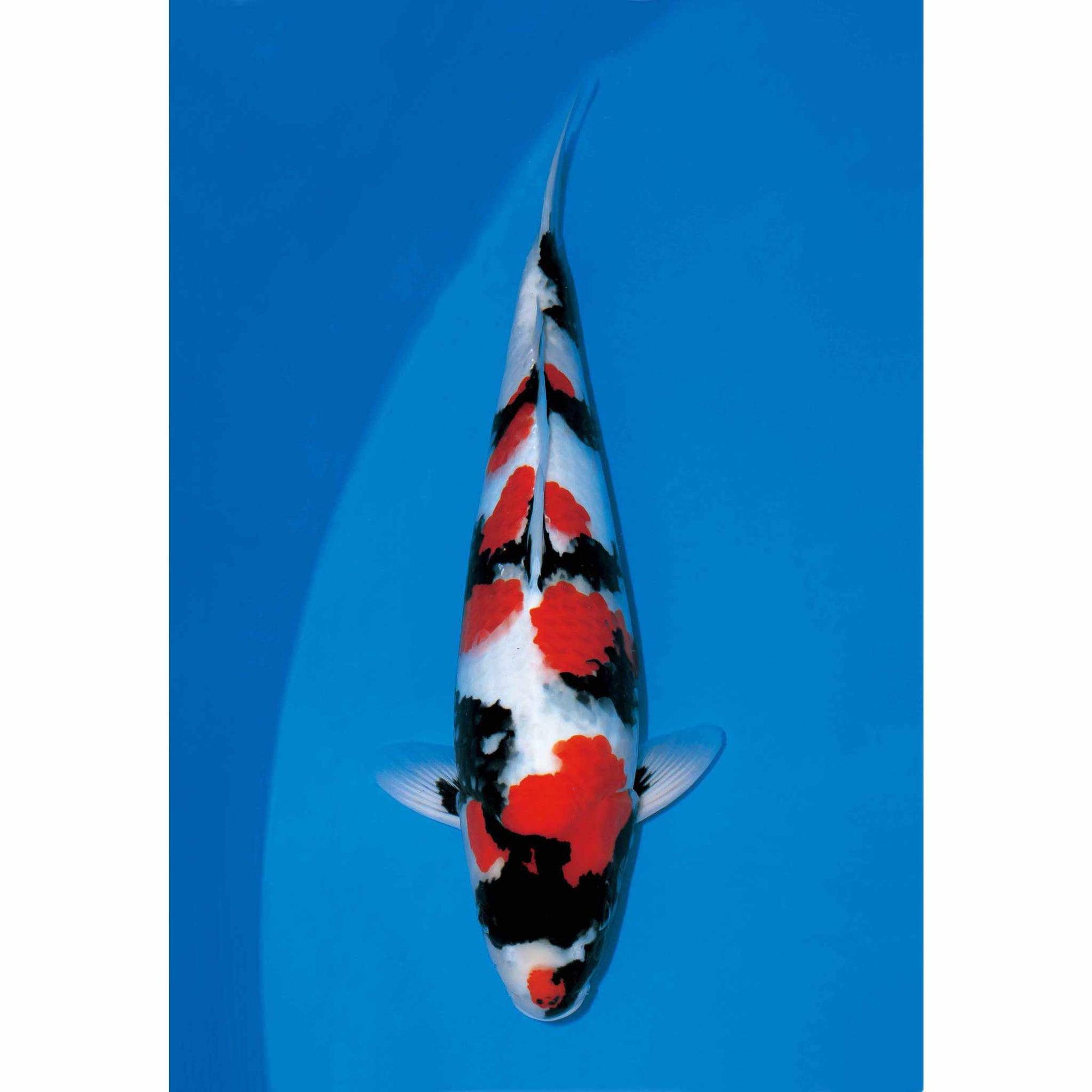
Ask ten koi keepers to name the hardest variety to buy well and most of them will say Showa. A Kohaku shows you what it is on day one. A Showa hides half its pattern under the skin and spends the next five years deciding how much of it to reveal. That is what makes the variety addictive — and why so many first-time Showa buyers panic at age two when the black disappears.
This guide covers what a Showa Sanshoku actually is, how the sumi behaves across the fish's life, how to judge one, what a Showa koi costs and why, and how to tell a Showa from a Sanke. If you are newer to Gosanke, start with our complete guide to Kohaku koi and our complete guide to Sanke koi — the pattern vocabulary carries over.

What Is a Showa Koi?
Showa Sanshoku (昭和三色) is a three-color koi carrying black (sumi), red (hi), and white (shiroji). It is one of the Gosanke — the "Big Three" alongside Kohaku and Taisho Sanke — and Gosanke are widely regarded as taking most Grand Champion awards at major shows.
The name gets written several ways. Showa Sanshoku is the full form, and dealer listings and search results shorten it every direction — showa koi carp, koi fish showa, or simply Showa. They are all the same fish; only the listing conventions differ.
Showa Sanshoku is the full form, and dealer listings and search results shorten it every direction — showa koi carp, koi fish showa, or simply Showa. They are all the same fish; only the listing conventions differ.
The defining idea: a Showa is a black fish wearing red and white, not a white fish wearing red and black. That single sentence explains nearly everything about how a Showa looks and behaves. The sumi is the ground. It wraps the body in broad bands, crosses below the lateral line, runs onto the belly, and climbs onto the head. The hi and shiroji sit on top of it.
Worth being straight about: this is a descriptive and judging convention, not a proven genetic mechanism. We are not aware of published work establishing that Showa sumi occupies a different pigment layer than Sanke sumi. But the framing predicts the fish's behavior so reliably that breeders, judges, and dealers all use it. Treat it as the working model it is.
The History of Showa Sanshoku
The conventional account holds that Showa was first produced in 1927 by Jukichi Hoshino, who crossed a Kohaku with a Ki Utsuri — the yellow-and-black Utsuri. As with all koi history, that account comes from dealers and hobbyists rather than any register, so treat it as the standard version rather than a documented fact. The variety takes its name from the Showa imperial era (1926–1989), in which it was created.
The early fish were not good. Yellow pigment carried over from the Ki Utsuri side is the usual explanation for their muddy, brownish reds and dull yellowish whites. For close to four decades, Showa was a curiosity rather than a contender.
The turnaround came from Tomiji Kobayashi in the 1960s, who introduced strong Kohaku bloodlines to fix the hi and clean up the shiroji. Sources disagree on whether this was 1964 or 1965 and on the exact parent fish, so treat "the mid-1960s" as the safe version. The result was the modern Showa standard: deep crimson hi plates, bright white, and a bold sumi motif on the head. That 1960s work is the foundation of the Showa you can buy today; when keepers say "old style" Showa, they mean the heavier-sumi, muddier fish that came before it.
How to Judge a Showa Koi
Judging a showa koi carp follows the same order as any koi — body first, then skin and color, then pattern. What changes is that the black is doing most of the work, and the black is the part that is still moving.
In most shows judging is comparative — fish are ranked against the others on the bench rather than tallied to a score sheet — though various clubs and organizations publish weighting guidance, and some do score to sheets. Rather than quote percentages that vary by organization, work from the order: body conformation first, color and skin quality second, pattern last. A stunning pattern on a mediocre body loses to a good pattern on a great body.
Sumi quality
You want sumi that reads like wet ink — jet, glossy, with weight to it. The top grade is called urushi sumi ("lacquer black"), deep and glossy with a faint bluish tinge under light. Grayish or brownish sumi on an older fish is a finish problem. On a young fish it may just be sumi that has not surfaced yet, which is a different situation entirely (see below).
Menware — the head sumi
A Showa is expected to carry sumi on the head. It is the variety's signature, and its absence is a real fault — though not a disqualification, since a Showa with no visible head sumi is still a Showa. The classic form is menware ("divided face") or hachiware ("divided head") — a bold black stripe running from the shoulder forward through the head, splitting the head hi. When it zigzags, keepers call it inazuma, lightning. A head showing all three colors in balance, with the sumi cutting through as a decisive stroke rather than a smudge, is what separates a good Showa from an average one.
Motoguro — sumi at the pectoral joints
Motoguro is solid black at the base of the pectoral fins, radiating outward from the body. It does two jobs. First, it is diagnostic: motoguro points to Showa, while black stripes through the fin rays (tejima) point to Sanke. Second — and this is how dealers and clubs explain it rather than anything we can source to a judging body — motoguro is read as evidence that the fish's sumi is genuinely body-wide and strong, not superficial. It also visually finishes the pattern by terminating the sumi flow at the fins.
The usual convention is to prefer motoguro tightly confined to the joint rather than bleeding messily out along the rays. Clear or white pectorals are tolerated but generally place lower.
Hi and shiroji
Hi should be thick, uniform in shade, and ideally interconnected into plates rather than scattered patches. Shiroji should be crisp and genuinely white — any yellow cast is a fault, and it is usually explained as the old Ki Utsuri ancestry showing through. Pattern edges matter too: the trailing edge of a block (kiwa) should be sharp, while the leading edge (sashi) is naturally softer.
Showa vs. Sanke: How to Tell at a Glance
This is the most-asked question in the variety, and the quick version is: sumi on the head points to Showa; a head carrying only red and white points to Sanke. Treat that as the strongest single indicator rather than an absolute rule — our Sanke guide covers the exceptions, including the small gill-cover marking that keepers and judges generally tolerate on a Sanke.
Four backup tests:
- Pectoral fins. Showa tends to show motoguro (solid black at the joint); Sanke tends to show tejima (stripes through the rays) or clear fins. This is the usual tie-breaker, but it is not absolute — not every Showa has motoguro and not every Sanke has tejima.
- Sumi geometry. Showa sumi comes in large bands and swathes. Sanke sumi comes in small, isolated, discrete spots.
- Origin point. Showa sumi often starts at the mouth, spreads across the cheeks, and connects through to the pectoral motoguro.
- Overall impression. Showa reads black-with-red-and-white. Sanke reads white-with-red-and-black.
You will also hear that Showa sumi crosses below the lateral line while Sanke sumi stays above it. That is a rough tendency rather than a rule — plenty of well-regarded Sanke carry sumi lower on the body.
Where the quick version breaks down: white-dominant Kindai Showa can look like a Sanke from ten feet away, and young fish often have head sumi that has not surfaced yet. On a young fish, provenance beats visual guessing.
Showa Sub-Varieties
A doitsu showa is the German-scaled version: mirror scales along the back against smooth skin, which makes the sumi edges look razor-sharp. Doitsu showa are benched separately from scaled Showa at most shows.

- Kindai Showa (近代昭和, "modern Showa") — white-dominant, commonly described as around 40% or more shiroji. Cleaner, more elegant, more symmetrical, and the look that dominates modern collections.
- Hi Showa (緋昭和) — red-dominant, heavy hi plates, little white. The bold, traditional-looking end of the range.
- Aka Showa — the extreme of that end: hi covering nearly the whole body, with sumi and a little shiroji breaking it up.
- Boke Showa (ぼけ昭和, "blurred") — soft-edged grayish sumi with gradual transitions instead of hard blocks. In Showa this is a recognized style rather than a defect, which is worth knowing because blurred sumi on a mature Sanke reads as a fault instead. On a young fish, undeveloped sumi and true boke sumi look similar and only time tells them apart.
- Tancho Showa — a single red circle on the head, black-and-white pattern on the body, no other hi anywhere.
- Maruten Showa — a distinct head hi patch plus hi on the body, unlike Tancho, where the head marking is the only red.
- Doitsu Showa — German-scaled, so the sumi and hi sit on smooth skin. Pattern edges look dramatically sharper.
- Kage Showa (影昭和, "shadow") — blurred reticulated sumi shadowing the white areas.
- Kin Gin Rin Showa — reflective sparkling scales over the Showa pattern. Usually shortened to "Ginrin Showa" in conversation, but Kin Gin Rin is the full term.
- Kin Showa — a metallic Showa, where the whole fish carries a luster rather than individual sparkling scales.
- Koromo Showa — indigo or navy reticulation laid over the hi (not over the sumi), giving the red scales a netted, robed look.
Kindai and Hi Showa are best understood as the ends of a continuum of white-to-red dominance rather than separate classes, and plenty of fish sit in the middle.
The Showa Sumi Timeline: Why Your Showa Went White
This is the part every other guide covers in one sentence, and it is one of the most common questions we get about Showa.
Showa sumi is unstable by design. It sinks and rises repeatedly before it settles. A rough shape of what keepers see:
- Tosai (year 1): sumi is often minimal or present as gray, bluish shadows under the skin. Head sumi may be a smudge rather than a stroke.
- Nisai (year 2): the scary year. Sumi frequently recedes hard — some fish drop so much black that, with the hi still in place, they read as a Kohaku for a season. This is normal, not pigment loss.
- Sansai (year 3): sumi starts pushing back up, usually first at the shoulder and the pectoral joints.
- Yonsai to gosai (years 4–5): sumi typically thickens and hardens toward its adult state. Many lines only reveal their real quality here.
Some lines are talked about in the hobby as late developers — fish that shed sumi as tosai and nisai and return it thicker at yonsai and gosai. If a dealer sold you one and told you to be patient, that is honest advice rather than a hedge.
Commercially, this is why Showa are priced and sold the way they are. A tosai is being sold on potential, not on what is in the photograph, so the same fish can look worse at two than it did at one and still be on track. It is also why a Showa bought as a finished-looking baby is usually the worse buy: there is nothing left underneath to come up.
What is not normal: sumi that vanishes alongside faded hi, dulled skin, and changes in the fish's behavior or appetite. That is a fish-health question, not a pigment question, and it needs your water tested and a conversation with someone who can look at the animal.
Showa-Specific Care
Most care advice for Showa is just koi care with the variety name pasted on, and we are not going to repeat it here — our pond filtration basics guides cover water chemistry, filtration sizing, and seasonal routines properly. There is one genuine Showa exception: a Showa's appearance is more environment-sensitive than a Kohaku's.
Keepers consistently observe that cooler water and harder, more mineralized water encourage sumi to rise and hold, while warm, soft water lets it sink. Practically, this means your Showa will often look its blackest in fall and spring and its washiest in the middle of a hot summer. Do not chase it. Chasing sumi with sudden water changes costs you more in fish stress than you gain in color.
What is worth doing: keep KH stable rather than letting it crash, since a stable buffer keeps pH steady and stability is what actually protects the fish. Give the pond enough filtration that you are never trading water quality for appearance — start with pond filtration sized above your stocking level. And feed for color rather than trying to fix color with water.
On food, Nijikawa Color Genesis is our first recommendation for Gosanke, because hi depth is what carries a Showa visually while the sumi does its slow thing. It comes with the same trade-off we flag in the Kohaku guide, and it matters more on a Showa: color foods push the reds, and pushed too hard or fed year-round they can also warm the shiroji toward cream — the exact yellow cast the judging section calls a fault.
Feed it seasonally, watch the whites, and back off when they start to lose their edge. For young fish you are trying to put size on, Nijikawa Growth Formula is the better default, and Nijikawa Four Seasons covers the shoulder-season temperatures when appetite drops. For larger fish in deeper ponds, Nijikawa Professional Sinking Pellet keeps food down where the fish are. The full range is in koi food.
What your Showa looks like through the year
This is the seasonal pattern that catches new Showa keepers out, and it is about appearance rather than health. Knowing it stops you treating a normal season as a problem.
- Spring. Often the best your Showa looks all year — the water is still cool and the sumi sits up. Feed lightly as the pond warms and let the fish come out of winter at its own pace.
- Summer. The washiest stretch. Warm water lets sumi sink, so the hi can look bright while the black goes soft and gray. This is the season people mistake for a fish losing its pattern. Aeration matters most now, because warm water carries less oxygen and a crowded pond feels it first.
- Fall. The sumi comes back as the water cools, usually the sharpest it will be all year. This is the honest time to photograph or assess a Showa, and the reason a fish bought in August can look like a different animal in October.
- Winter. Nothing much happens visually, and nothing should. Feeding stops as the water cools, the fish sits deep, and the pattern holds. Judge nothing and change nothing.
The through-line: a Showa's black moves with the seasons, so compare a fish against itself a year apart rather than against how it looked last month. For the pond-side routines behind all of this — filtration sizing, water chemistry and seasonal maintenance — our pond filtration basics guides go into it properly.
Bloodlines: Which One Should You Buy?
Whether a seller lists it as koi fish showa, showa koi carp or Showa Sanshoku, what you are buying is the same animal and the same gamble — so the line behind the fish is the most useful thing on the label.
Bloodline matters more on Showa than on almost any other variety, because you are buying a fish whose final appearance does not exist yet. You are not buying what is in the bowl. You are buying the breeder's track record of what their fish become.
The honest guidance is that most bloodline talk in the hobby is name-dropping, and specific claims about which farm produces which character are very hard to verify from outside Japan. Beyond the historical Kobayashi work that produced the modern Showa, treat breeder names as a reason to ask your dealer questions, not as a specification. What is not in dispute is the consensus among experienced keepers: a plain-looking tosai from a breeder with a known track record beats a flashy tosai from an unknown one. Flash at age one on an unknown line usually means finished sumi that will not improve. Plainness on a good line often means sumi still waiting underneath.
How Much Does a Showa Koi Cost?
Prices on showa koi for sale span an enormous range, and the spread is not arbitrary — it tracks how much of the fish’s future has already been settled.
There is no single answer, and any site that gives you one is guessing. At the entry end, a Showa from a multi-fish package starts in the low hundreds. Individually selected fish run from several hundred into four figures, and show-quality koi go well beyond that. What nobody explains is what visually separates the tiers.
Moving up a tier, in order, buys you:
- Body conformation — thickness through the shoulder, symmetry, a strong caudal peduncle.
- Sumi finish — jet and glossy rather than gray and flat.
- Shiroji that is genuinely white rather than cream.
- A head pattern that resolves into a real menware instead of a blob.
- Clean motoguro tight to the joint.
Notice that pattern novelty is nowhere on that list. A weird, eye-catching pattern on a mediocre body is a cheap fish that looks expensive in a photo.
What factors determine the price of a Showa koi?
- Size and age. The biggest single factor. Every year a breeder grows a fish is a year of food, space, water, and risk, and the fish that survive to sansai are the ones already selected as worth keeping.
- How much risk has been removed. This is the Showa-specific one. A tosai is priced on potential; a sansai is priced on a pattern that has largely settled. You are paying to stop gambling.
- Pattern and color quality. Yes, but less than people expect, and it is the finish that costs — lacquer sumi, white that is actually white, sharp kiwa — rather than the shape of the pattern.
- Breeder and line. Real, and worth paying for on Showa specifically, because the line is your only forecast of how the sumi will arrive.
- Whether it is a single fish or a package. Packages are the usual way into the variety, which is why the entry price is where it is.
How does size affect the value of a Showa koi?
Size and age are the biggest single factor in the price, but they work as a multiplier on whatever quality is already there rather than on their own. A six-inch tosai with good sumi is a promising fish; the same genetics at twenty inches is a finished one, and the price reflects the years of feeding, water and risk that separate them. Size alone does not make a koi valuable — a large fish with weak sumi is still a large fish with weak sumi — but among fish of equal quality, price rises steeply with length because the odds of getting there are poor. Our own catalog shows the shape of it: Showa in mixed tosai packages start in the low hundreds, a single 16 to 20 inch premium Tancho Showa is $1,340, and a 70cm Showa from a named Dainichi bloodline has listed with us at $12,800.
Do pattern and color quality influence Showa koi prices?
Color quality does. Pattern shape does far less than most buyers expect. What costs money on a Showa is the finish of the sumi — jet and glossy rather than gray and flat, thick enough that no white shows through it, with menware that resolves into a real head pattern and motoguro tight to the pectoral joints. Those are finish traits, not pattern traits. A novel, eye-catching arrangement on a mediocre body is a cheap fish that photographs well, while a koi fish showa with unremarkable markings and genuinely lacquer sumi is not. The hi should be even and the shiroji white rather than cream, but between two Showa it is the quality of the black that decides the number.
What is the price range for young Showa koi versus mature ones?
Young Showa are sold on potential and priced accordingly — in tosai and mixed packages they work out from about $45 a fish — our Koshiji packages are $255 for five 5 to 6 inch koi and $445 for ten, and $325 for three larger 6 to 8 inch fish. Mature Showa are sold on what they have actually become, and start about where the young fish stop: a single 16 to 20 inch Tancho Showa is $1,340, individually selected Japanese Showa from established breeders start at $1,600, and large fish from named bloodlines go into five figures. The gap is the cull rate. Most young Showa do not finish well, so the ones that do carry the cost of the ones that did not.
Are lineage and breeder reputation important in Showa koi pricing?
Yes, and more so on Showa than on most varieties, because sumi is the trait that develops latest and least predictably. A breeder with a proven Showa line is selling odds — a higher proportion of their fish hold their black through the years when most Showa lose it — and that is what the name premium buys. It is a probability rather than a guarantee: bloodline improves the average outcome, it does not certify the individual fish in front of you.
How much do high-quality Showa koi fetch at auctions?
There is no published price index for Showa. We sell through the store rather than at auction, so the benchmark we can actually stand behind is our own dealer pricing: a single Tancho Showa is $1,340, individually selected Japanese Showa from established breeders start at $1,600, and large fish from named bloodlines have listed with us at $12,800. The headline results occasionally reported out of Japanese auctions involve a handful of exceptional fish and are not a guide to what a Showa costs.
How much should I expect to pay for an ornamental Showa koi for a backyard pond?
For a pond fish you want to enjoy rather than show, the entry point is a package rather than a single fish: $255 buys five 5 to 6 inch Showa from Koshiji Koi Farm and $445 buys ten, which is about $45 to $51 each. That is what a healthy young Showa from a real Japanese breeder costs, with sumi worth watching develop — the genuinely interesting part of owning one. Spending more buys certainty — a mature fish whose black has already arrived — and that is a fair trade if you would rather not wait three years to find out. Spending much less usually means an unnamed domestic fish whose sumi may never come in at all. Two conditions either way, and neither is optional: quarantine every new koi in a separate, filtered, aerated holding system for two to four weeks before it goes near your main pond, and size the group to your pond rather than to your enthusiasm — count the adult fish your volume and filtration can carry, then buy under that number.
Where to buy a Showa from us
Listings for showa koi fish for sale run from tosai packages to finished show fish, and the gap between them is mostly how much of the sumi has already arrived.
Dealer listings file these under everything from koi fish showa to Showa Sanshoku, so search both ways when you are comparing sellers.
Most of our Showa koi for sale come as multi-fish packages, and on a variety whose sumi takes years to settle, several outcomes beat one — but single finished fish are listed too when we have them.
For most home ponds, a package is the sensible entry — on a variety this unpredictable, several rolls of the dice beat one:
- Koshiji Koi Farm — Kikokuryu, Ochiba & Showa Packages, from $255. Our deepest Showa stock and the easiest starting point.
- Shinoda Koi Farm — Doitsu Gosanke Packages, from $235, if the sharper-edged Doitsu look appeals.
- Premium Gosanke Japanese Koi Fish Packages, from $335 — all three Gosanke varieties together, which is the fastest way to train your eye on what separates them.
- Premium Japanese Tancho Showa Koi Fish, from $1,340, for a single statement fish rather than a group.
You can also browse the wider Japanese koi selection, or the full koi fish range if you are still deciding on variety.
Before you order any multi-fish package, two conditions, and neither is optional. First, quarantine every new koi in a separate, filtered, aerated holding system for two to four weeks before it goes anywhere near your main pond — a group purchase means a group of new arrivals, and one unquarantined fish can take out an established collection. Second, size the group to your pond, not to your enthusiasm: koi grow into large fish, and a group that fits comfortably as tosai can overload the same pond by sansai. Count the adult fish your volume and filtration can carry, then buy under that number.
Buying a Showa for a backyard pond: what to pick and what to pass on
Almost everything written about choosing a Showa is written for the show bench. In a backyard pond you are buying a fish you will look down at, in daylight, for the next twenty years, and the practical question is narrower: at this age, what can I actually judge, and what am I gambling on?
Tosai — first year, roughly 5 to 8 inches
Pick a thick, straight body and clean white. At this age the sumi is barely a forecast, so buy the parts that are already real: a fish broad across the shoulders and even when viewed from above will still be a good fish when the black arrives. Buy tosai in a package rather than singly — the variety is unpredictable enough this young that several outcomes genuinely beat one.
Pass on a slender or bent body, on shiroji that reads gray rather than white, and on any fish sold to you on its pattern alone. Pattern at tosai is the least reliable thing on the fish.
Nisai — second year, roughly 10 to 14 inches
Pick the first real sumi. By nisai you should see black beginning to harden rather than sitting as a gray shadow, and you can start to judge menware across the head. For a home pond this is usually the best value step on the ladder: much of the gamble is gone and the fish is still growing into its body.
Pass on a fish whose sumi has gone patchy and flat, or whose white has yellowed. Both usually get worse rather than better.
Sansai and older — third year up, 16 inches and beyond
Pick what you can see, because at this age what you see is roughly what you keep: lacquer-black sumi, tight motoguro at the pectoral joints, clean white, and a body that has filled out without going soft behind the head.
Pass on anything you are told will "still change." Mostly it will not, and paying a sansai price for a tosai gamble is the most common way to overspend on this variety.
One condition applies at every age, and it is not optional. Quarantine every new koi in a separate, filtered, aerated holding system for two to four weeks before it goes anywhere near your main pond, and size the group to your pond rather than to your enthusiasm — count the adult fish your volume and filtration can carry, then buy under that number.
Frequently asked questions
What is the difference between a Showa and a Sanke?
Head sumi is the strongest single indicator when you are comparing a showa koi carp with a Sanke. A Showa carries black on the head, usually in a menware or hachiware pattern; a Sanke's head plate shows only red and white, though keepers and judges generally tolerate a small sumi marking on the gill covers. Showa also tends to show motoguro — solid black at the pectoral fin joints — where Sanke tends to show striped or clear fins. Both tests are strong indicators rather than absolute rules.
How much do Showa koi cost?
Prices on showa koi fish for sale start around $45 a fish in a ten-koi package and run to five figures for a finished show fish; a doitsu showa is usually priced alongside its scaled equivalent. Showa koi fish for sale from a known bloodline cost more because the line is the only real forecast of when the black arrives.
Showa koi for sale range from around a hundred dollars for a tosai to five figures for a finished show fish. A Showa from a multi-fish package starts in the low hundreds. Individually selected fish run from several hundred into four figures, and show-quality koi go well beyond that. Size and age drive price more than anything else, followed by how much developmental risk has been removed — a settled three-year-old costs far more than a one-year-old sold on potential. Packages bring the per-fish cost down, which is why most keepers start there. If you do buy a group, quarantine every new koi in a separate, filtered, aerated holding system for two to four weeks first, and size the group to the adult fish your pond volume and filtration can carry.
Can Showa koi live with other fish?
Yes. Showa are ordinary koi in temperament and mix comfortably with other koi varieties. The real constraints are not about compatibility but about capacity and biosecurity: stock to the adult size your pond volume and filtration can carry rather than to the size the fish arrive at, and quarantine every new arrival in a separate, filtered, aerated holding system for two to four weeks first. Goldfish and koi are often kept together, though koi grow far larger and generally out-compete them at feeding time.
Why did my Showa lose its black?
Almost certainly normal development. Showa sumi is unstable and commonly recedes hard at age two — some fish drop so much black that, with the hi still in place, they read as a Kohaku for a season — then it returns and thickens between ages three and five. If the black is fading alongside dull skin, faded red, and appetite changes, that is a health question instead and needs your water checked.
What is menware on a Showa koi?
Menware ("divided face") is the bold black stripe running from the shoulder forward across the head, splitting the head hi. When it zigzags it is called inazuma, or lightning. It is the Showa's signature marking and usually the first thing keepers look at when assessing a Showa's head.
What is motoguro and why does it matter?
Motoguro is solid sumi at the base of the pectoral fins. It matters for two reasons: it is the fastest fin-level pointer toward Showa rather than Sanke, and it is read as evidence that the fish's sumi is strong and body-wide rather than surface-deep. The usual convention is to prefer motoguro tightly confined to the joint rather than bleeding along the fin rays. It is a strong indicator, not an absolute one — not every Showa carries it.
What is the difference between Kindai Showa and Hi Showa?
Kindai Showa is white-dominant, commonly described as around 40% or more shiroji, with a cleaner and more elegant look that dominates modern collections. Hi Showa is red-dominant, with heavy interconnected hi plates and little white. They are best understood as two ends of a continuum rather than separate classes.
Should I feed my Showa a color-enhancing food?
In moderation. Color food deepens the hi, which is what carries a Showa visually while the sumi is developing, but fed too hard or year-round it can warm the shiroji toward cream — and a yellow cast on the white is a fault. Feed color food seasonally, watch the whites, and switch back to a growth or staple diet if they start to lose their crispness.
How big do Showa koi get and how long do they live?
Keepers generally see Gosanke reach roughly 24 to 30 inches in a well-run pond, with well-fed fish in large systems going larger. Commonly cited lifespans run 25 to 35 years, and longer is documented. Both figures depend far more on pond volume, filtration, and stocking density than on variety.
Are Showa harder to keep than other koi?
No — the husbandry is the same as any koi. What is harder is buying one well and staying patient with it, because a Showa's appearance changes more over its life, and more with the seasons, than a Kohaku's does.