
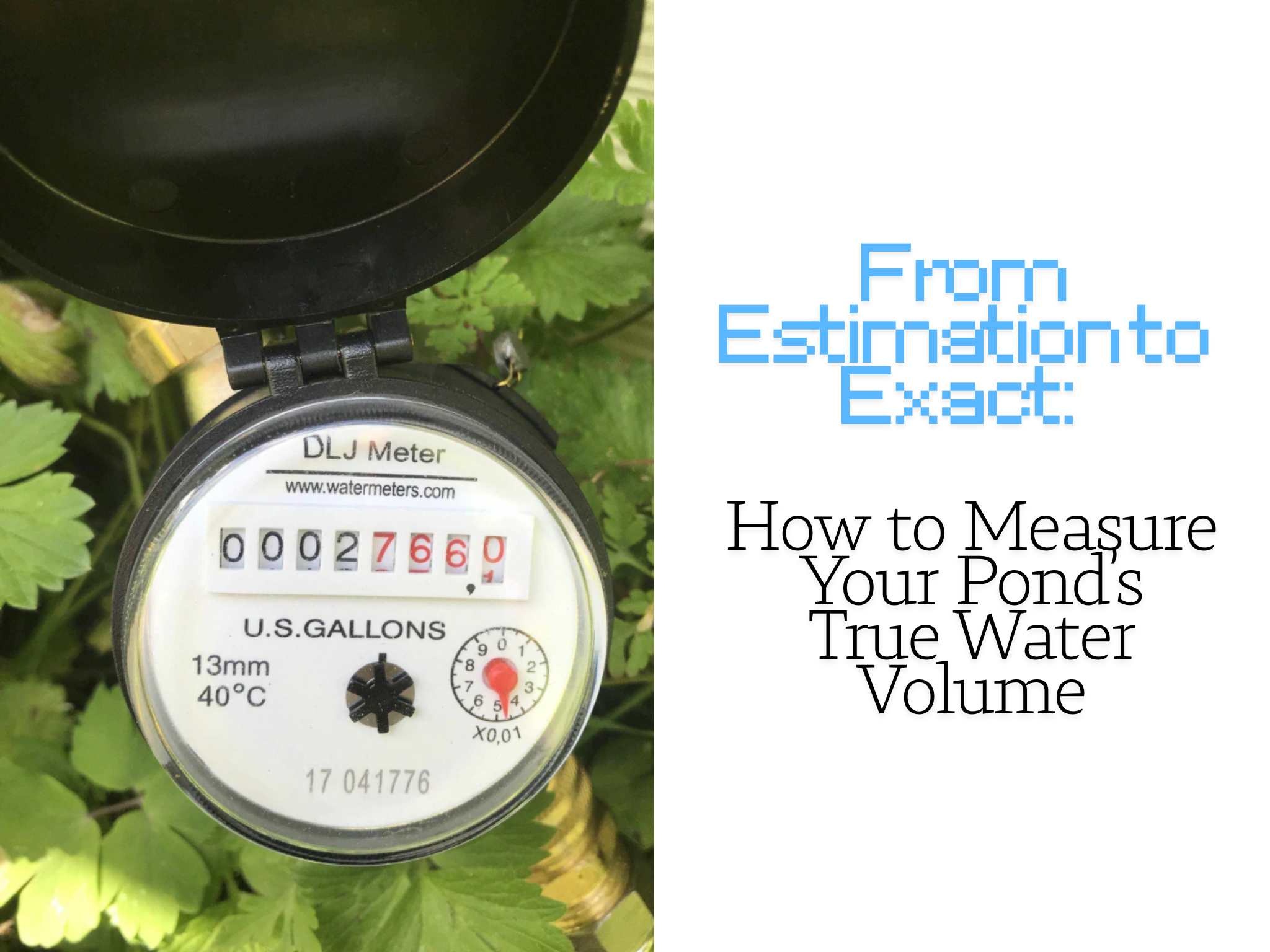
Before filling a newly constructed water feature, it’s important to understand how much water your system actually holds. This isn’t just about curiosity, knowing your pond’s real volume affects fish health, treatment dosing, water changes, overflow setup, and long-term maintenance.
This guide walks you through two levels of measurement:
-
A simple, fast estimate using pond dimensions
-
A one-time, highly accurate measurement using real fill and drain data
Start simple. Then dial it in.
Step 1: Basic Pond Volume Calculation (Your Starting Point)
Before getting into timing fill rates and measuring components, calculate a baseline estimate. This gives you a reference number to work from.
Rectangular or Square Ponds
Example:
10 ft × 8 ft × 3 ft × 7.48 = 1,795 gallons
Free-Form or Sloped Ponds
Most ponds aren’t perfect rectangles. For curved edges, shelves, or sloped sides:
-
Measure the maximum length
-
Measure the maximum width
-
Find the average depth
-
(Shallow depth + deep depth) ÷ 2
-
-
Apply a shape correction factor
Common Shape Factors
-
Light slope / rounded edges: 0.85
-
Shelves or noticeable slope: 0.75
-
Very irregular koi ponds: 0.65–0.70
This gives you a realistic estimate, not a guess.
This number does not include plumbing, filters, pumps, or gravel displacement. Everything below replaces this estimate with exact data.
Step 2: Know Your Fill Rate
Before filling the system, understand your water source:
-
Tap water pressure
-
Fill line size
-
Flow rate
If you don’t have a water meter, use a bucket test:
-
Time how long it takes to fill a 5-gallon bucket
-
Repeat five times
-
Throw out the fastest and slowest
-
Average the remaining three
This gives you a reliable gallons-per-minute (GPM) fill rate.
Step 3: Measure Individual Components First
If possible, fill components one at a time and record their exact capacity.
Include:
-
Filters
-
Skimmer boxes
-
External pumps
-
Primer pots
Example:
-
Filter tank: 110 gallons
-
Skimmer box: 34 gallons
-
Pump + primer pot: ~1 gallon
If water remains in these components when the system is off, they count.
Tip: Write the gallon capacity directly on the component for future reference.
Step 4: Account for Water Held in Plumbing
If water remains in pipes when the system is shut down, measure it.
-
Measure the total length of each pipe size
-
Multiply by the gallons-per-foot value below
Gallons per Linear Foot
-
½″ pipe: 0.010
-
¾″ pipe: 0.023
-
1″ pipe: 0.041
-
1¼″ pipe: 0.064
-
1½″ pipe: 0.092
-
2″ pipe: 0.163
-
2½″ pipe: 0.255
-
3″ pipe: 0.367
Example:
15 ft of 2″ pipe × 0.163 = 2.4 gallons
Step 5: Filling the Main Pool or Cistern (The Only Time to Get Exact Data)
This is the most important step; and the only time you’ll realistically ever do it.
If your pond has a gravel bottom filter:
-
Fill only to the top of the gravel
-
Record gallons and time
Build a Staff Head Gauge
Before filling further:
-
Place a straight pole or 2×2 on the bottom
-
Mark the final water level
-
Divide that height into:
-
Quarters
-
Six-inch increments
-
Any meaningful depth changes
-
Example:
-
Full depth above gravel: 42 inches
-
Mark ¼, ½, ¾
-
Mark every 6 inches
Free-form ponds hold far more water near the top than the bottom, so depth alone doesn’t tell the story.
Fill in Stages and Record Data
As you fill:
-
Record start and end time
-
Record gallons added
-
Do this at every marked level
Continue until full.
Add all stages together to determine true pond capacity.
Step 6: Convert Your Data Into a Working Tool
Transfer your measurements onto a permanent Staff Head Gauge that shows:
-
Water depth
-
Gallons at that depth
-
Time required to fill or drain
This becomes invaluable during:
-
Large water changes
-
Emergency drains
-
Maintenance planning
It may feel like extra work now — but you’ll be grateful later.
Step 7: Confirm the Full Surface Level
Even careful leveling doesn’t guarantee perfection.
Once full:
-
Look for low edges
-
Adjust as needed
-
Mark the true full level
-
Set your overflow just above it
-
Test the overflow with additional water
Step 8: Determine Drain Rates
Now measure how fast water leaves the system.
-
Drain a component with a known volume
-
Time how long it takes
-
Calculate GPM
Example:
-
Single gravity drain
-
Measured at ~11.5 GPM
If pumps are used, calculate based on pump output.
Knowing drain rates makes maintenance predictable instead of stressful.
Final Thought
Estimating pond volume is easy. Knowing it takes a little work — but only once.
That data pays you back every time you:
-
Treat fish
-
Change water
-
Troubleshoot flow
-
Plan maintenance
Measure it right, and your pond works with you not against you.