
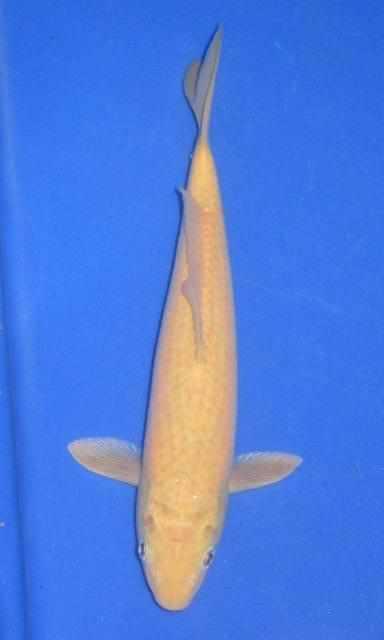
A Kigoi is a koi with nothing on it: one flat, unbroken lemon yellow, no pattern, no shine. That last part is the whole point, and it is where buyers go wrong.
This guide covers what a Kigoi is, where the color came from, how to tell one from the metallic yellow koi it gets confused with, and how to keep one.
Kigoi koi at a glance
| What it is | A non-metallic, single-color yellow koi. Ki means yellow, goi means carp |
| Finish | Matte, not metallic |
| Show class | Kawarimono, the catch-all class |
| Prized form | Akame Kigoi, the red-eyed form |
| Confused with | Yamabuki Ogon, the metallic yellow fish |
| Size | Commonly 24 to 28 inches in a well-run pond; a backyard pond produces less |
| Buying in | Not in stock with us as we write this |
What a Kigoi is, and how it differs
Nearly every koi variety is defined by how two or more colors meet. A Kigoi has only one, so nothing hides a fault: you are buying body shape and skin quality. It gets mistaken for the Yamabuki Ogon, and the test is light — in daylight the Yamabuki reflects and the Kigoi does not. Our guide to Yamabuki Ogon covers the metallic side.
Natural color variation, or a hybrid?
A natural variation, fixed by selection. Every ornamental koi descends from magoi koi, the wild dark carp farmed for food in the Niigata rice paddies, and the colors began as mutations among them that were bred on deliberately. A Kigoi is a short step from magoi koi, not a cross with anything — there is no other species to cross with. The hobby credits magoi koi ancestry for the toughness of the plain varieties, which is the standard account rather than documented fact.
How to identify a Kigoi
Four things together: a matte, non-reflective finish; one even yellow, pale lemon when young and deeper with age, though it stays paler than a metallic gold; plain, often translucent fins; and clean skin, because on a fish this plain one dark speck reads across the garden. The prized form is Akame Kigoi, with red eyes — generally described as an albinistic trait, and rare enough that a seller should show you the eye rather than assert it.
How rare are Kigoi against other golden koi?
Less common than the metallic yellows. Yamabuki Ogon are bred and sold in far greater numbers, so most golden koi on any shelf are metallic. Akame Kigoi are scarcer again. Our own catalog is the honest illustration: none listed right now.
Caring for Kigoi in a backyard pond
No Kigoi-specific husbandry: volume sized to the adult fish rather than the one you bought, filtration rated above your bioload, depth enough to overwinter, and steady parameters rather than a target number. What is particular is visibility — a pale, unpatterned body shows a scrape or dulled skin long before a Showa would, which makes a Kigoi a useful gauge on your water. Partial shade helps, since hard summer sun is unkind to pale skin. If a fish is genuinely unwell, get a proper diagnosis first.
Do Kigoi need a special diet?
No. A quality staple, with a growth food for young fish, is the whole requirement. The one deliberate choice is color food: carotenoid-heavy diets push warm tones and can drag a clean lemon toward orange. Feed it sparingly and seasonally, if at all.
How large Kigoi grow, and when the color finishes
Commonly 24 to 28 inches in a well-run pond, with exceptional fish beyond — trade-cited ranges rather than a schedule, and a typical backyard pond produces less. Growth tracks volume, temperature and feeding far more than variety. Most length arrives in the first three or four years and the body thickens for several more, while color runs on its own clock: a Kigoi often starts close to cream and deepens, though breeders do not agree on when it stops.
Keeping Kigoi with other koi and pond fish
No reservation on temperament. Kigoi are ordinary koi and mix with any other variety, and with pond fish suited to the same water. The real limits are capacity and biosecurity, both covered below.
Where to buy Kigoi koi from us
The straight answer is that we do not have Kigoi in stock right now: no single fish, and no mixed package that carries the variety. We would rather say so than sell you something adjacent. Browse the Japanese koi selection for what is listed today, or get in touch and we will tell you when Kigoi are due in.
Whenever you do buy, two conditions. Quarantine every new koi in a separate, filtered, aerated holding system for two to four weeks before it goes near your main pond. And stock to the adult size your volume and filtration can carry, not to the size the fish arrive at.
Frequently asked questions
What is kigoi koi and how does it differ from other koi varieties?
A non-metallic, single-color yellow koi with no pattern. Other varieties are defined by how two or more colors interact; with one color, a Kigoi is judged on body shape and skin quality alone. It benches in Kawarimono.
Are kigoi koi a natural colour variation or a hybrid breed?
A natural color variation fixed by selective breeding, not a cross. Kigoi are common carp descended from magoi koi, the wild dark carp of Niigata, carrying a yellow mutation breeders selected and stabilized.
What are the identifying characteristics of a kigoi koi?
A matte, non-reflective finish; one even yellow, paler when young; plain, often translucent fins; and clean, unmarked skin. Red eyes mark the prized Akame Kigoi. If the fish reflects light, it is metallic, not a Kigoi.
How rare are kigoi koi compared to other golden koi types?
Less common than the metallic yellows. Yamabuki Ogon dominate the golden koi market, so matte yellow is produced in smaller numbers, and the red-eyed Akame Kigoi is scarcer still. We have none listed as we write this.
How should I care for kigoi koi in a backyard pond?
As you would any koi: volume sized to the adult fish, filtration rated above your bioload, depth enough to overwinter, and every new arrival held first in a separate, filtered, aerated holding system for two to four weeks.
What water conditions are best for keeping kigoi koi healthy?
Stable ones. Steady temperature, volume sized to the adult fish, filtration above your bioload, and consistent parameters rather than a target number. The Kigoi-particular note is light rather than chemistry: partial shade protects pale skin.
Do kigoi koi require special diet or feeding routines?
No. A quality staple, with a growth food for young fish, covers it. The one deliberate choice is color food, which pushes warm tones and can warm a clean lemon toward orange if fed hard year-round.
How large do kigoi koi typically grow?
Commonly 24 to 28 inches in a well-run pond, with exceptional fish going beyond. Growth follows volume, temperature and feeding far more than variety, so a typical backyard pond usually produces a smaller fish.
At what age do kigoi koi reach their full colour and size?
Most length arrives in the first three or four years, with the body thickening for several more. The yellow tends to start pale and deepen with maturity, though breeders do not agree on when it stops.
Can kigoi koi be kept with other koi varieties and pond fish?
Yes. Kigoi are ordinary koi in temperament and mix with any variety, and with pond fish suited to the same water. The limits are capacity and biosecurity: stock to the adult size your volume and filtration can carry, and quarantine every new koi in a separate, filtered, aerated holding system for two to four weeks.