
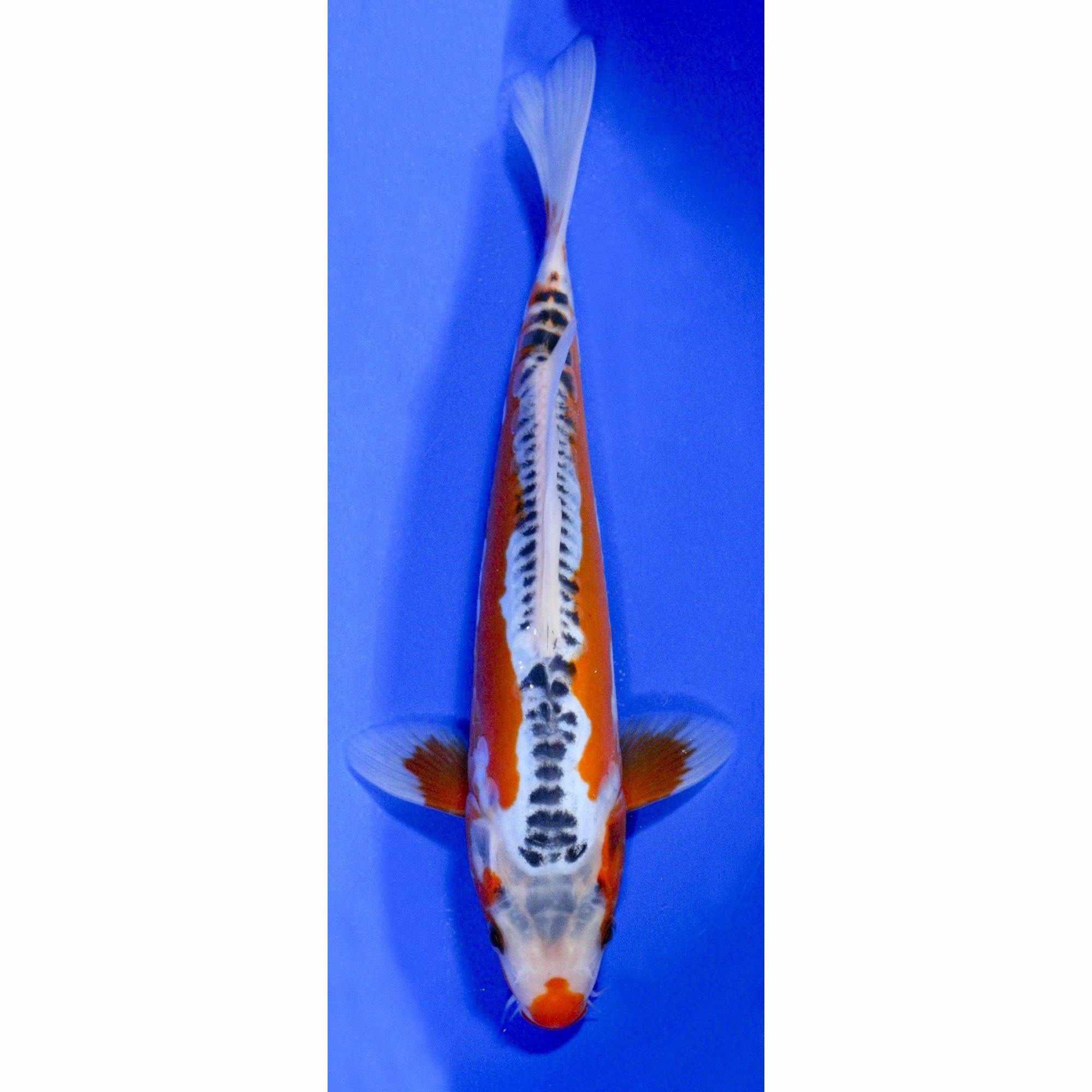
A Shusui is an Asagi in different skin: mirror scales in limited rows down the spine, and red that reads twice as bright with no scale texture over it.
This guide covers what a shusui koi fish is, how to spot a genuine one, its colors, cold hardiness, size, and where to buy one. It is often searched as sushi koi fish, or as koi fish shusui with the words the other way round. Sushi koi fish is simply the typo people make for shusui — same fish either way.
Shusui koi at a glance
| What it is | The Doitsu, German-scaled form of Asagi |
| Scales | Mirror scales in limited rows, dorsal and often lateral line |
| Color | Blue-indigo back, red up the flanks and often over it |
| Buying in | Packages from $210; single fish at $1,600 |
What a Shusui koi is
Shusui is the Doitsu — German-scaled — form of the same fish: instead of full scaling it carries mirror scales only in limited rows, usually along the dorsal line and often along the lateral line too, against otherwise smooth skin. Reduced and enlarged, never absent. Our guide to Asagi covers the parent variety; a koi fish shusui is judged on that row, not on a net.
Identifying a genuine Shusui
Look down the spine. The row should run straight from head to tail, matched left and right where it doubles; scales out of line, missing or doubled are the faults full scaling would hide. A shusui koi fish also needs the blue-to-indigo back — red on white with no blue is a Doitsu Kohaku.
Shusui colors and patterns
Blue or indigo down the back, hi up the flanks, and red carried right over the back marks it as a Hi Shusui, though faulted on a fully scaled Asagi. Hi Shusui carries hi over the whole back, Hana Shusui breaks it into a flowery side pattern, Ki Shusui is yellow and uncommon.
Shusui in cold climates
Hardy on the same terms as any koi, the robustness usually credited to the magoi descent behind Asagi. Nothing is variety-specific: depth enough not to freeze through, gas exchange maintained, feeding stopped as the water cools. Handle gently — smooth skin marks more visibly.
What size Shusui koi reach
Trade sources put a mature koi fish shusui in the same band as its fully scaled parent: commonly 24 to 28 inches, exceptional fish beyond. Most backyard ponds produce less; volume, temperature and feeding matter more than variety.
Where to buy Shusui koi from us
Most shusui koi fish reach us in mixed breeder packages rather than as standing single listings, so the shusui koi for sale here are usually a box of young fish rather than one named koi. If a blue shusui koi as a single fish is what you want, the two shusui koi for sale listed below are the ones to look at.
- Miyatora Koi Farm Mixed Tosai Select Packages, from $225 for five 5 to 6 inch koi, about $45 a fish. Tagged Shusui.
- Hosokai Koi Farm Kawarimono & Gosanke Tosai Packages, from $210 for five 5 to 7 inch koi, about $42 a fish. Tagged Shusui and Asagi.
- An individually selected Shusui at $1,600, with a second at the same price — single Japanese fish, one of each, listed as we write this.
Each mixed pack is a unique assortment across several varieties, so treat Shusui content as likely rather than promised.
Before any multi-fish order, two things. Quarantine every new koi in a separate, filtered, aerated holding system for two to four weeks before it goes near your main pond. And stock to the adult size your volume and filtration can carry.
Frequently asked questions
What is a Shusui koi and how does it differ from other koi varieties?
The Doitsu, German-scaled form of Asagi — mirror scales in limited rows along the dorsal line, often the lateral line too, on otherwise smooth skin. Judged on that row, not on a color pattern.
How can you identify a genuine Shusui koi?
Straight, even mirror scales in limited rows down the spine, over a blue-to-indigo back with red on the flanks. Out-of-line, missing or doubled scales are the giveaway.
What colors and patterns are typical for Shusui koi?
On a blue shusui koi, a blue or indigo back with red up the flanks and over the back — normal here, faulted on a fully scaled Asagi. Hi, Hana and Ki Shusui are the named variants.
Are Shusui koi hardy in cold climates?
As hardy as any koi, credited to magoi ancestry. Overwintering needs pond depth, gas exchange kept open, and feeding stopped as the water cools.
What size do Shusui koi typically reach?
Commonly 24 to 28 inches in a well-run pond, matching Asagi. Most backyard ponds produce less, since volume, temperature and feeding matter more than variety.
How long do Shusui koi usually live with proper care?
Commonly cited figures for well-kept koi run from roughly 25 to 35 years, with documented cases far longer. A blue shusui koi is no shorter-lived than a fully scaled variety. What shortens koi lives is a pond too shallow to stay stable in winter, too little oxygen in summer, crowding as the fish reach adult size, and disease brought in on an unquarantined arrival.
What water conditions are best for keeping Shusui koi?
Ammonia and nitrite at zero, nitrate kept low through routine partial water changes, and a pH that is stable rather than any particular number — maintain carbonate hardness so it does not swing. Stability matters more than hitting an ideal, and because a Shusui carries so much bare skin, poor water shows on it sooner than on a fully scaled fish.
How often should you feed a Shusui koi and what should you feed it?
A good-quality koi pellet suited to the water temperature, in small amounts a few times a day in warm weather, and only as much as is cleanly eaten in a few minutes. Taper as the water cools, move to easily digested wheat-germ formulas through the shoulder season, and stop entirely once the water is near 50F, since below that a koi's metabolism has slowed to the point where food sits undigested.
Can Shusui koi be kept with other koi varieties or pond fish?
Yes. All koi are the same species and mix without trouble, and goldfish are reliable companions too. The real constraints are capacity and biosecurity rather than compatibility: stock to the adult size your volume and filtration can carry, and quarantine every new koi in a separate, filtered, aerated holding system for two to four weeks first.
Do Shusui koi require special pond setup or filtration?
Nothing unique to the variety, though the smooth skin rewards a little care. Size mechanical filtration to catch solids before they break down and biological filtration for the adult stocking level rather than the current one, keep aeration generous through summer, and round off sharp rockwork, because scrapes show on bare skin sooner than on scales. If you are shopping shusui koi for sale, buy the pond capacity before you buy the fish.