

Description
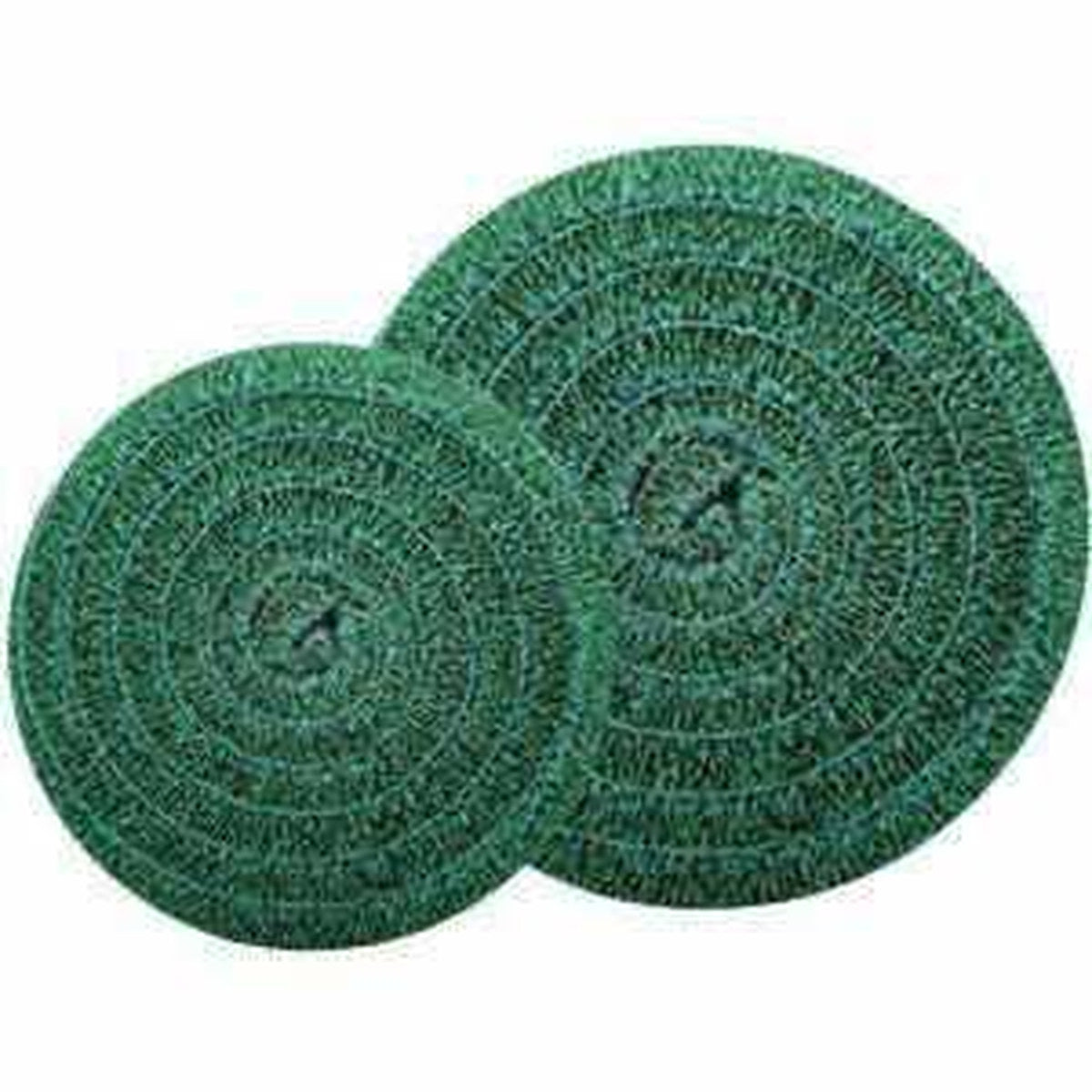
Roll Matala Green 6 Inches Thick
R-Matala, the perfect "drop in" media for Vortex filters and barrel filters. R-Matala has the same qualities as the sheets of Matala but formed into a coiled pre-cut cartridge. Simply select the diameter roll and the density you need for your round tank and drop it in. R-Matala coils are not designed to be un-rolled.
MEDIUM DENSITY GREEN
The Green R-Matala traps a medium size particle. They clean out very easily by simply shaking the pieces out before draining the sump then use the garden hose to spray them clean. Dirt falls off very easily.
The Green R-Matala functions as a prefilter to the biological section. The green media removes dirt particles before they reach the biological section. The Green Matala can also function as a light biological filter due to its available surface area for bacteria attachment.
R-Matala will naturally wedge in place without any need for support. However, you must measure the inside diameter of your tank and order the coil size which fits tight. If the coil fits too loose then the water will flow around the pads instead of through them. Four sequential densities can be perfectly employed to achieve maximum solids / bio-filtration. Each roll is 6 inches thick with a tremendous potential to trap dirt and yet is super easy to clean. Simply drain the waste out your bottom drain and gently pour pond water over the R-Matala
Matala media works perfectly with up-flow filter designs. The ideal upflow configuration would be the Black or Green R-Matala at the bottom of filter to capture the large particles. The next layer should be the Blue R-Matala to act as a biological filter and will filter out a medium size particle. The final layer will be the Gray R-Matala for high surface area biological filtration and fine particle removal. If you only have room for three layers of R-Matala, we suggest you use the Black on the bottom followed by the Blue and the Gray.
Note: due to cost of shipping, ALL FILTER MEDIA SALES ARE FINAL.
Documentation
Estimate shipping
Payment & Security
Your payment information is processed securely. We do not store credit card details nor have access to your credit card information.
Bio media sizing
How much bio media does your pond need?
Ammonia comes from food, so that's where sizing starts. Tell us how much you feed and how warm the water runs — we'll size every media we carry against it.
1 How much do you feed?
2 How warm is the water?
Fine tuning
optionalMost koi diets run 35–40% protein — check your bag. Chamber fill only matters for moving-bed media like K1 or K+; aim for 50–65% so the media can actually tumble.
Design R is how many grams of ammonia one square metre of mature biofilm clears in a day. It is the divisor in this whole calculation — the single biggest lever on the answer.
R is not a property of the media. It's a property of the conditions: water temperature, dissolved oxygen, how briskly water moves across the biofilm, and how mature the bacterial colony is. The same K1 bead clears several times more ammonia in a well-aerated moving bed at 75°F than it does sitting in a static box at 50°F.
Because R divides, a lower R means more media. Choosing a conservative R is how you buy yourself safety margin.
What 0.50 assumes
Not all the nitrogen in food becomes ammonia — some is built into fish growth, some leaves as solids you skim out. This is the share that reaches the water column. 0.75 suits most ponds.
Every media compared
How much food goes in
Everything starts here. Food is the only meaningful source of ammonia in a koi pond, so what you feed sets the size of the biofilter you need.
How much ammonia that produces
Protein is about 16% nitrogen by weight. Only part of that nitrogen reaches the water as TAN — total ammonia nitrogen — because fish retain some as growth and some leaves as solids.
How much biofilm surface that needs
R is the nitrification rate — the ammonia one square metre of biofilm clears per day. Cold water and low oxygen slow the bacteria down, which is why a cold pond needs more media, not less.
How much media that is
Each media has a specific surface area — the square metres of usable biofilm surface packed into a cubic metre. Divide the surface you need by that figure and you have the volume to buy.
Oxygen the biofilter consumes
Nitrification burns roughly 4.6 g of oxygen per gram of ammonia processed. Warm water holds less dissolved oxygen exactly when demand peaks — so if you run warm, add aeration or size using a lower R.
Alkalinity the biofilter consumes
Each gram of ammonia processed also consumes about 7.1 g of carbonate hardness. Keep KH in the 100–150 mg/L range; if it falls, pH turns unstable and the filter stalls.
How KH gets used up, and what it takes to hold it steady →
A note on accuracy. Figures marked Verified are published by the manufacturer. Figures marked Estimated are derived from a published total surface area or from media geometry. Sizing a biofilter is a design exercise, not a precise measurement — when in doubt, size up.