
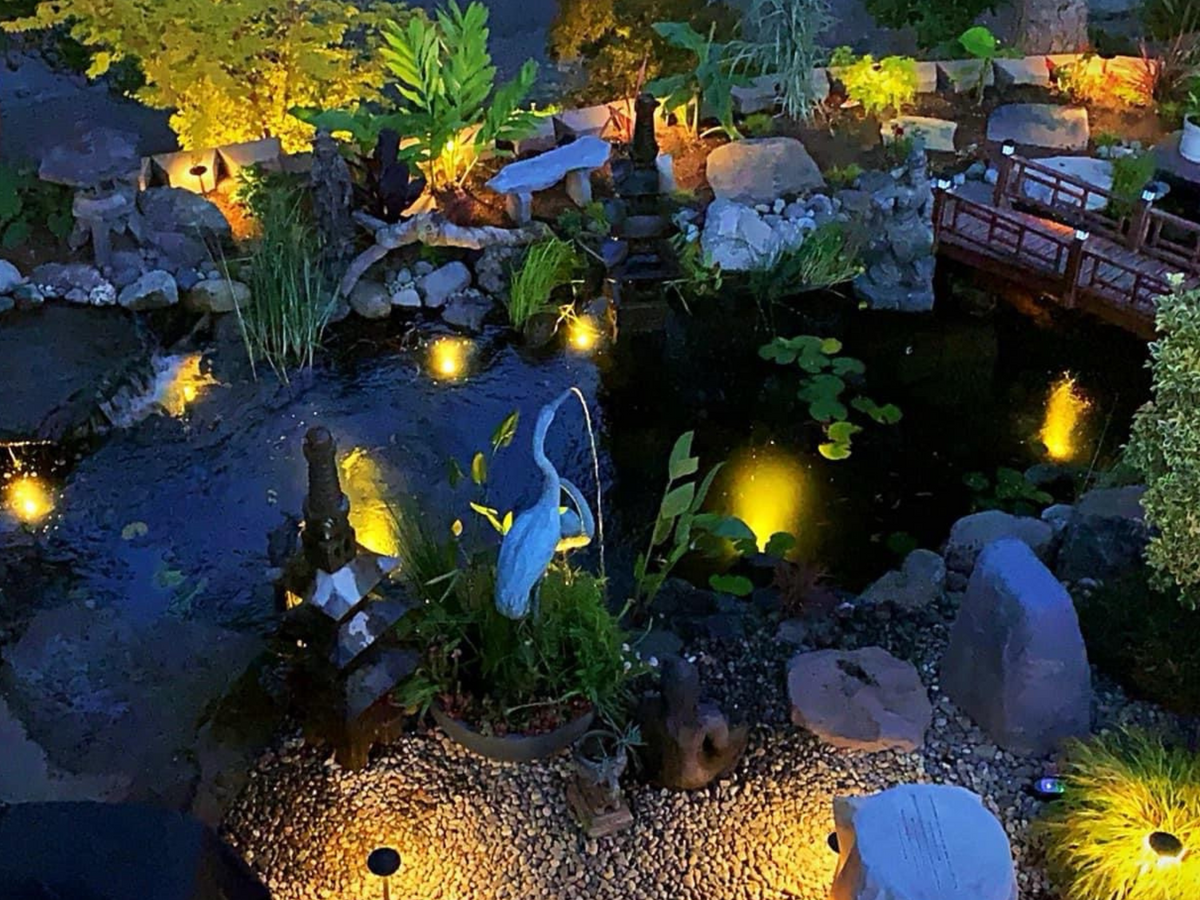
Ashly Berg's koi pond sits in her front yard in Burien, Washington, on a slope so steep she had to build retaining walls before she could build a pond. She dug the hole herself with a rented mini excavator. Today a single 2 HP pump sends the whole pond up to a long, tall waterfall, ten or eleven air stones bubble along the bottom, and the banks are packed with plants picked to stay green through a Seattle-area winter. There is no filter beyond a pair of skimmer baskets, a UV light and the plants. When Ivan from our team interviewed her, his note to the rest of us was short: a 100% natural pond, and the flow and aeration are the secret.
We rebuilt her pond in 3D in our Pond Planner, waterfall, bridge, plants and all. Skip ahead to explore it.

From a forgotten front yard to a koi pond
Ashly wanted a place at home that felt like getting away. She has always loved tropical gardens, and she wanted koi from the start. The way she describes them, koi swim up and look at you as if they want to be petted.
The spot she picked was her front yard: big, steep, and so plain that some of her neighbors didn't know it was there. She read up on what a koi pond needs, rented a U35 mini excavator and started digging. Once the hole was dug, she hired a pond builder to get the levels right and set the liner. That split is worth copying. Digging is hard work, but it forgives mistakes. A pond that is off level shows a strip of liner on one side forever, and a badly seated liner is a leak waiting to happen.
In September 2022 she came by Play It Koi to pick out koi with Ben, and she has been part of our community since.
Building a pond on a steep slope
A steep yard means the pond has to be cut into the hill and held there. Ashly built retaining walls from blocks that weigh about 70 pounds each, then set big rocks for the edges, the waterfall and caves where the fish can hide. She told us moving those rocks was the hardest part of the build. Every rock around the edge had to sit solid enough that she could stand on it to work on the pond later.
The fish caves do a second job. Great blue herons, coyotes, possums, raccoons and cats all hunt koi in her neighborhood, and a cave gives a fish somewhere to go. In the end she covered the pond with a net. She doesn't love how it looks and has thought about enclosing the whole area, but the net keeps her koi alive. If you live near herons, plan for a koi pond net from day one.

One pump, a long waterfall and a lot of air
The waterfall is the first thing you notice. It starts on the far side of the pond under a red moon gate and comes down over stacked rock into the water. On a hillside lot, a waterfall has room to drop, and Ashly built a UV light into one of hers.
The system behind it is simple. A single 2 HP pump moves all of the water up to the big falls, and it also runs a smaller fountain on the right side of the pond. From the falls the water crosses the pond and runs over spillways toward the skimmer baskets, which catch leaves and floating debris before the water goes around again.
She told us the shape of the pond and where the return comes in were the keys to keeping it healthy: water moving everywhere, with no still corners. On top of that, she runs 10 to 11 air stones on the bottom of the pond, set beside the underwater lights. Air keeps oxygen up for the koi and feeds the bacteria that break down waste, which counts most on warm summer nights, when warm water holds less oxygen.

Plants and restraint do the rest of the filtering. Ashly feeds lightly. Her water lilies take up nutrients that would otherwise feed algae, and every spring she lifts them, untangles the roots and replants them so they don't take over.
Running koi without a mechanical filter is a trade-off. Waste settles on the floor instead of leaving the pond, so the system depends on light feeding, strong circulation, plenty of air and plants, which is exactly what Ashly runs. If you want to keep a bigger koi collection with less hands-on cleaning, our guides to bottom drains and pond aeration explain how the two approaches compare.
Fountains, sculptures and herons that are on her side
Designing the look was the part of the project Ashly enjoyed most, and water comes out of a lot more than the waterfall. Two tall Japanese fountains and two large columns stand around the pond, along with small frog and turtle fountains, and two big iron blue herons spray water into it. Given how much trouble the real herons cause, we like that the only herons welcome at her pond are made of iron.
Across the back, the red moon gate frames a carved totem. An arched wooden bridge with lantern posts crosses one arm of the pond, and stone pagoda lanterns and a Buddha sit among the rocks.
Plants that stay green through a Pacific Northwest winter
Ashly wanted the pond to look tropical all year, which is a tall order in western Washington. She spent a lot of time working out which plants would stay green and good-looking through the winter. Bamboo, grasses, flowering plants and maples crowd the banks, water lilies cover part of the surface, and marginal plants grow at the edges. Every year she adds something new.
If you're planning a planted pond, our pond plant buyer's guide sorts plants by planting depth and lists the ones koi tend to leave alone.
Lighting the pond at night
The lights are what make her photos. Underwater lights shine up through the water next to the air stones, path lights pick out the plants and boulders, and lanterns line the bridge. A seating area with a fire table and two fire bowls looks out over the pond. For your own pond, start with our pond lighting.

A second pond for rescued fish
Ashly takes in fish that need a new home. She has rehomed koi, and she built a small second pond just for goldfish she rescued from around Seattle.
Living with the pond
The pond has become part of her day. Ashly sits by it for about an hour every day, watching the koi, and she calls it her peace and therapy. Upkeep turned out to be easier than she expected. The one constant job is summer evaporation. She tops the pond off regularly and adds dechlorinator every time, because city tap water carries chlorine or chloramine that harms koi and the good bacteria in the pond. In her words, it's all about how you set it up.
Two small things save her the most work. Mesh cube pre-filters around her pumps keep leaves and debris out of them, and the net that keeps herons out also catches pine needles before they sink.
Koi in pencil
Ashly also photographs her koi and turns the photos into pencil drawings, many of them gifts for family. She signed this one in September 2025.

Ashly's tips for new pond owners
- Make the plumbing and electrical easy to reach. Ashly buried some of her electrical, and when a part failed, the repair was slow and hard. Leave access to every connection, pump and valve.
- Put a mesh pre-filter around every in-pond pump. It cuts down on clogs and cleaning. We carry pump pre-filters and strainers.
- Plan for predators before the koi arrive. A net is easier to install while the pond is new.
- Top off with dechlorinated water. Evaporation adds up fast in summer.
What the pond means to her
For Ashly the pond is never finished. She adds plants and features every year, and every corner of the yard holds something new. Her advice to anyone on the fence about building a pond: the work is worth it for the peace it brings.
Ashly's pond at a glance
- Location: Burien, Washington, south of Seattle
- Built by: Ashly Berg, who dug it herself; a pond builder set the levels and the liner
- Site: a steep front yard held by retaining walls of 70-pound blocks
- Circulation: one 2 HP pump feeding a long waterfall, a smaller fountain and spillways
- Filtration: skimmer baskets, a UV light in the waterfall, plants and light feeding
- Aeration: 10 to 11 air stones on the bottom
- Extras: fountains, iron heron sculptures, underwater and garden lighting, a bridge, and a second pond for rescued goldfish
- Predator protection: a net and fish caves
Gear for a pond like Ashly's
Ashly put her system together herself, so these are the kinds of parts it uses rather than her exact models:
- External pond pumps and waterfall pumps sized for a tall waterfall. Our pump sizing guide covers flow and head height.
- Pond air pumps and air diffusers. The air pump sizing guide helps you pick by depth.
- Pond UV sterilizers to keep green water away
- Pond skimmers to catch leaves and needles
- Pump pre-filters and strainers
- Pond lighting
- Koi fish nets
- Hardy water lilies and marginal plants
- Fountains and spitters
- Pond liner and underlayment
- Water conditioners and dechlorinators
Plan a pond like Ashly's
Now you can walk around Ashly's pond yourself. We rebuilt it in our Pond Planner from her photos: a free-form pond about 26 by 16 feet with a 2-foot planting shelf around the edge, a 4-foot bowl in the middle and a 3-foot pool across the bridge. The waterfall drops down the back bank between boulders and three retaining walls, and a smaller spillway feeds the far pool. One 2 HP pump runs everything through a UV clarifier, two skimmers catch the leaves, ten air diffusers line the bottom and ten warm white lights sit under the water. Water lilies, irises and cattails fill the shallows, maples, pines and a palm crowd the banks, and stepping stones lead past the red bridge to a fire pit.


Ashly never measured her pond, so the size and depth are our estimates from her photos, which puts it at about 6,500 gallons. Her pump's brand isn't recorded either, so a PerformancePro Artesian2 2 HP stands in for it. We built it in the planner's Water garden mode, because its Koi pond mode adds bottom drains, a sieve and a pressure filter, and none of those are part of Ashly's story. The planner will point out that the plan has no filter. That's a fair warning for most koi ponds, and Ashly answers it with light feeding, strong flow and a lot of air. The waterfall is drawn at the planner's 6-foot maximum drop.
Open Ashly's pond in the planner to spin around the waterfall in 3D, switch to the top-down plan, and see every part on the list. Like what you see? Hit "Start my own pond" and design yours.